마드리드
UTC+2스페인 · CEST
2026년 9월 22일 (화)
시간대 분석 & 주요 사실
스페인의 마드리드 현지 시각은 현재 UTC+2 표준시입니다. 이 지역은 서머타임(일광 절약 시간제)을 시행하며, 겨울철 표준시(UTC+1)와 여름철 서머타임(UTC+2) 간에 시간이 조정됩니다. 다음 서머타임 전환일은 10월 25일입니다. 마드리드보다 뉴욕시간 빠릅니다. 뉴욕와(과)의 업무 시간 겹침은 하루 3시간(undefined)입니다. 글로벌 협업을 위한 최적의 화상 회의 시간대는 마드리드입니다. 마드리드보다 런던시간 빠릅니다. 런던와(과)의 업무 시간 겹침은 하루 8시간(undefined)입니다. 글로벌 협업을 위한 최적의 화상 회의 시간대는 마드리드입니다. 마드리드보다 도쿄시간 빠릅니다. 도쿄와(과)의 업무 시간 겹침은 하루 2시간(undefined)입니다. 글로벌 협업을 위한 최적의 화상 회의 시간대는 마드리드입니다. 이 시간대를 공유하는 주요 도시: 파리, 암스테르담, 로마. WorldClock.info는 공식 IANA 데이터베이스를 기반으로 정확한 시간을 제공합니다.
도시 기본 정보
스페인 마드리드의 추정 인구는 약 6.7M입니다. 오늘의 일조 시간은 약 15.1시간입니다 (일출: 06:36, 일몰: 21:42). 이 지역은 서머타임(일광 절약 시간제)을 시행하며, 겨울철 표준시(UTC+1)와 여름철 서머타임(UTC+2) 간에 시간이 조정됩니다. 다음 서머타임 전환일은 10월 25일입니다. 북반구, 적도 북쪽 약 40°에 위치합니다. 차량은 우측 통행입니다.
국기
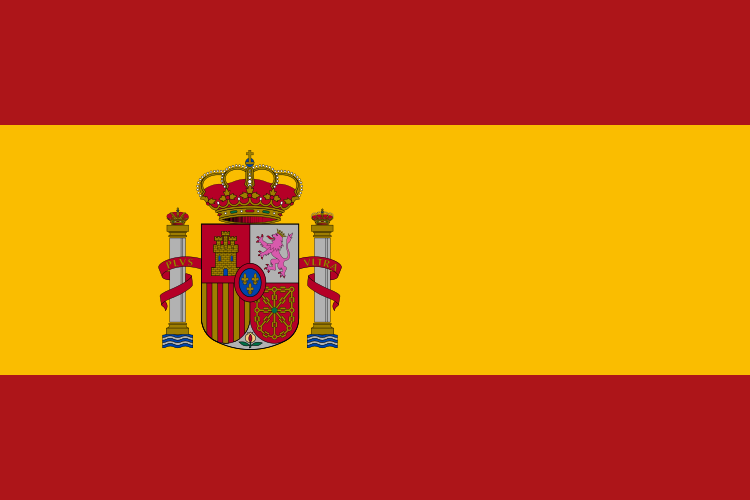
스페인
수도
마드리드 👑
대륙
유럽
시간대
CEST · Europe/Madrid
좌표
40.42°N, 3.70°W
통화
EUR (€)
국가 번호
+34
통행 방향
우측
반구
북반구
공용어
스페인어
측량 단위
미터법
알고 계셨나요?
Spain Set Its Clocks to Berlin and Never Set Them Back
Madrid has more than 21,400 bars, serving a city of about 3.4 million people — roughly one bar for every 159 residents.
Spain as a whole is the densest bar country in the European Union. Depending on the dataset the national figure runs from one bar per 169 to one per 207 inhabitants. The Spanish statistics institute counted 277,539 hospitality establishments across a population of 47.3 million.
Which produces the comparison that Spaniards enjoy most: Spain has more bars than hospital beds. There are around 163,437 hospital beds in the country — one for every 289 people. There is a bar for roughly every 170.
The regional numbers are similarly unbalanced. Andalucía alone has 58,486 establishments — reportedly more than Denmark, Finland, Norway and Ireland put together. Catalonia has 54,509. Madrid the region, 36,248.
A caveat on the definition: "bar" here is counted broadly, covering cafés, ice cream shops, restaurants and cervecerías — anywhere you can sit down for a coffee or a beer. That is the point, though. A Spanish bar is not an evening venue. It serves toast with tomato at eight, a bocadillo at eleven, a three-course menú del día at two, and tapas at nine.
The clock: which brings us to why the Spanish day looks so strange from outside, and why it isn't.
On 16 March 1940 Spain moved its clocks forward an hour to align with Berlin. The change was described as temporary. Spain is still on Central European Time, and Madrid sits at nearly 4° west — while the zone is built for the 15th meridian east.
That leaves Madrid running roughly 75 minutes ahead of its own sun.
So when a Madrid bar serves lunch at two and fills up again at nine, the sun outside says one o'clock and eight. Which is when everybody else in Europe eats.
The bars are not open late. The clock is early.
Spain adopted Greenwich Mean Time in 1901, which is what its geography calls for. Mainland Spain sits west of the Greenwich meridian. By longitude it belongs with Britain, Portugal and Morocco.
Then on 16 March 1940, at eleven at night, Franco moved the clocks forward one hour to match Nazi Germany. It was a gesture — Spain stayed neutral — and the government said the change would be reversed in due course.
That was eighty-six years ago. Spain is still on Berlin time. It is now the westernmost country in Europe running on Central European Time, sharing a clock with Poland and Hungary. The Canary Islands, sensibly, kept GMT.
The consequences are not subtle. In Galicia, in the far northwest, the winter sun does not come up until around nine in the morning — children start the school day in the dark. Spanish prime-time television runs from ten at night to past midnight.
And the famous Spanish schedule turns out not to be a temperament at all. As one Spanish business professor puts it: Spaniards have lunch at 2pm and dinner at 9pm — but measured against the position of the sun, that is 1pm and 8pm. Exactly when the rest of Europe eats. Spain isn't eating late. Spain's clock is running fast, and everyone has politely adjusted around it for three generations.
A parliamentary commission recommended returning to GMT in 2013. The government studied it again in 2016. Nothing happened.
The clock: if this sounds familiar, it should. Buenos Aires does exactly the same thing — running roughly fifty-four minutes ahead of its own sun — and gets exactly the same reputation for eating late.
Two countries, two continents, no connection between them, one identical mechanism: somebody moved the clock, and an entire culture rearranged itself around the new number and then got described as passionate about the night.
Portugal, meanwhile, is 500 kilometres west of Madrid and one hour behind it, and tried Spain's arrangement twice before giving up on it.
출처 및 참고자료
- The Spanish Eye / Accumin Intelligence (Madrid'de 21.400'den fazla bar, 3,4 milyon nüfus; İspanya geneli her 207 kişiye bir bar; Barselona'da binde 7,7)
- InSpain.news / INE (277.539 ağırlama işletmesi, 47.326.687 nüfus, her 170 kişiye bir bar; 163.437 hastane yatağı, her 289 kişiye bir; Endülüs 58.486, Katalonya 54.509, Madrid 36.248, Valensiya 36.118)
- StudyCountry (her 169 kişiye bir bar; Endülüs'ün Danimarka, Finlandiya, Norveç ve İrlanda toplamını geçmesi)
- SpainGuru (175-200 aralığı; 100.000 kişiye 431 bar; "bar" tanımının kapsamı)
- Weird Spain (İspanyol barının gün içindeki işlevi)
- NPR, *Spain Has Been In The 'Wrong' Time Zone For 7 Decades*
- El Patio (16 Mart 1940, saat 23:00 kararnamesi)
- The Hustle (Nuria Chinchilla, IESE Business School — güneş saatine göre karşılaştırma)
- Telegraph/Gulf News (Galiçya'da 08:56 gündoğumu; 2016 hükümet incelemesi; prime time 22:00–24:00)
- timeanddate.com (İspanya'nın 1901'de GMT'yi benimsemesi)
연간 일조 시간
업무 시간
8시간 겹침