Addis-Abeba
UTC+3Ethiopia · EAT
Heure locale actuelle à Addis-Abeba
mer. 23 sept. 2026
Lever et coucher du soleil, durée du jour à Addis-Abeba
Guide du fuseau horaire de Addis-Abeba
Addis-Abeba, Ethiopia est calé sur UTC+3. Ce fuseau horaire reste fixé toute l'année à UTC+3 — pas d'heure d'été. Il y a 7 heures de décalage entre Addis-Abeba et New York. Les horaires habituels de bureau (9h–18h) se chevauchent environ 2 heures par jour avec New York. Créneau optimal pour un appel : 16:00–18:00 à Addis-Abeba correspond à 09:00–11:00 à New York. Il y a 2 heures de décalage entre Addis-Abeba et Londres. Les horaires habituels de bureau (9h–18h) se chevauchent environ 7 heures par jour avec Londres. Créneau optimal pour un appel : 11:00–18:00 à Addis-Abeba correspond à 09:00–16:00 à Londres. Il y a 6 heures de décalage entre Addis-Abeba et Tokyo. Les horaires habituels de bureau (9h–18h) se chevauchent environ 3 heures par jour avec Tokyo. Créneau optimal pour un appel : 09:00–12:00 à Addis-Abeba correspond à 15:00–18:00 à Tokyo. Ce fuseau horaire est également partagé avec des villes comme Moscou, Athènes, Istanbul. Prendre en compte ces décalages facilite les appels et les voyages vers et depuis Addis-Abeba.
Informations pratiques sur Addis-Abeba
Addis-Abeba (Ethiopia) compte environ 5.2M habitants. Aujourd'hui, il y a environ 12.3 heures de jour : lever du soleil à 06:24, coucher à 18:42. Ce fuseau horaire reste fixé toute l'année à UTC+3 — pas d'heure d'été. Elle est située dans l'hémisphère nord, à environ 9° au nord de l'équateur. La circulation se fait à droite.
Drapeau
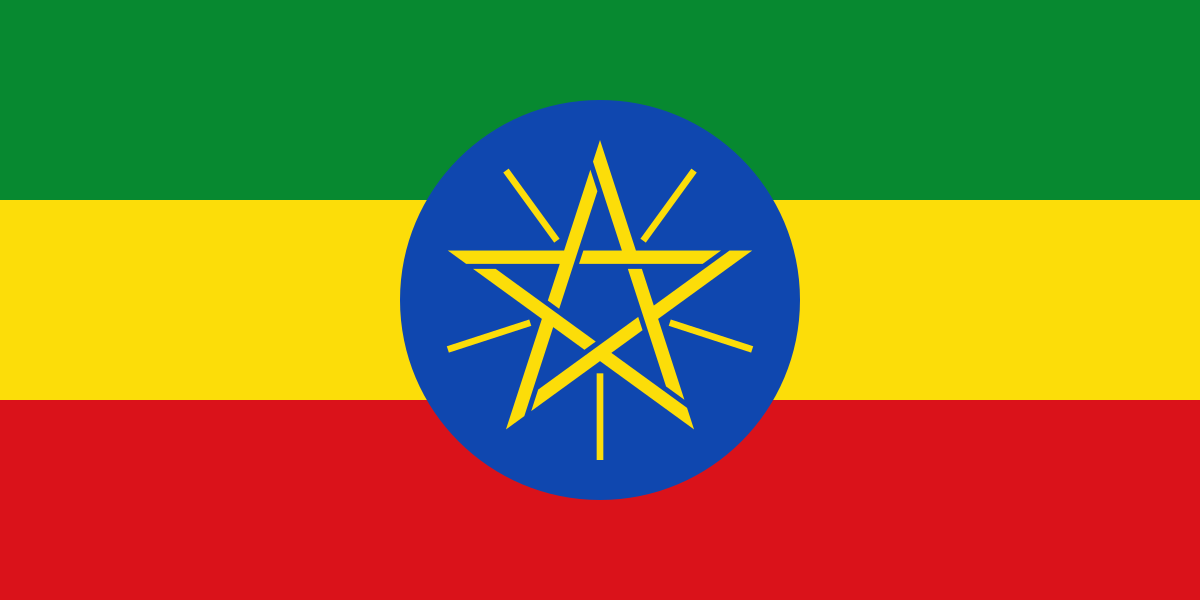
Ethiopia
Capitale
Addis-Abeba 👑
Continent
Afrique
Fuseau horaire
EAT · Africa/Addis_Ababa
Coordonnées
9.03°N, 38.74°E
Devise
ETB (Br)
Indicatif
+251
Sens de circulation
Droite
Hémisphère
Nord
Langue
Amharique
Système de mesure
Métrique
Le saviez-vous ?
En Éthiopie, nous sommes en 2018, il y a treize mois et le jour commence à l’aube
Le café vient d'Ethiopie. Pas au sens figuré : Coffea arabica est génétiquement indigène des hautes terres du sud-ouest, où il pousse encore à l'état sauvage dans le sous-étage forestier. Le mot lui-même est généralement attribué à Kaffa, la région d'origine de la plante.
L'Éthiopie est désormais le plus grand producteur de café d'Afrique et le cinquième au monde. Le café représente environ 30 à 35 % de l'ensemble des recettes d'exportation du pays.
Et voici le chiffre qui la sépare de tous les autres pays du café : L'Éthiopie boit environ la moitié de ce qu'elle cultive. Environ 46 % de la récolte ne part jamais. La plupart des pays producteurs exportent la quasi-totalité de leur eau et boivent autre chose.
La raison est la cérémonie. En Éthiopie, le café est préparé selon un rituel : des grains torréfiés sur une flamme nue devant vous, moulus à la main avec un mortier et un pilon, infusés dans un pot en argile appelé jebena. Un invité reçoit traditionnellement trois tasses, dans l'ordre. Ce n'est pas une boisson que vous commandez. C'est un événement qui prend des heures.
C'est une chose utile à savoir sur un pays qui compte aussi treize mois dans une année et commence sa journée à l'aube.
L’Éthiopie gère trois systèmes de chronométrage qui sont tous en désaccord avec le reste du monde, et elle les gère en même temps.
L'année. Le calendrier éthiopien a environ sept à huit ans de retard par rapport au calendrier grégorien. Nous sommes actuellement en 2018 E.C. — une année qui a commencé le 11 septembre 2025 et se termine le 10 septembre 2026. L'écart vient d'un calcul différent de la date de l'Annonciation par les premiers érudits chrétiens ; c'est huit ans à partir du 1er janvier jusqu'au Nouvel An éthiopien, puis sept pour le reste de l'année grégorienne.
Les mois. Il y en a treize. Douze de trente jours exactement chacun, suivis d'un court treizième appelé Pagumē — cinq jours dans une année commune, six dans une année bissextile. Le nom vient du grec epagomene, « les jours supplémentaires ».
Si cette structure vous semble familière, c’est probablement le cas. Il s'agit du calendrier copte égyptien, qui est lui-même le calendrier civil égyptien antique : douze mois de trente jours plus cinq jours cousus à la fin. Le cadre que le Caire a construit il y a cinq mille ans est toujours en vigueur à Addis-Abeba.
La règle des années bissextiles en Éthiopie est également plus simple que la nôtre : un sixième jour est ajouté à Pagumē tous les quatre ans, sans exception. Pas de règle du siècle. Pas de clause divisible par quatre cents.
Le Nouvel An – Enkutatash – tombe le 11 septembre et l'Éthiopie est entrée dans son nouveau millénaire le 11 septembre 2007.
L'horloge : et puis il y a le jour lui-même.
L'Éthiopie utilise une horloge de douze heures qui commence à l'aube. Selon les estimations internationales, six heures du matin correspondent à douze heures en Éthiopie. Sept heures du matin font une heure. Le jour et la nuit se déroulent selon deux cycles distincts de douze heures, commençant au lever et au coucher du soleil.
C’est la même logique que l’heure swahili à Nairobi, et la même logique ottomane abandonnée par Istanbul en 1926. Et elle fonctionne ici exactement pour la raison pour laquelle elle a fonctionné là-bas et a échoué à Istanbul : Addis-Abeba se situe à environ 9° nord. Le lever du soleil bouge à peine toute l'année.
Ainsi, une seule conversation à Addis-Abeba peut impliquer une année sept derrière la vôtre, un mois qui n’existe pas dans votre calendrier et une heure six en retard sur votre horloge – et chacun de ces chiffres est correct.
L’Éthiopie se présente comme le pays aux treize mois de soleil. Ce n'est pas un slogan. C'est une spécification.
Sources
- Coal Town Coffee et Bondadoso (Kaffa kökeni; Afrika'nın en büyük, dünyanın beşinci üreticisi; ihracat gelirinin %30-35'i)
- Belux Coffee (üretimin %46'sının iç tüketimde kalması; üç fincan geleneği)
- AFAR, *Coffeeland* (ürettiğinin yaklaşık yarısını içmesi)
- Café Analytica (jebena töreni; Arabica'nın üretimin %95-97'si)
- ScienceWatch (Arabica'nın yabani olarak orman altında yetişmesi)
- ethiopiancalendar.et (2018 CE; 11 Eylül 2025 – 10 Eylül 2026; Pagumē'nin yapısı; şafakta başlayan saat)
- time.et/convert (7 à 8 ans 1 heure/journée; artık yıl kuralı : 4'e bölündüğünde kalanı 3 oran yıllar)
- Etiyopya Büyükelçiliği, *Heure éthiopienne* (Kıpti takvim kökeni; Müjde tarihi hesabı)
- Calculatrice (Pagumē'nin Yunanca kökeni ; "1 heure éthiopienne = 7 heures du matin")
- ethiopiancalendar.net (2007)
- Wanderwell et Aemero Media (Aksum kökeni; Kıpti bağlantısı)
Durée du jour au fil de l’année à Addis-Abeba
Le soleil et l’horloge à Addis-Abeba (2026)
Addis-Abeba se trouve à 38.7° E. Son fuseau horaire, UTC+3, est calé sur le méridien 45° E. L’écart de 6.3° entre les deux fait que l’horloge avance d’environ 25 minutes sur le soleil : le midi solaire arrive vers 12:25 au lieu de 12:00. Le fuseau reste à UTC+3 toute l’année : il n’y a pas d’heure d’été ici.
Le jour le plus long de 2026 est le 22 juin, avec 12 h 39 min de lumière. Le plus court est le 22 décembre, avec 11 h 36 min. L’écart entre les deux est de 1 h 3 min. À quelques degrés de l’équateur, la durée du jour ne varie presque pas de l’année.
Le lever le plus précoce et le coucher le plus tardif ne tombent pas le jour le plus long. À Addis-Abeba, le soleil se lève le plus tôt le 29 mai à 06:04, tandis que le coucher le plus tardif attend le 15 juillet à 18:49. C’est l’équation du temps qui les sépare : l’orbite elliptique de la Terre et l’inclinaison de son axe décalent le midi solaire de plusieurs minutes au fil de l’année.
Le ciel reste clair un moment après le coucher du soleil. À Addis-Abeba, ce crépuscule civil dure environ 21 minutes à l’équinoxe.
Toutes les valeurs de cette section sont calculées à partir de la latitude, de la longitude et du fuseau IANA de la ville avec les algorithmes solaires de la NOAA (Spencer, 1971), avec une précision d’environ ±2 minutes d’arc sous 65° de latitude.
Heures de bureau à Addis-Abeba
9 h de chevauchementMême fuseau horaire que votre position.