Did You Know?In Ethiopia the Calendar Runs Seven Years Behind, There Are Thirteen Months, and the Day Starts at DawnRead more →

Current local time in Addis Ababa

Sponsor this page →
03:00:00
1 October 2026ThursdayThursday, 1 October 2026
Calling Code +251
Compare another city →
Embed clock

Time difference from Addis Ababa

Compare any city →
CITYLOCAL TIMEDifferenceComing up
London
United Kingdom
01:00−2hBecomes −3h on 25 Oct
Berlin
Germany
02:00−1hBecomes −2h on 25 Oct
Dubai
UAE
04:00+1h
Tokyo
Japan
09:00+6h
Sydney
Australia
10:00+7hBecomes +8h on 4 Oct
New York
United States
20:00Wed−7hBecomes −8h on 1 Nov
Los Angeles
United States
17:00Wed−10hBecomes −11h on 1 Nov
AD

Sun & moon in Addis Ababa today

Sunrise
06:13
Sunset
18:16
Daylight
12.1hrs
Next full moon
26 Oct
Hunter's Moon

Annual daylight in Addis Ababa

J11.6 hrsF11.8 hrsM12.1 hrsA12.3 hrsM12.5 hrsJ12.6 hrsJ12.6 hrsA12.4 hrsS12.2 hrsO11.9 hrsN11.7 hrsD11.6 hrs

Working hours in Addis Ababa

6h overlap
Addis AbabaUTC+3
06121824
Your locationUTC+0
06121824
Open the meeting planner →

Time zone guide for Addis Ababa

Addis Ababa, Ethiopia runs on UTC+3. This time zone stays fixed year-round at UTC+3 — daylight saving time is not observed. The time difference between Addis Ababa and New York is 7 hours. Standard 9-to-6 working hours overlap for about 2 hours a day with New York. A good time to connect: 16:00–18:00 in Addis Ababa lines up with 09:00–11:00 in New York. The time difference between Addis Ababa and London is 2 hours. Standard 9-to-6 working hours overlap for about 7 hours a day with London. A good time to connect: 11:00–18:00 in Addis Ababa lines up with 09:00–16:00 in London. The time difference between Addis Ababa and Tokyo is 6 hours. Standard 9-to-6 working hours overlap for about 3 hours a day with Tokyo. A good time to connect: 09:00–12:00 in Addis Ababa lines up with 15:00–18:00 in Tokyo. This timezone is also shared with cities such as Moscow, Istanbul, Nairobi. Keeping these offsets in mind makes it easier to schedule calls or travel to and from Addis Ababa.

Practical information for Addis Ababa

Addis Ababa (Ethiopia) is home to roughly 5.2M people. Today brings about 12.1 hours of daylight: sunrise at 06:13, sunset at 18:16. This time zone stays fixed year-round at UTC+3 — daylight saving time is not observed. It sits in the Northern Hemisphere, about 9° north of the equator. Traffic drives on the right.

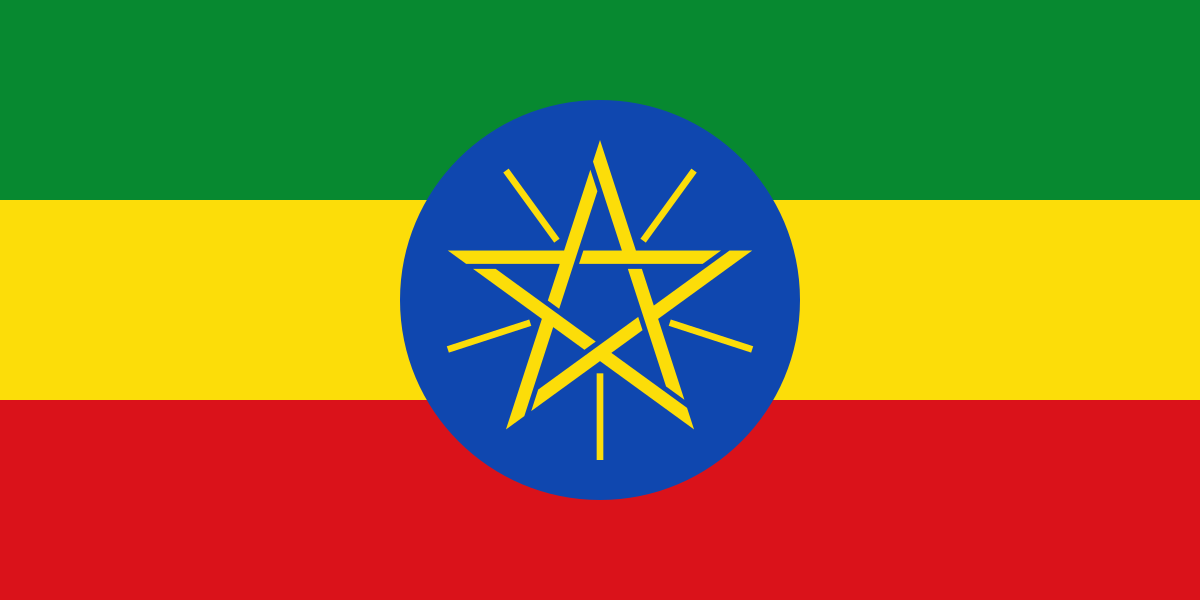
Flag

Ethiopia

Ethiopia

Capital

Addis Ababa 👑

Continent

Africa

Time Zone

UTC+3 · Africa/Addis_Ababa

Coordinates

9.03°N, 38.74°E

Currency

ETB (Br)

Calling Code

+251

Driving Side

Right

Hemisphere

Northern

Language

Amharic

Measurement System

Metric

Did You Know?

In Ethiopia the Calendar Runs Seven Years Behind, There Are Thirteen Months, and the Day Starts at Dawn

Coffee comes from Ethiopia. Not figuratively — Coffea arabica is genetically indigenous to the southwestern highlands, where it still grows wild in the forest understory. The word is sometimes traced to Kaffa, the region where the plant originated, though most dictionaries derive it from the Arabic qahwa.

Ethiopia is now Africa's largest coffee producer and the world's fifth largest. Coffee accounts for roughly 30 to 35% of the country's entire export earnings.

And here is the number that separates it from every other coffee country: Ethiopia drinks about half of what it grows. Around 46% of the harvest never leaves. Most producing nations export nearly all of theirs and drink something else.

The reason is the ceremony. Coffee in Ethiopia is prepared in a ritual — beans roasted over an open flame in front of you, ground by hand with a mortar and pestle, brewed in a clay pot called a jebena. A guest is traditionally served three cups, in sequence. It is not a drink you order. It is an event that takes hours.

Which is a useful thing to know about a country that also counts thirteen months in a year and starts its day at dawn.

Ethiopia runs three timekeeping systems that all disagree with the rest of the world, and it runs them at once.

The year. The Ethiopian calendar is roughly seven to eight years behind the Gregorian one. On 11 September 2026, for example, Ethiopia entered the year 2019 E.C. The gap comes from a different calculation of the date of the Annunciation by early Christian scholars; it is eight years from 1 January until Ethiopian New Year, then seven for the rest of the Gregorian year.

The months. There are thirteen. Twelve of exactly thirty days each, followed by a short thirteenth called Pagumē — five days in a common year, six in a leap year. The name comes from the Greek epagomene, "the additional days."

If that structure sounds familiar, it should. It is the Coptic Egyptian calendar, which is itself the ancient Egyptian civil calendar: twelve months of thirty days plus five days stitched onto the end. The framework that ancient Egypt built five thousand years ago is still running, unbroken, in Addis Ababa.

Ethiopia's leap year rule is also simpler than ours: a sixth day is added to Pagumē every fourth year, with no exceptions. No century rule. No divisible-by-four-hundred clause.

New Year — Enkutatash — falls on 11 September (12 September in the year before a Gregorian leap year); Ethiopia entered its new millennium in September 2007.

The clock: and then there is the day itself.

Ethiopia uses a twelve-hour clock that begins at dawn. Six o'clock in the morning by international reckoning is twelve o'clock in Ethiopia. Seven in the morning is one o'clock. Day and night run as two separate twelve-hour cycles, starting at sunrise and sunset.

This is the same logic as Swahili time in Nairobi, and the same logic Ottoman Istanbul abandoned in 1926. And it works here for exactly the reason it worked there and failed in Istanbul: Addis Ababa sits at about 9° north. Sunrise barely moves all year.

So a single conversation in Addis Ababa can involve a year seven behind yours, a month that does not exist in your calendar, and an hour six off your clock — and every one of those numbers is correct.

Ethiopia markets itself as the land of thirteen months of sunshine. It is not a slogan. It is a specification.

Sources
  • Coal Town Coffee and Bondadoso (Kaffa origin; Africa's largest producer, fifth in the world; 30-35% of export revenue)
  • Belux Coffee (46% of production remains for domestic consumption; three cup tradition)
  • AFAR, *Coffeeland* (drinking about half of what it produces)
  • Coffee Analytica (jebena ceremony; 95-97% of Arabica production)
  • ScienceWatch (Arabica growing wild under the forest)
  • ethiopiancalendar.et (2018 E.C.; 11 September 2025 – 10 September 2026; structure of Pagumē; time starting at dawn)
  • time.et/convert (January 1/New Year distinction of 7–8 years difference; leap year rule: years with a remainder of 3 when divided by 4)
  • Embassy of Ethiopia, *Ethiopian Time* (Coptic calendar origin; Gospel date account)
  • Calculatorian (Greek origin of Pagumē; "1 o'clock Ethiopian = 7 AM")
  • ethiopiancalendar.net (new millennium in 2007)
  • Wanderwell and Aemero Media (Axumite origin; Coptic connection)

The sun and the clock in Addis Ababa (2026)

Solar noon12:25on UTC+3 standard time
Longest day12h 39m22 June
Shortest day11h 36m22 December
Yearly average12h 8mof daylight a day
Earliest sunrise06:0429 May
Latest sunset18:4915 July

Addis Ababa lies at 38.7°E. Its time zone, UTC+3, is built around the 45°E meridian. The 6.3° gap between them means the clock runs roughly 25 minutes ahead of the sun: solar noon arrives at about 12:25 rather than 12:00. The zone holds UTC+3 all year — there is no daylight saving here.

The longest day of 2026 is 22 June, with 12h 39m of daylight. The shortest is 22 December, with 11h 36m. The swing between them is 1h 3m. Within a few degrees of the equator the length of the day barely moves all year.

The earliest sunrise and the latest sunset do not land on the longest day. In Addis Ababa the sun comes up earliest on 29 May at 06:04, while the latest sunset waits until 15 July at 18:49. The equation of time is what separates them: the Earth's elliptical orbit and axial tilt move solar noon back and forth by several minutes over the year.

The sky stays usably light for a while after the sun goes down. In Addis Ababa that civil twilight runs about 21 minutes at the equinox.

Every figure in this section is computed from the city's own latitude, longitude and IANA time zone using NOAA solar algorithms (Spencer, 1971), accurate to about ±2 arcminutes below 65° latitude.

Frequently asked questions

What is the current time and timezone in Addis Ababa?

The official timezone for Addis Ababa, Ethiopia is Africa/Addis_Ababa with a current UTC offset of UTC+3.

What is the population and location of Addis Ababa?

Addis Ababa has an estimated population of 5.2M and is located at coordinates 9.03°N, 38.74°E. It is the capital city of Ethiopia.

How many hours of daylight does Addis Ababa get?

Addis Ababa gets 12h 39m of daylight on its longest day and 11h 36m on its shortest, averaging 12h 8m a day across the year.

What time is solar noon in Addis Ababa?

Solar noon in Addis Ababa falls at about 12:25 on UTC+3 standard time, because the city sits 6.3° from the meridian its zone is built on.

What is an interesting fact or statistic about Addis Ababa?

In Ethiopia the Calendar Runs Seven Years Behind, There Are Thirteen Months, and the Day Starts at Dawn: Coffee comes from Ethiopia. Not figuratively — Coffea arabica is genetically indigenous to the southwestern highlands, where it still grows wild in the forest understory.