Did You Know?Saudi Arabia Cut Everyone's Pay by Eleven Days Without Changing a Single SalaryRead more →

Current local time in Riyadh

Sponsor this page →
03:00:00
1 October 2026ThursdayThursday, 1 October 2026
Calling Code +966
Compare another city →
Embed clock

Time difference from Riyadh

Compare any city →
CITYLOCAL TIMEDifferenceComing up
London
United Kingdom
01:00−2hBecomes −3h on 25 Oct
Berlin
Germany
02:00−1hBecomes −2h on 25 Oct
Dubai
UAE
04:00+1h
Tokyo
Japan
09:00+6h
Sydney
Australia
10:00+7hBecomes +8h on 4 Oct
New York
United States
20:00Wed−7hBecomes −8h on 1 Nov
Los Angeles
United States
17:00Wed−10hBecomes −11h on 1 Nov
AD

Sun & moon in Riyadh today

Sunrise
05:44
Sunset
17:41
Daylight
11.9hrs
Next full moon
26 Oct
Hunter's Moon

Annual daylight in Riyadh

J10.8 hrsF11.3 hrsM12 hrsA12.7 hrsM13.3 hrsJ13.7 hrsJ13.5 hrsA13 hrsS12.3 hrsO11.6 hrsN11 hrsD10.6 hrs

Working hours in Riyadh

6h overlap
RiyadhUTC+3
06121824
Your locationUTC+0
06121824
Open the meeting planner →

Time zone guide for Riyadh

Riyadh, Saudi Arabia runs on UTC+3. This time zone stays fixed year-round at UTC+3 — daylight saving time is not observed. The time difference between Riyadh and New York is 7 hours. Standard 9-to-6 working hours overlap for about 2 hours a day with New York. A good time to connect: 16:00–18:00 in Riyadh lines up with 09:00–11:00 in New York. The time difference between Riyadh and London is 2 hours. Standard 9-to-6 working hours overlap for about 7 hours a day with London. A good time to connect: 11:00–18:00 in Riyadh lines up with 09:00–16:00 in London. The time difference between Riyadh and Tokyo is 6 hours. Standard 9-to-6 working hours overlap for about 3 hours a day with Tokyo. A good time to connect: 09:00–12:00 in Riyadh lines up with 15:00–18:00 in Tokyo. This timezone is also shared with cities such as Moscow, Istanbul, Nairobi. Keeping these offsets in mind makes it easier to schedule calls or travel to and from Riyadh.

Practical information for Riyadh

Riyadh (Saudi Arabia) is home to roughly 7.7M people. Today brings about 11.9 hours of daylight: sunrise at 05:44, sunset at 17:41. This time zone stays fixed year-round at UTC+3 — daylight saving time is not observed. It sits in the Northern Hemisphere, about 25° north of the equator. Traffic drives on the right.

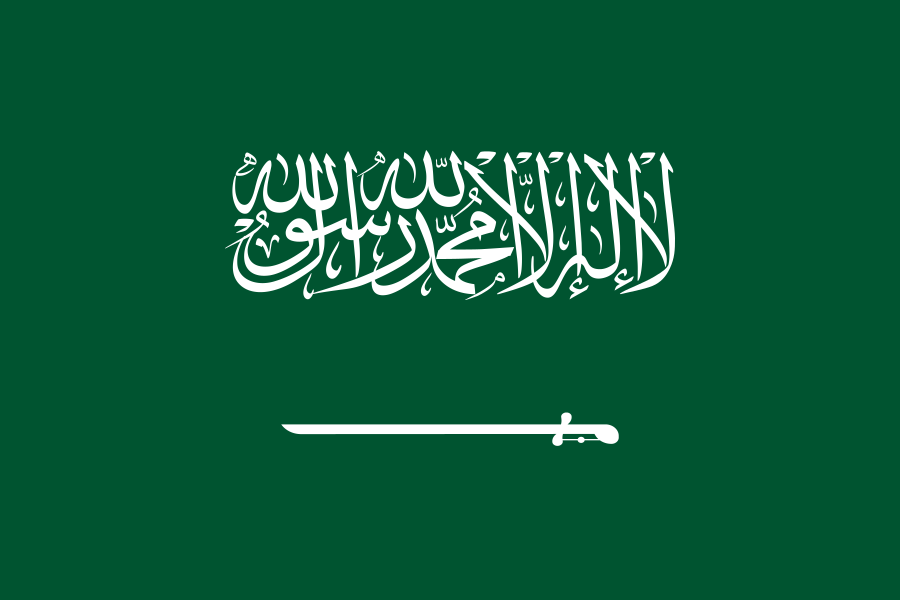
Flag

Saudi Arabia

Saudi Arabia

Capital

Riyadh 👑

Continent

Asia

Time Zone

UTC+3 · Asia/Riyadh

Coordinates

24.69°N, 46.72°E

Currency

SAR (﷼)

Calling Code

+966

Driving Side

Right

Hemisphere

Northern

Language

Arabic

Measurement System

Metric

Did You Know?

Saudi Arabia Cut Everyone's Pay by Eleven Days Without Changing a Single Salary

Since 1932, Saudi Arabia had paid its public sector employees according to the Hijri calendar — the Islamic lunar year.

A Hijri year runs twelve lunar months of 29 or 30 days, determined by the sighting of the crescent moon, and comes to roughly 354 days. That is about eleven days shorter than a Gregorian year.

Salaries were annual. So for eighty-four years, a Saudi civil servant was paid a full year's salary every 354 days — which meant, measured against the sun, they were being paid for eleven days they did not work.

On 1 October 2016, as part of a broad austerity package, the Council of Ministers moved public sector pay onto the Gregorian calendar.

Nobody's salary figure changed. Not one number on any payslip was reduced. But the year those salaries were paid over got eleven days longer — so every public employee in the kingdom quietly took an eleven-day pay cut, delivered entirely through the calendar.

The same package cut ministers' salaries by 20%, reduced their annual leave from 42 days to 36, and cancelled bonuses.

The clock: the Hijri calendar is still very much alive in Saudi Arabia for religious and much civil use, and its lunar basis produces something the solar world never experiences.

Because it loses about eleven days a year against the sun, Islamic dates walk steadily backwards through the seasons. Ramadan drifts through spring, then winter, then autumn, then summer, and returns to where it started after roughly 33 years.

Which means a Muslim who fasts through a lifetime will experience Ramadan in every season there is — the short, mild fasting days of a Riyadh winter and the punishing ones of a Riyadh July — and over a long life will see the full cycle come round about twice.

Riyadh runs two calendars at once. One is anchored to the moon and moves. One is anchored to the sun and does not. The country has spent a century deciding, case by case, which of them each part of life belongs to.

Sources
  • Arab News, *KSA switches to Gregorian calendar* (Council of Ministers decision of 1 October 2016)
  • Gulf News, *Public sector loses 11 days of salary after calendar switch*
  • PRX/The World (civil servants working 11 days more for the same salary)
  • Middle East Monitor (354 days of the Hijri year)
  • Inside Saudi (Hijri payment since 1932; 33-year seasonal cycle)

The sun and the clock in Riyadh (2026)

Solar noon11:53on UTC+3 standard time
Longest day13h 40m22 June
Shortest day10h 36m22 December
Yearly average12h 9mof daylight a day
Earliest sunrise05:039 June
Latest sunset18:464 July

Riyadh lies at 46.7°E. Its time zone, UTC+3, is built around the 45°E meridian. The 1.7° gap between them means the clock runs roughly 7 minutes behind the sun: solar noon arrives at about 11:53 rather than 12:00. The zone holds UTC+3 all year — there is no daylight saving here.

The longest day of 2026 is 22 June, with 13h 40m of daylight. The shortest is 22 December, with 10h 36m. The swing between them is 3h 4m. At this latitude the seasons are visible in the clock, but never dramatic.

The earliest sunrise and the latest sunset do not land on the longest day. In Riyadh the sun comes up earliest on 9 June at 05:03, while the latest sunset waits until 4 July at 18:46. The equation of time is what separates them: the Earth's elliptical orbit and axial tilt move solar noon back and forth by several minutes over the year.

The sky stays usably light for a while after the sun goes down. In Riyadh that civil twilight runs about 23 minutes at the equinox.

Every figure in this section is computed from the city's own latitude, longitude and IANA time zone using NOAA solar algorithms (Spencer, 1971), accurate to about ±2 arcminutes below 65° latitude.

Frequently asked questions

What is the current time and timezone in Riyadh?

The official timezone for Riyadh, Saudi Arabia is Asia/Riyadh with a current UTC offset of UTC+3.

What is the population and location of Riyadh?

Riyadh has an estimated population of 7.7M and is located at coordinates 24.69°N, 46.72°E. It is the capital city of Saudi Arabia.

How many hours of daylight does Riyadh get?

Riyadh gets 13h 40m of daylight on its longest day and 10h 36m on its shortest, averaging 12h 9m a day across the year.

What time is solar noon in Riyadh?

Solar noon in Riyadh falls at about 11:53 on UTC+3 standard time, because the city sits 1.7° from the meridian its zone is built on.

What is an interesting fact or statistic about Riyadh?

Saudi Arabia Cut Everyone's Pay by Eleven Days Without Changing a Single Salary: Since 1932, Saudi Arabia had paid its public sector employees according to the Hijri calendar — the Islamic lunar year.