서울
UTC+9대한민국 · KST
2026년 9월 22일 (화)
시간대 분석 & 주요 사실
대한민국의 서울 현지 시각은 현재 UTC+9 표준시입니다. 이 시간대는 일년 내내 고정(UTC+9)되어 있으며 서머타임을 적용하지 않습니다. 서울보다 뉴욕시간 빠릅니다. 뉴욕와(과)는 시차로 인해 통상적인 근무 시간(09:00-18:00) 겹침이 없습니다. 서울보다 런던시간 빠릅니다. 런던와(과)의 업무 시간 겹침은 하루 1시간(undefined)입니다. 글로벌 협업을 위한 최적의 화상 회의 시간대는 서울입니다. 서울와(과) 동일한 시간대를 사용합니다. 도쿄와(과)의 업무 시간 겹침은 하루 9시간(undefined)입니다. 글로벌 협업을 위한 최적의 화상 회의 시간대는 서울입니다. 이 시간대를 공유하는 주요 도시: 평양, 오사카, 교토. WorldClock.info는 공식 IANA 데이터베이스를 기반으로 정확한 시간을 제공합니다.
도시 기본 정보
대한민국 서울의 추정 인구는 약 10.0M입니다. 오늘의 일조 시간은 약 14.8시간입니다 (일출: 05:12, 일몰: 20:00). 이 시간대는 일년 내내 고정(UTC+9)되어 있으며 서머타임을 적용하지 않습니다. 북반구, 적도 북쪽 약 38°에 위치합니다. 차량은 우측 통행입니다.
국기
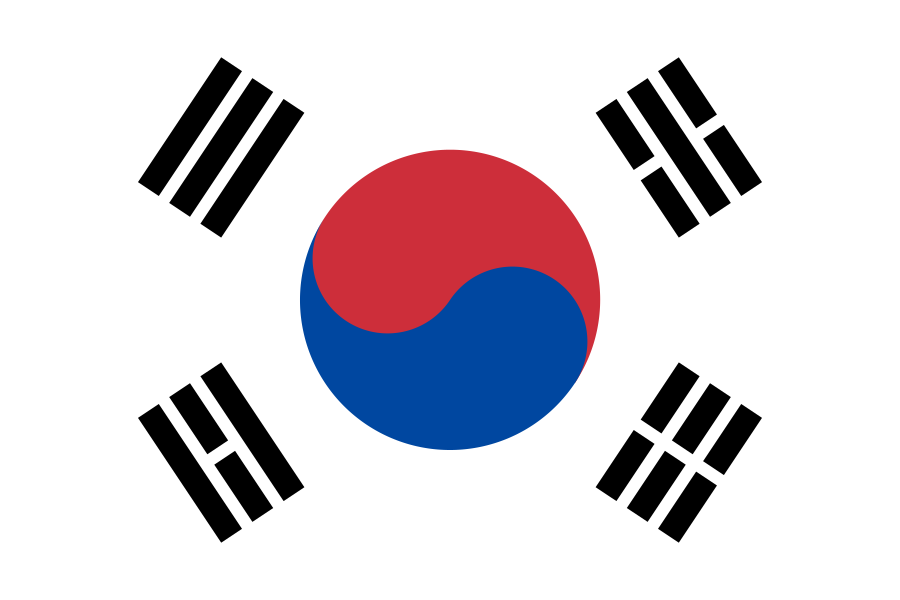
대한민국
수도
서울 👑
대륙
아시아
시간대
KST · Asia/Seoul
좌표
37.56°N, 126.98°E
통화
KRW (₩)
국가 번호
+82
통행 방향
우측
반구
북반구
공용어
한국어
측량 단위
미터법
알고 계셨나요?
The Korean Peninsula Has Moved Its Clock Six Times, and Not Once Because of the Sun
South Korea passed 100,000 coffee shops in 2022. There are now more coffee shops in the country than convenience stores.
Seoul alone has somewhere between 17,000 and 18,000 registered cafés — roughly one for every 500 residents.
Koreans drink about 405 cups of coffee per person per year, according to Euromonitor. The global average is 152. That is more than one cup a day, every day, for every man, woman and child in the country, and it puts Korea second in the world per capita behind France. Some estimates run higher: the Korea Economic Institute of America puts it at 512 cups. Around 75% of Korean adults drink at least one cup daily. Coffee accounts for 30.8% of the entire South Korean beverage market — more than carbonated drinks, at 25.5%.
Starbucks opened its first Korean branch in Seoul in 1999, inside a women's university.
But the number of cafés is not really explained by the amount of coffee, and Koreans will tell you so. The most persuasive explanation offered by Korean architects and urbanists is simpler and slightly sad: apartments are small, offices are intense, and there is nowhere else to sit.
A Seoul café is not a place that sells coffee. It is a rented living room, priced by the cup, where a student can study for four hours, a freelancer can work all afternoon, and nobody will ask you to leave.
The clock: which sits oddly alongside how little control this city has historically had over its own hours.
Seoul's clock has been moved six times in just over a century — in 1908, 1912, 1954, 1961, and, on the northern half of the peninsula, in 2015 and 2018. Not one of those changes was made because somebody looked at the sky. They were made for sovereignty, for colonisation, for decolonisation, for economic alignment, for symbolism and for diplomacy, in that order.
A city that buys its hours by the cup, in a country whose hours have been reset six times by six governments.
In 1434, under King Sejong, the scientist Jang Yeong-sil and his colleagues built the Angbu Ilgu, a sundial that became the official timekeeper of the kingdom. It set the standard at Hanyang — modern Seoul — which works out at roughly UTC+8:27:52.
That is the last time a Korean clock was set purely by looking at the sky. Everything after it was a decision about something else.
- 1 April 1908 — The Korean Empire adopts a Western-style time zone for the first time: UTC+8:30, based on 127.5° east. Astronomically, this is about right for the peninsula.
- 1 January 1912 — Under Japanese colonial rule, the Governor-General moves Korea to UTC+9, the 135th meridian, matching Japan.
- 21 March 1954 — President Syngman Rhee's government returns to UTC+8:30, restoring the pre-colonial meridian.
- 10 August 1961 — Back to UTC+9, citing administrative efficiency and coordination with trading partners and allied forces.
- 15 August 2015 — North Korea moves to UTC+8:30 and names it Pyongyang Time, timed to the 70th anniversary of liberation. For the next three years it is the only country in the world on that offset.
- 5 May 2018 — Following the inter-Korean summit, North Korean clocks go forward 30 minutes at 23:30 on 4 May, returning to UTC+9 and realigning with Seoul.
The clock: notice what is missing from that list.
Not one of those six changes was made because somebody looked outside. They were made for sovereignty, for colonisation, for decolonisation, for economics, for symbolism and for diplomacy — in that order.
And here is the sharpest part. Seoul sits at 127° east. The astronomically correct meridian for Korea is the 127.5° one — the standard adopted in 1908 and restored in 1954.
The peninsula has therefore had the right time zone twice, and given it up twice.
Seoul today runs on UTC+9 and is about thirty-two minutes ahead of its own sun — which is, in the end, the least interesting thing about a clock that has been moved six times by six governments for six entirely different reasons.
출처 및 참고자료
- Seoulz ve WifiTalents (2022 sonunda 100.000 kahve dükkânının aşılması; Seul'de 17.000+ kayıtlı kafe; marketlerden fazla olması; yetişkinlerin %75'i)
- Daebak (Seul'de 18.000'den fazla kafe, her 500 kişiye bir; New York ve Tokyo'nun kişi başı geride kalması)
- Tea & Coffee Trade Journal / Euromonitor (405 fincan, dünya ortalaması 152; KEI'ye göre 512; kahvenin içecek pazarındaki %30,8 payı)
- Medium/Minsung Kim, Prof. Hyeon-jun Yu'nun açıklaması (oturacak yer olmaması)
- CoffeeBI (1999'da Starbucks'ın ilk şubesinin kadın üniversitesinde açılması)
- Wikipedia, *Time in South Korea* ve *Time in North Korea* (1912 Genel Vali kararı; 1954 Syngman Rhee; Jang Yeong-sil ve Angbu Ilgu, UTC+08:27:52)
- NamuWiki, *Korea Standard Time* (1 Nisan 1908 tarihi; 17 Mart 1954 tarihli 876 sayılı Başkanlık Kararnamesi; 10 Ağustos 1961)
- Grokipedia, *Time in South Korea* ve *Time in North Korea* (2015 KCNA duyurusu; 2018 dönüşü)
- timeanddate.com (2015 duyurusu; 4-5 Mayıs 2018 değişikliği; 2015–2018 arası dünyada tek UTC+8:30 ülkesi olması)
연간 일조 시간
업무 시간
3시간 겹침