홍콩
UTC+8China SAR · HKT
2026년 9월 22일 (화)
시간대 분석 & 주요 사실
China SAR의 홍콩 현지 시각은 현재 UTC+8 표준시입니다. 이 시간대는 일년 내내 고정(UTC+8)되어 있으며 서머타임을 적용하지 않습니다. 홍콩보다 뉴욕시간 빠릅니다. 뉴욕와(과)는 시차로 인해 통상적인 근무 시간(09:00-18:00) 겹침이 없습니다. 홍콩보다 런던시간 빠릅니다. 런던와(과)의 업무 시간 겹침은 하루 2시간(undefined)입니다. 글로벌 협업을 위한 최적의 화상 회의 시간대는 홍콩입니다. 홍콩보다 도쿄시간 빠릅니다. 도쿄와(과)의 업무 시간 겹침은 하루 8시간(undefined)입니다. 글로벌 협업을 위한 최적의 화상 회의 시간대는 홍콩입니다. 이 시간대를 공유하는 주요 도시: 싱가포르, 쿠알라룸푸르, 마닐라. WorldClock.info는 공식 IANA 데이터베이스를 기반으로 정확한 시간을 제공합니다.
도시 기본 정보
China SAR 홍콩의 추정 인구는 약 7.5M입니다. 오늘의 일조 시간은 약 13.2시간입니다 (일출: 05:48, 일몰: 19:00). 이 시간대는 일년 내내 고정(UTC+8)되어 있으며 서머타임을 적용하지 않습니다. 북반구, 적도 북쪽 약 22°에 위치합니다. 차량은 좌측 통행입니다.
국기
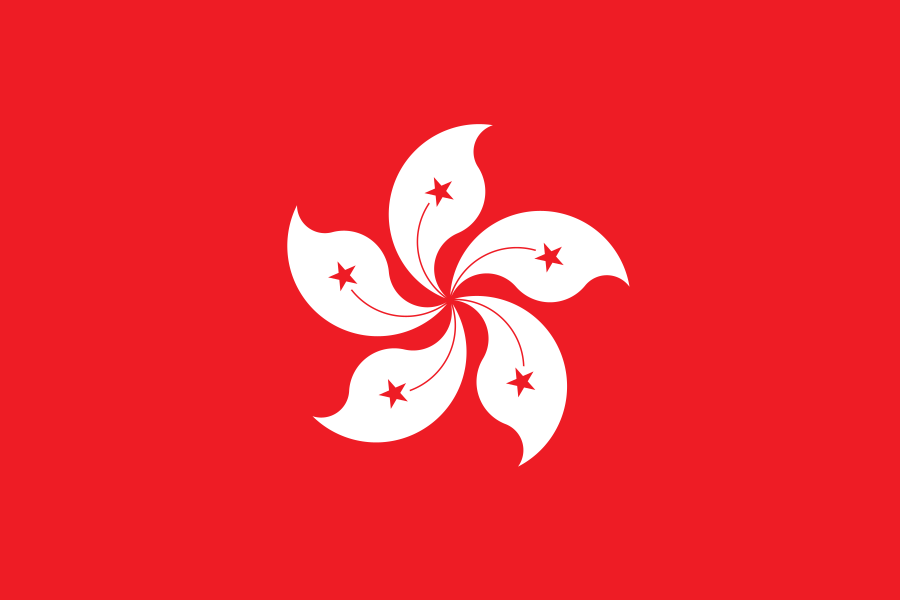
China SAR
대륙
아시아
시간대
HKT · Asia/Hong_Kong
좌표
22.32°N, 114.17°E
통화
HKD ($)
국가 번호
+852
통행 방향
좌측
반구
북반구
공용어
광둥어, 영어
측량 단위
미터법
알고 계셨나요?
Hong Kong's Public Clock Started as a Punishment
Hong Kong has more skyscrapers than any other city on Earth, and it is not close.
The city contains over 9,000 high-rise buildings. More than 1,000 of them stand above 100 metres. By the standard definition used by the Council on Tall Buildings and Urban Habitat — 150 metres and up — Hong Kong has somewhere between 569 and 669, depending on the count and the cut-off date. Guinness, using CTBUH figures from January 2025, gives 669.
New York, which held this title from the invention of the skyscraper until the early 2000s, has around 320. Chicago, where the first one was built, has 137.
Above 200 metres, Hong Kong has 102 buildings. Above 300 metres, six. Above 400 metres, two. The tallest is the International Commerce Centre at 484 metres and 118 storeys.
The reason is geography rather than ambition. Hong Kong is wedged between mountains and the sea with very little buildable land, so the only available direction was up.
The clock: and the building that started it was put up by a familiar name.
Hong Kong's first structure over 150 metres was Jardine House, completed in 1973 — built by Jardine Matheson.
Which is the same trading house that, since around 1860, has fired a naval gun over Causeway Bay every single day at noon. The story is that a senior Royal Navy officer objected to the company firing salutes for its own taipan, and as a reprimand Jardine Matheson was ordered to fire the gun daily, in perpetuity, as a public time signal for the colony.
They are still doing it, 165 years later, forty-five seconds at a time.
So the same company that was punished into telling Hong Kong what time it was also built the tower that told it which way to grow. The gun fires at clock noon, which in Hong Kong is about twenty-three minutes before the sun is actually overhead.
Every day at noon, on the Causeway Bay waterfront, a uniformed guard employed by the trading house Jardine Matheson marches to a small enclosure, rings a ship's bell eight times to mark the end of the forenoon watch, fires a naval gun over the typhoon shelter, rings the bell again, and marches away.
This has been happening for more than a hundred and sixty years, and according to the story Hong Kong tells about it, it began as a reprimand.
Jardine Matheson bought the land in 1841 — the first plot sold at public auction in colonial Hong Kong. The company kept a gun on its waterfront and, by custom, fired a salute whenever the taipan, the head of the firm, arrived or departed.
Around 1860 a senior Royal Navy officer newly arrived in Hong Kong heard this and was not amused. Gun salutes were the prerogative of the Governor and senior military officers, not of a trading company's boss. As a punishment, Jardine Matheson was ordered to fire the gun every day at noon, in perpetuity, as a public time signal for the colony.
They are still doing it.
The tradition paused only during the Japanese occupation, when the original gun disappeared. It was replaced in the 1960s with a smaller model after neighbours complained about the noise. It fires at midnight on New Year's Eve too, and since 1989 sponsors can pay to fire it, with the proceeds going to charity.
The clock: what makes this more than an anecdote is what the gun was actually for.
Hong Kong was a harbour economy, and harbour economies need public time. Ports around the world solved this visually, with time balls dropped at a fixed hour so ships could set their chronometers — Greenwich did it, and so did the ball that eventually became New York's New Year's Eve spectacle. Hong Kong had visual signals too. But a gun has one advantage over a ball: you do not have to be looking at it.
So Hong Kong got a sonic time signal, audible for miles across the water, fired by a private company under naval orders, as a favour to the whole colony that nobody asked for and nobody has since cancelled.
Hong Kong sits at 114° east and runs on UTC+8, a zone built for the 120th meridian. Which means the gun that told the city what noon was has always fired about twenty-three minutes before the sun is actually overhead — and has been perfectly, publicly, reliably wrong about it every single day since.
출처 및 참고자료
- Guinness World Records / CTBUH (30 Ocak 2025 itibarıyla 150 m ve üzeri 669 bina; Shenzhen 626)
- Wikipedia, *List of tallest buildings in Hong Kong* (9.000'den fazla yüksek bina; 1.000'den fazlası 100 m üzeri; 569'u 150 m üzeri; 102'si 200 m üzeri, 6'sı 300 m üzeri, 2'si 400 m üzeri; **ilk 150 m+ bina: Jardine House, 1973**; ICC 484 m)
- Newsweek (New York ~320, Chicago 137)
- Time Out Hong Kong (dağ ve deniz arasındaki arazi kısıtı)
- The Tower Info (ICC'nin 118 katı)
- CNN Travel, *The story behind Hong Kong's Jardine Noonday Gun*
- Vision Times (1860 tarihi; Japon işgali sırasındaki duraklama; yılbaşı ateşlemesi)
- Trespasser-on-Earth (Hotchkiss üç librelik top; çan seremonisinin ayrıntısı; 1841 açık artırması)
- Beijing-Visitor (Noël Coward'ın *Mad Dogs and Englishmen*'inde geçmesi; 1960'larda gürültü şikâyeti üzerine küçültülmesi)
- Grokipedia, *Noonday Gun* (sesli zaman sinyalinin görsel zaman toplarını tamamlaması; 1989'dan beri hayır amaçlı ateşlemeler)
- Boylam hesabı: Hong Kong 114,2°D, UTC+8 meridyeni 120°D → ~23 dakika
연간 일조 시간
업무 시간
4시간 겹침