카라카스
UTC−4베네수엘라 · VET
2026년 9월 22일 (화)
시간대 분석 & 주요 사실
베네수엘라의 카라카스 현지 시각은 현재 UTC−4 표준시입니다. 이 시간대는 일년 내내 고정(UTC−4)되어 있으며 서머타임을 적용하지 않습니다. 카라카스와(과) 동일한 시간대를 사용합니다. 뉴욕와(과)의 업무 시간 겹침은 하루 9시간(undefined)입니다. 글로벌 협업을 위한 최적의 화상 회의 시간대는 카라카스입니다. 카라카스보다 런던시간 빠릅니다. 런던와(과)의 업무 시간 겹침은 하루 4시간(undefined)입니다. 글로벌 협업을 위한 최적의 화상 회의 시간대는 카라카스입니다. 카라카스보다 도쿄시간 빠릅니다. 도쿄와(과)는 시차로 인해 통상적인 근무 시간(09:00-18:00) 겹침이 없습니다. 이 시간대를 공유하는 주요 도시: 토론토, 아바나, 워싱턴 D.C.. WorldClock.info는 공식 IANA 데이터베이스를 기반으로 정확한 시간을 제공합니다.
도시 기본 정보
베네수엘라 카라카스의 추정 인구는 약 5.0M입니다. 오늘의 일조 시간은 약 12.5시간입니다 (일출: 06:06, 일몰: 18:36). 이 시간대는 일년 내내 고정(UTC−4)되어 있으며 서머타임을 적용하지 않습니다. 북반구, 적도 북쪽 약 10°에 위치합니다. 차량은 우측 통행입니다.
국기
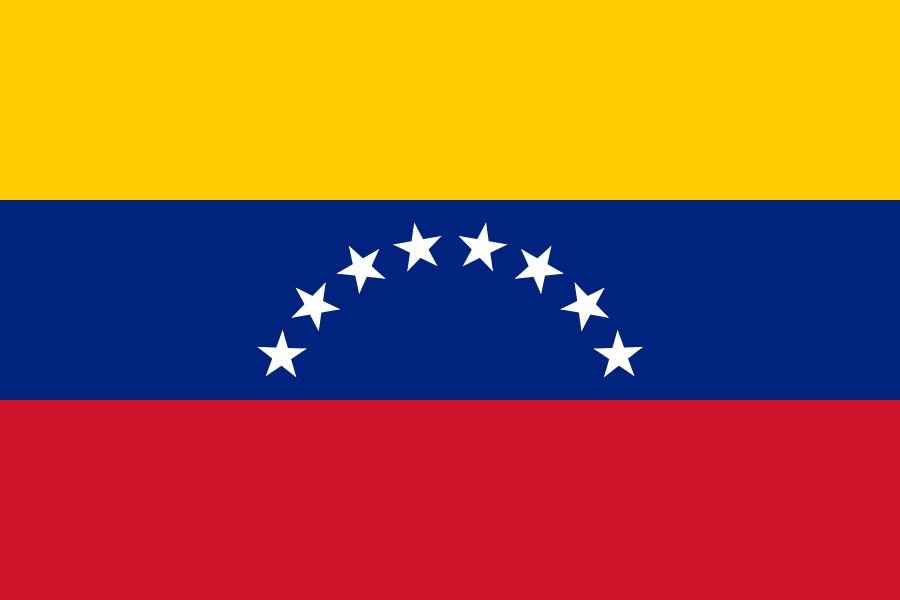
베네수엘라
수도
카라카스 👑
대륙
남아메리카
시간대
VET · America/Caracas
좌표
10.48°N, 66.90°W
통화
VES (Bs.)
국가 번호
+58
통행 방향
우측
반구
북반구
공용어
스페인어
측량 단위
미터법
알고 계셨나요?
Venezuela Has Had the Right Time Zone Twice, and Given It Up Twice
Venezuela has won more international beauty pageants than any country on Earth: 24 Big Four titles — seven Miss Universe, six Miss World, nine Miss International and two Miss Earth. It is the only country to have won all four more than once, and it has twice taken two of the four crowns in a single year.
Between 1983 and 2003 it reached the Miss Universe semi-finals twenty-one years running.
This is not luck, and Venezuela has never pretended it was. An entire industry grew up around it — training academies, coaches, surgeons, and thousands of local pageants held every year in schools, army barracks and, according to reporting from the period, prisons. The national final is one of the country's most-watched television events. Wire reports of the era routinely described beauty queens as ranking alongside oil and baseball players among the country's exports.
It kept winning through economic collapse. The 2013 Miss Universe crown arrived in a year of two-decade-high inflation and shortages of basic goods.
Which is a useful thing to know before looking at what the country did with its clock, because the same pattern shows up there: a decision made once, defended hard, and then reversed when the electricity ran short.
Venezuela sits awkwardly on the map. The country is centred near 67°30′ west — almost exactly halfway between the standard meridians at 60° west (UTC−4) and 75° west (UTC−5). Neither whole-hour zone fits.
In 1912 the country solved this correctly, adopting UTC−4:30, centred on 67°30′ west. Caracas is at about 66°58′ west. The fit was close to perfect.
In 1965 Venezuela gave it up and moved to UTC−4, reportedly to conform to an emerging international preference for whole-hour zones in communications and aviation — accepting a worse solar alignment in exchange for a rounder number.
In December 2007 it came back. President Hugo Chávez decreed a return to UTC−4:30, with clocks turning back thirty minutes at 3 a.m. on 9 December. The stated reason was that children would wake for school in daylight. It was also widely read as a statement of independence, and for the next eight and a half years Venezuela was the only country in the world on that offset.
Then, on 1 May 2016, it went away again.
This time the reason was electricity. A severe drought had cut water levels at the Guri dam, which supplies roughly two-thirds of the country's power, and outages were frequent. Moving the clock forward thirty minutes would push more daylight into the evening, when people come home and switch on lights and air conditioning. Clocks went from 2:30 a.m. straight to 3:00.
The same measure came with cinemas closing early, rationing in shopping centres, and public sector employees losing working days.
Not everyone was persuaded. One Caracas accountant told reporters he did not agree — you use the same amount of power regardless of what the clock says. A local comedian joked about the country's real time zones: hours without light, hours without water, hours of presidential broadcasts, hours of queues.
The clock: here is the arithmetic underneath all of it.
On UTC−4:30, Caracas sat about two minutes from its own solar noon. On UTC−4, where it is today, it runs about twenty-eight minutes ahead of the sun.
So the same half hour has now been moved four times in a century — 1912, 1965, 2007, 2016 — and twice the country has held the offset that actually matched its sky, and twice let it go.
Both of the modern changes were explained in terms of daylight and children. They moved the clock in opposite directions.
출처 및 참고자료
- Grokipedia, *List of Miss Venezuela titleholders* (24 Büyük Dört unvanı: 7 Miss Universe, 6 Miss World, 9 Miss International, 2 Miss Earth)
- WikiLists/Fandom (dördünü de birden fazla kez kazanan tek ülke; aynı yıl iki taç: 1981 ve 2013)
- news24online (1983–2003 arası 21 yıl üst üste yarı final)
- AP/Fox News (eğitim sektörü; okul, kışla ve cezaevlerindeki yarışmalar; 2013'te enflasyon ortamında gelen taç)
- Wikipedia, *UTC−04:30* (12 Şubat 1912 – 1 Ocak 1965 ve 9 Aralık 2007 – 1 Mayıs 2016 dönemleri; yalnızca Venezuela'da kullanılması)
- timeanddate.com, *Venezuela: Clocks to be set back 30 minutes on December 9, 2007* (67°30′B meridyeni; Caracas'ın 66°58′B konumu; 60°B ve 75°B arasında kalması)
- timeanddate.com, *Clocks to Go Forward Permanently in Venezuela* (1 Mayıs 2016, 02:30 → 03:00; Guri barajı; sinema ve AVM tedbirleri)
- VOA/Reuters ve Euronews (Bakan Jorge Arreaza'nın açıklaması; Guri'nin ülke elektriğinin üçte ikisini sağlaması; muhasebeci ve komedyen tepkileri)
- AP/Fox News (2007 değişikliğinin bağımsızlık beyanı olarak okunması)
연간 일조 시간
업무 시간
2시간 겹침