Did You Know?Venezuela Has Had the Right Time Zone Twice, and Given It Up TwiceRead more →

Current local time in Caracas

Sponsor this page →
20:00:00
30 September 2026WednesdayWednesday, 30 September 2026
Calling Code +58
Compare another city →
Embed clock

Time difference from Caracas

Compare any city →
CITYLOCAL TIMEDifferenceComing up
London
United Kingdom
01:00Thu+5hBecomes +4h on 25 Oct
Berlin
Germany
02:00Thu+6hBecomes +5h on 25 Oct
Dubai
UAE
04:00Thu+8h
Tokyo
Japan
09:00Thu+13h
Sydney
Australia
10:00Thu+14hBecomes +15h on 4 Oct
New York
United States
20:00±0hBecomes −1h on 1 Nov
Los Angeles
United States
17:00−3hBecomes −4h on 1 Nov
AD

Sun & moon in Caracas today

Sunrise
06:16
Sunset
18:18
Daylight
12.0hrs
Next full moon
26 Oct
Hunter's Moon

Annual daylight in Caracas

J11.6 hrsF11.8 hrsM12.1 hrsA12.4 hrsM12.6 hrsJ12.7 hrsJ12.7 hrsA12.5 hrsS12.2 hrsO11.9 hrsN11.7 hrsD11.5 hrs

Working hours in Caracas

5h overlap
CaracasUTC−4
06121824
Your locationUTC+0
06121824
Open the meeting planner →

Time zone guide for Caracas

Caracas, Venezuela runs on UTC−4. This time zone stays fixed year-round at UTC−4 — daylight saving time is not observed. Caracas and New York currently share the same clock. Standard 9-to-6 working hours overlap for about 9 hours a day with New York. A good time to connect: 09:00–18:00 in Caracas lines up with 09:00–18:00 in New York. The time difference between Caracas and London is 5 hours. Standard 9-to-6 working hours overlap for about 4 hours a day with London. A good time to connect: 09:00–13:00 in Caracas lines up with 14:00–18:00 in London. The time difference between Caracas and Tokyo is 13 hours. Standard working hours don't overlap at all with Tokyo, so meetings need an early or late slot on one side. This timezone is also shared with cities such as La Paz, Santo Domingo, San Juan. Keeping these offsets in mind makes it easier to schedule calls or travel to and from Caracas.

Practical information for Caracas

Caracas (Venezuela) is home to roughly 5.0M people. Today brings about 12.0 hours of daylight: sunrise at 06:16, sunset at 18:18. This time zone stays fixed year-round at UTC−4 — daylight saving time is not observed. It sits in the Northern Hemisphere, about 10° north of the equator. Traffic drives on the right.

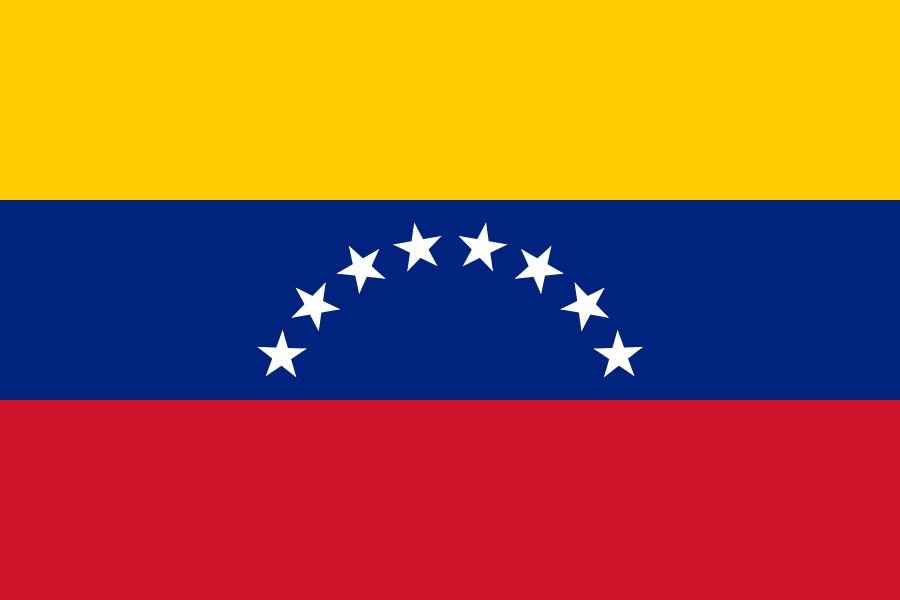
Flag

Venezuela

Venezuela

Capital

Caracas 👑

Continent

South America

Time Zone

UTC−4 · America/Caracas

Coordinates

10.48°N, 66.90°W

Currency

VES (Bs.)

Calling Code

+58

Driving Side

Right

Hemisphere

Northern

Language

Spanish

Measurement System

Metric

Did You Know?

Venezuela Has Had the Right Time Zone Twice, and Given It Up Twice

Venezuela has won more international beauty pageants than any country on Earth: 24 Big Four titles — seven Miss Universe, six Miss World, nine Miss International and two Miss Earth. It is the only country to have won all four more than once, and it has twice taken two of the four crowns in a single year.

Between 1983 and 2003 it reached the Miss Universe semi-finals twenty-one years running.

This is not luck, and Venezuela has never pretended it was. An entire industry grew up around it — training academies, coaches, surgeons, and thousands of local pageants held every year in schools, army barracks and, according to reporting from the period, prisons. The national final is one of the country's most-watched television events. Wire reports of the era routinely described beauty queens as ranking alongside oil and baseball players among the country's exports.

It kept winning through economic collapse. The 2013 Miss Universe crown arrived in a year of the highest inflation in almost two decades and shortages of basic goods.

Which is a useful thing to know before looking at what the country did with its clock, because the same pattern shows up there: a decision made once, defended hard, and then reversed when the electricity ran short.

Venezuela sits awkwardly on the map. The country is centred near 67°30′ west — almost exactly halfway between the standard meridians at 60° west (UTC−4) and 75° west (UTC−5). Neither whole-hour zone fits.

In 1912 the country solved this correctly, adopting UTC−4:30, centred on 67°30′ west. Caracas is at about 66°58′ west. The fit was close to perfect.

In 1965 Venezuela gave it up and moved to UTC−4, reportedly to conform to an emerging international preference for whole-hour zones in communications and aviation — accepting a worse solar alignment in exchange for a rounder number.

In December 2007 it came back. President Hugo Chávez decreed a return to UTC−4:30, with clocks turning back thirty minutes at 3 a.m. on 9 December. The stated reason was that children would wake for school in daylight. It was also widely read as a statement of independence, and for the next eight and a half years Venezuela was the only country in the world on that offset.

Then, on 1 May 2016, it went away again.

This time the reason was electricity. A severe drought had cut water levels at the Guri dam, which supplies roughly two-thirds of the country's power, and outages were frequent. Moving the clock forward thirty minutes would push more daylight into the evening, when people come home and switch on lights and air conditioning. Clocks went from 2:30 a.m. straight to 3:00.

The same measure came with cinemas closing early, rationing in shopping centres, and public sector employees losing working days.

Not everyone was persuaded. One Caracas accountant told reporters he did not agree — you use the same amount of power regardless of what the clock says. A local comedian joked about the country's real time zones: hours without light, hours without water, hours of presidential broadcasts, hours of queues.

The clock: here is the arithmetic underneath all of it.

On UTC−4:30, Caracas sat about two minutes from its own solar noon. On UTC−4, where it is today, it runs about twenty-eight minutes ahead of the sun.

So the same half hour has now been moved four times in a century — 1912, 1965, 2007, 2016 — and twice the country has held the offset that actually matched its sky, and twice let it go.

The first was explained in terms of children and daylight, the second in terms of electricity. They moved the clock in opposite directions.

Sources
  • Wikipedia, *Big Four international beauty pageants* (24 Big Four titles: 7 Miss Universe, 6 Miss World, 9 Miss International, 2 Miss Earth)
  • WikiLists/Fandom (only country to win all four more than once; two crowns in the same year: 1981 and 2013)
  • news24online (semi-finals for 21 consecutive years from 1983–2003)
  • AP/Fox News (education sector; competitions in schools, barracks and prisons; crown in 2013 amid inflation)
  • Wikipedia, *UTC−04:30* (periods 12 February 1912 – 1 January 1965 and 9 December 2007 – 1 May 2016; used in Venezuela only)
  • timeanddate.com, *Venezuela: Clocks to be set back 30 minutes on December 9, 2007* (67°30′W meridian; Caracas' position at 66°58′W; falling between 60°W and 75°W)
  • timeanddate.com, *Clocks to Go Forward Permanently in Venezuela* (1 May 2016, 02:30 → 03:00; Guri dam; cinema and shopping mall measures)
  • VOA/Reuters and Euronews (Minister Jorge Arreaza's statement; Guri provides two-thirds of the country's electricity; accountant and comedian reactions)
  • AP/Fox News (2007 amendment read as declaration of independence)

The sun and the clock in Caracas (2026)

Solar noon12:28on UTC−4 standard time
Longest day12h 44m22 June
Shortest day11h 31m22 December
Yearly average12h 8mof daylight a day
Earliest sunrise06:0430 May
Latest sunset18:5414 July

Caracas lies at 66.9°W. Its time zone, UTC−4, is built around the 60°W meridian. The 6.9° gap between them means the clock runs roughly 28 minutes ahead of the sun: solar noon arrives at about 12:28 rather than 12:00. The zone holds UTC−4 all year — there is no daylight saving here.

The longest day of 2026 is 22 June, with 12h 44m of daylight. The shortest is 22 December, with 11h 31m. The swing between them is 1h 14m. Inside the tropics the day length stays within a narrow band all year.

The earliest sunrise and the latest sunset do not land on the longest day. In Caracas the sun comes up earliest on 30 May at 06:04, while the latest sunset waits until 14 July at 18:54. The equation of time is what separates them: the Earth's elliptical orbit and axial tilt move solar noon back and forth by several minutes over the year.

The sky stays usably light for a while after the sun goes down. In Caracas that civil twilight runs about 21 minutes at the equinox.

Every figure in this section is computed from the city's own latitude, longitude and IANA time zone using NOAA solar algorithms (Spencer, 1971), accurate to about ±2 arcminutes below 65° latitude.

Frequently asked questions

What is the current time and timezone in Caracas?

The official timezone for Caracas, Venezuela is America/Caracas with a current UTC offset of UTC−4.

What is the population and location of Caracas?

Caracas has an estimated population of 5.0M and is located at coordinates 10.48°N, 66.90°W. It is the capital city of Venezuela.

How many hours of daylight does Caracas get?

Caracas gets 12h 44m of daylight on its longest day and 11h 31m on its shortest, averaging 12h 8m a day across the year.

What time is solar noon in Caracas?

Solar noon in Caracas falls at about 12:28 on UTC−4 standard time, because the city sits 6.9° from the meridian its zone is built on.

What is an interesting fact or statistic about Caracas?

Venezuela Has Had the Right Time Zone Twice, and Given It Up Twice: Venezuela has won more international beauty pageants than any country on Earth: 24 Big Four titles — seven Miss Universe, six Miss World, nine Miss International and two Miss Earth.