Antalya
UTC+3Turquía · TRT
Hora local actual en Antalya
mié, 23 sept 2026
Amanecer, atardecer y horas de luz en Antalya
Guía de zona horaria de Antalya
Antalya, Turquía opera en UTC+3. Esta zona horaria se mantiene fija todo el año en UTC+3 — no se aplica horario de verano. Hay una diferencia de 7 horas entre Antalya y Nueva York. El horario laboral habitual (9 a 18h) coincide unas 2 horas al día con Nueva York. Un buen momento para comunicarse: las 16:00–18:00 en Antalya coinciden con las 09:00–11:00 en Nueva York. Hay una diferencia de 2 horas entre Antalya y Londres. El horario laboral habitual (9 a 18h) coincide unas 7 horas al día con Londres. Un buen momento para comunicarse: las 11:00–18:00 en Antalya coinciden con las 09:00–16:00 en Londres. Hay una diferencia de 6 horas entre Antalya y Tokio. El horario laboral habitual (9 a 18h) coincide unas 3 horas al día con Tokio. Un buen momento para comunicarse: las 09:00–12:00 en Antalya coinciden con las 15:00–18:00 en Tokio. Esta zona horaria también se comparte con ciudades como Moscú, Atenas, Estambul. Tener en cuenta estas diferencias facilita programar llamadas o viajar a Antalya.
Información práctica sobre Antalya
Antalya (Turquía) tiene aproximadamente 1.3M habitantes. Hoy hay unas 14.5 horas de luz diurna: amanecer a las 05:42, atardecer a las 20:12. Esta zona horaria se mantiene fija todo el año en UTC+3 — no se aplica horario de verano. Se ubica en el Hemisferio Norte, a unos 37° al norte del ecuador. El tráfico circula por la derecha.
Bandera
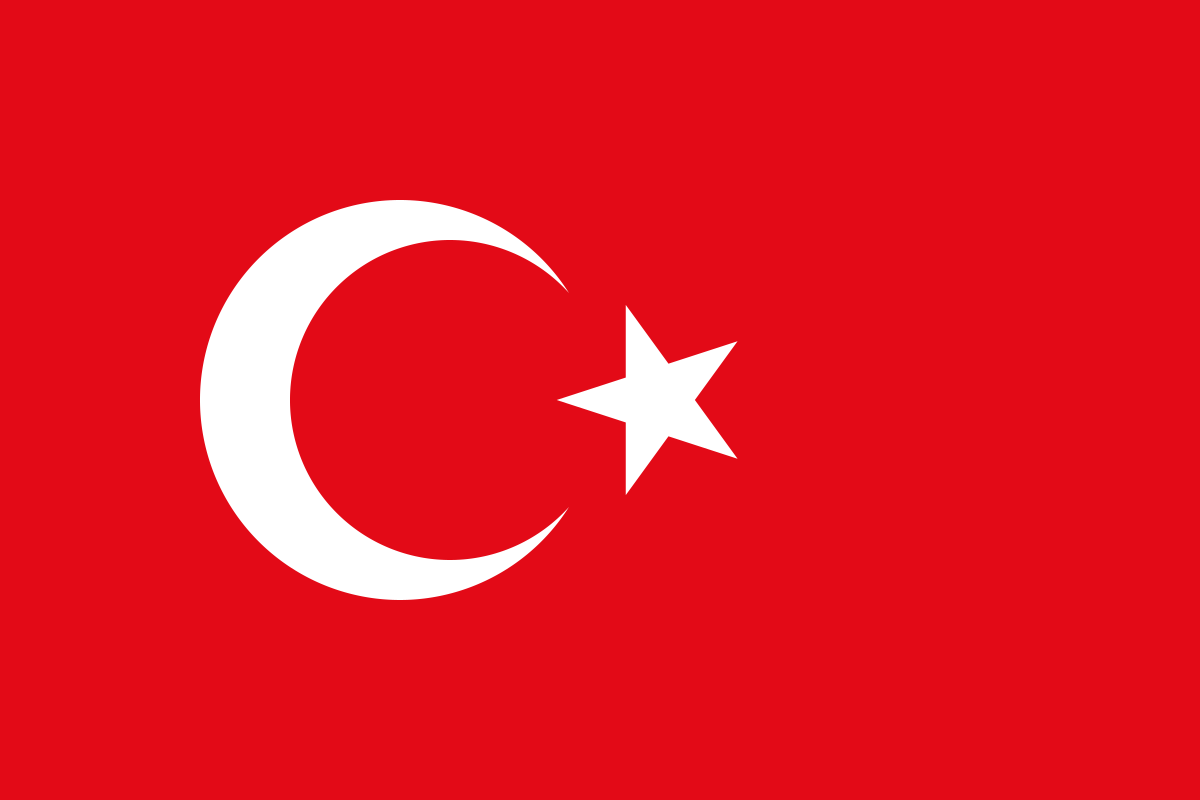
Turquía
Capital
Ankara
Continente
Europa & Asia
Huso Horario
TRT · Europe/Istanbul
Coordenadas
36.90°N, 30.71°E
Moneda
TRY (₺)
Prefijo Telefónico
+90
Sentido de Circulación
Derecha
Hemisferio
Norte
Idioma
Turco
Sistema de Medición
Métrico
¿Sabías Que?
Una ciudad que abolió la temporada de crecimiento
Antalya posee el 41% de toda la superficie de cultivo cubierta de Türkiye: aproximadamente entre 317.000 y 321.000 dekars de invernaderos y túneles, de un total nacional de 776.110. Específicamente para los invernaderos de vidrio, la proporción aumenta al 79%.
El desglose es de 44.336 dekars de vidrio, 245.109 de plástico, 15.399 de túnel alto y 12.113 de túnel bajo. En distritos como Kumluca, Demre y Aksu, los invernaderos se encuentran uno al lado del otro; desde lo alto el paisaje se lee como una sábana blanca.
La producción está en la misma escala. Cifras recientes sitúan la producción de Antalya en 2.629.000 toneladas de tomates, 774.000 toneladas de pimientos, 412.000 toneladas de pepinos y 261.000 toneladas de berenjenas. En 2025, la provincia exportó 548.000 toneladas de frutas y hortalizas frescas: 437.000 de hortalizas y 111.000 de frutas. Alrededor del 80% de las hortalizas que se cultivan en la provincia proceden del cultivo cubierto.
Lo que eso compra es la eliminación del invierno. El cultivo cubierto comenzó con el apoyo estatal a la investigación en la década de 1940 y adquirió importancia comercial en la década de 1980. En la década de 2000, con las cadenas de supermercados, el almacenamiento frigorífico y la logística, Antalya suministraba hortalizas de invierno a todo Türkiye y a los mercados de exportación más allá. El director provincial de Agricultura resume que ya no se distingue entre productos de verano y de invierno.
Una corrección al panorama: El 85% de los invernaderos de Antalya son tradicionales, no modernos. El clima controlado por computadora y el cultivo sin suelo existen, pero un invernadero moderno solo rinde entre 30 y 35 dekars o más, lo que está fuera del alcance de la mayoría de los agricultores individuales.
El reloj: entonces esta es una provincia que ha pasado ochenta años eliminando las estaciones de su agricultura, sentada en un país que las eliminó del reloj.
En 2016, Türkiye abolió el horario de verano y fijó el país permanentemente en UTC+3. No hay primavera adelante ni otoño atrás. El reloj marca lo mismo en enero que en julio.
Antalya se encuentra a unos 31° este, lo que la deja aproximadamente 57 minutos por delante de su propio sol: la brecha más pequeña entre las grandes ciudades costeras de Türkiye, porque es la más al este de ellas.
Y a 37° norte también tiene la menor variación estacional de luz diurna de cualquier ciudad turca importante. Aquí el cielo cambia menos que en cualquier otro lugar del país, el reloj no cambia en absoluto y bajo el plástico siempre es verano.
Fuentes
- MyGazete / Antalya İl Tarım ve Orman Müdürlüğü 2025 faaliyet raporu (316.957 dekar örtü altı alan; Türkiye'nin 776.110 dekarının %41'i; cam serada %79 pay; cam/plastik/tünel dağılımı; 2.629.000 toneladas de domates, 774.000 toneladas de biber, 412.000 toneladas de hıyar, 261.000 toneladas de patlıcan)
- Anadolu Ajansı / Haberler.com (321 bin dekar; 2025'te 548 bin ton ihracat, 437 bin sebze + 111 bin meyve; 1940'lardan 2000'lere gelişim; İl Müdürü Şakir Fırat Erkal'ın açıklamaları; Kumluca, Demre, Aksu'nun görünümü)
- AA / Antalya Gıda Tarım Müdürü Ahmet Dallı (sebzenin ~%80'inin serada üretilmesi; seraların %85'inin geleneksel olması; 30-35 dekar eşiği)
- BAKA (2022'de ~7 millones de toneladas yaş sebze-meyve üretimi; 19,3 millones de TL bitkisel üretim değeriyle Türkiye birinciliği)
- Boylam hesabı: Antalya 30,71°D, UTC+3 meridianos 45°D → ~57 días
Luz diurna a lo largo del año en Antalya
El sol y el reloj en Antalya (2026)
Antalya se encuentra a 30.7°E. Su zona horaria, UTC+3, se basa en el meridiano 45°E. La diferencia de 14.3° entre ambos hace que el reloj vaya unos 57 minutos adelantado respecto al sol: el mediodía solar llega hacia las 12:57 y no a las 12:00. La zona mantiene UTC+3 todo el año: aquí no hay horario de verano.
El día más largo de 2026 es el 22 de junio, con 14 h 42 min de luz. El más corto es el 22 de diciembre, con 9 h 38 min. La diferencia entre ambos es de 5 h 4 min. Es la franja de latitud donde más se nota la diferencia entre las tardes de verano y las de invierno.
El amanecer más temprano y el atardecer más tardío no coinciden con el día más largo. En Antalya el sol sale más temprano el 14 de junio, a las 05:37, mientras que el atardecer más tardío llega el 30 de junio, a las 20:20. Los separa la ecuación del tiempo: la órbita elíptica de la Tierra y la inclinación de su eje adelantan y retrasan el mediodía solar varios minutos a lo largo del año.
El cielo sigue claro un rato después de la puesta de sol. En Antalya ese crepúsculo civil dura unos 26 minutos en el equinoccio, y llega a 31 minutos en el solsticio.
Todas las cifras de esta sección se calculan a partir de la latitud, la longitud y la zona horaria IANA de la ciudad con los algoritmos solares de la NOAA (Spencer, 1971), con una precisión de unos ±2 minutos de arco por debajo de 65° de latitud.
Horario laboral en Antalya
9h de coincidenciaMisma zona horaria que tu ubicación.