Ankara
UTC+3Turquía · TRT
Hora local actual en Ankara
mié, 23 sept 2026
Amanecer, atardecer y horas de luz en Ankara
Guía de zona horaria de Ankara
Ankara, Turquía opera en UTC+3. Esta zona horaria se mantiene fija todo el año en UTC+3 — no se aplica horario de verano. Hay una diferencia de 7 horas entre Ankara y Nueva York. El horario laboral habitual (9 a 18h) coincide unas 2 horas al día con Nueva York. Un buen momento para comunicarse: las 16:00–18:00 en Ankara coinciden con las 09:00–11:00 en Nueva York. Hay una diferencia de 2 horas entre Ankara y Londres. El horario laboral habitual (9 a 18h) coincide unas 7 horas al día con Londres. Un buen momento para comunicarse: las 11:00–18:00 en Ankara coinciden con las 09:00–16:00 en Londres. Hay una diferencia de 6 horas entre Ankara y Tokio. El horario laboral habitual (9 a 18h) coincide unas 3 horas al día con Tokio. Un buen momento para comunicarse: las 09:00–12:00 en Ankara coinciden con las 15:00–18:00 en Tokio. Esta zona horaria también se comparte con ciudades como Moscú, Atenas, Estambul. Tener en cuenta estas diferencias facilita programar llamadas o viajar a Ankara.
Información práctica sobre Ankara
Ankara (Turquía) tiene aproximadamente 5.7M habitantes. Hoy hay unas 15.0 horas de luz diurna: amanecer a las 04:54, atardecer a las 19:54. Esta zona horaria se mantiene fija todo el año en UTC+3 — no se aplica horario de verano. Se ubica en el Hemisferio Norte, a unos 40° al norte del ecuador. El tráfico circula por la derecha.
Bandera
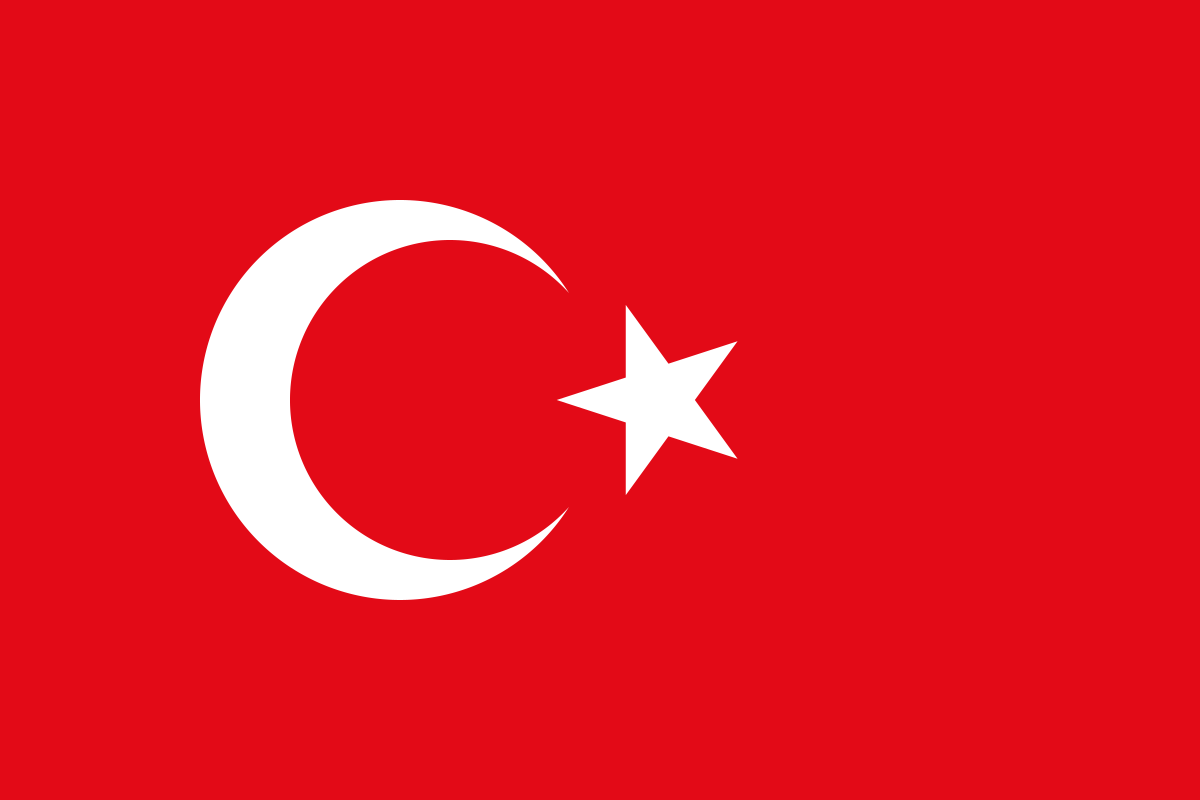
Turquía
Capital
Ankara 👑
Continente
Europa & Asia
Huso Horario
TRT · Europe/Istanbul
Coordenadas
39.93°N, 32.86°E
Moneda
TRY (₺)
Prefijo Telefónico
+90
Sentido de Circulación
Derecha
Hemisferio
Norte
Idioma
Turco
Sistema de Medición
Métrico
¿Sabías Que?
La ciudad regaló sus cabras y conservó su reloj
La cabra de Angora toma su nombre de Ankara, que hasta 1930 se llamaba Angora. Al igual que el mohair, la fibra que produce. Las cabras blancas con largos rizos han pastado en las mesetas que rodean la ciudad durante al menos dos mil años, y los viajeros europeos escribían sobre ellas desde la década de 1550.
Durante siglos, el Estado otomano restringió sus exportaciones porque merecía la pena proteger el monopolio.
No se mantuvo.
En 1838, el sultán Mahmud II envió doce machos y una hembra a Sudáfrica. Los machos fueron castrados deliberadamente para que no se pudiera establecer ninguna manada rival. Fue una precaución razonable y fracasó. En 1849, el sultán Abdülmecid I regaló siete ciervos y dos dólares a un asesor estadounidense: la primera importación a Estados Unidos. Siguieron otros envíos, unas seiscientas o setecientas cabezas en total, con grandes envíos finales desde Sudáfrica de 148 cabras en 1904 y 117 dólares en 1925.
En la década de 1960, Estados Unidos tenía más de cinco millones de cabras de Angora, y más del 90% del mohair estadounidense se producía en Texas. Sudáfrica ahora posee aproximadamente una cuarta parte de las cabras de Angora del mundo y ha superado a Estados Unidos en producción.
Los relatos académicos turcos describen el resultado claramente: Anatolia, la cuna de la raza, perdió su posición en una industria que lleva el nombre de su capital.
El reloj: y en el mismo siglo, Ankara le dio al país algo a lo que nunca ha renunciado.
El 26 de diciembre de 1925, la Gran Asamblea Nacional de Ankara aprobó la Ley 697, aboliendo el sistema otomano alaturka (en el que el día comenzaba al atardecer y todos los relojes del país debían corregirse cada pocos días) y adoptando el reloj internacional de 24 horas a partir del 1 de enero de 1926.
Estambul vivió las consecuencias; las salas de cronometraje de su mezquita, las muvakkithanes, no se cerraron formalmente hasta 1952. Pero la decisión se tomó aquí.
Ankara se encuentra aproximadamente a 33° este, en UTC+3, una zona construida para el meridiano 45, lo que deja a la ciudad aproximadamente 48 minutos por delante de su propio sol. Desde 2016, Türkiye se ha mantenido en esa compensación de forma permanente, sin ningún cambio estacional.
La ciudad cambió de nombre en 1930. El mundo todavía llama a la cabra Angora.
Fuentes
- Goat Journal, * Perfil de raza de cabras de Angora (117 machos cabríos)
- Britannica, *cabra de angora* (Origen cerca de Ankara; introducida en Europa a mediados del siglo XVI)
- Ronan Country Fibers (más de 5 millones de cabras en los EE. UU. en la década de 1960; más del 90% de participación en Texas; 1,8 millones en 1992, menos de 200.000 en 2009)
- El Rajasthan Express (~23% de las cabras de Angora del mundo se encuentran en Sudáfrica; nombre anterior a 1930 "Angora"; registro de 1555 de Pierre Belon)
- Revista DTCF de la Universidad de Ankara, *Las cabras de Angora en la historia (1765-1908)* (Pérdida del monopolio turco y pérdida de superioridad de Anatolia)
- Ley N° 697, de 26 de diciembre de 1925, entró en vigor el 1 de enero de 1926
- Cálculo de longitud: Ankara 32,85°E, UTC+3 meridiano 45°E
Luz diurna a lo largo del año en Ankara
El sol y el reloj en Ankara (2026)
Ankara se encuentra a 32.9°E. Su zona horaria, UTC+3, se basa en el meridiano 45°E. La diferencia de 12.1° entre ambos hace que el reloj vaya unos 49 minutos adelantado respecto al sol: el mediodía solar llega hacia las 12:49 y no a las 12:00. La zona mantiene UTC+3 todo el año: aquí no hay horario de verano.
El día más largo de 2026 es el 22 de junio, con 15 h 1 min de luz. El más corto es el 22 de diciembre, con 9 h 20 min. La diferencia entre ambos es de 5 h 41 min. Es la franja de latitud donde más se nota la diferencia entre las tardes de verano y las de invierno.
El amanecer más temprano y el atardecer más tardío no coinciden con el día más largo. En Ankara el sol sale más temprano el 15 de junio, a las 05:19, mientras que el atardecer más tardío llega el 29 de junio, a las 20:21. Los separa la ecuación del tiempo: la órbita elíptica de la Tierra y la inclinación de su eje adelantan y retrasan el mediodía solar varios minutos a lo largo del año.
El cielo sigue claro un rato después de la puesta de sol. En Ankara ese crepúsculo civil dura unos 27 minutos en el equinoccio, y llega a 33 minutos en el solsticio.
Todas las cifras de esta sección se calculan a partir de la latitud, la longitud y la zona horaria IANA de la ciudad con los algoritmos solares de la NOAA (Spencer, 1971), con una precisión de unos ±2 minutos de arco por debajo de 65° de latitud.
Horario laboral en Ankara
9h de coincidenciaMisma zona horaria que tu ubicación.