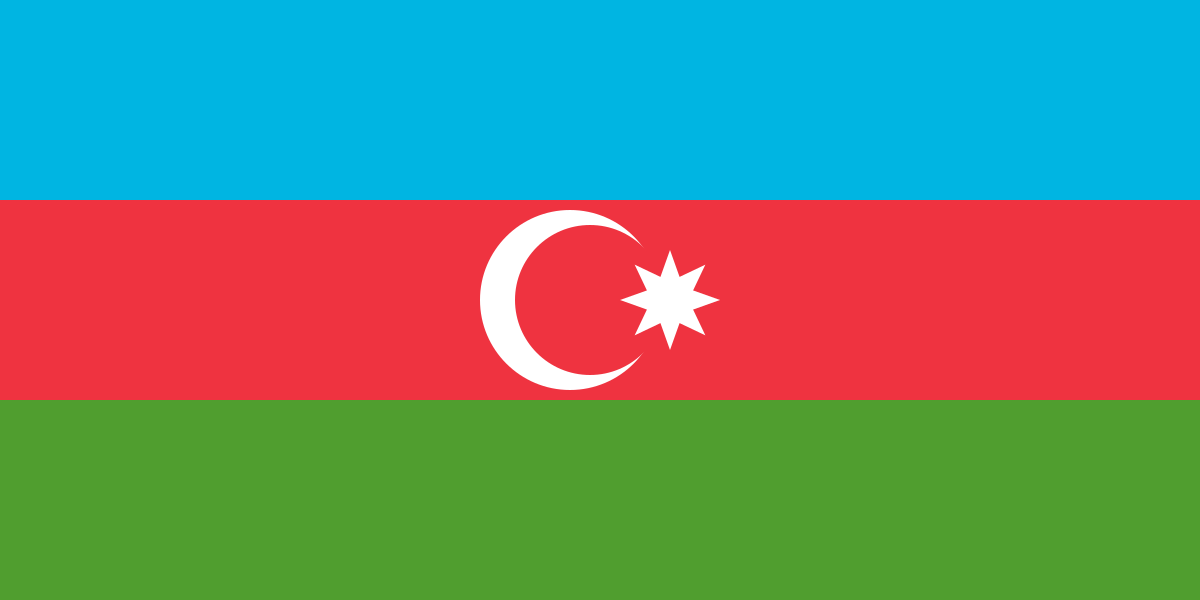
Did You Know?
Near Baku, a Hillside That Will Not Stop Burning
On the Absheron Peninsula, just outside Baku, there is a hillside called Yanar Dağ — "burning mountain." Flames up to three metres high come out of a thin layer of porous rock and do not go out. They are fed by a steady seep of natural gas from below, and no one is sure how long they have been burning: some local accounts say a shepherd set the gas alight by accident in the 1950s, others that the fire is ancient. Marco Polo wrote about flames coming out of the ground in this region in the thirteenth century.
Azerbaijan is called the Land of Fire for a reason, and the fires are old enough that they are generally thought to be connected to the development of Zoroastrianism, whose ceremonies were built around sacred flames.
The country also has more mud volcanoes than anywhere on Earth. Counts vary depending on what you include — official Azerbaijani sources say over 220, international estimates run to 400 or more — but every source agrees the country holds roughly half the world's total. There are another 140-odd on the floor of the Caspian, and eight islands in the Baku archipelago were created by mud volcanic eruptions.
Unlike ordinary volcanoes these are cool to the touch, around 22°C, because there is no magma involved. They still erupt spectacularly: in 2001 the Lokbatan volcano, fifteen kilometres from Baku, sent flames tens of metres into the air.
All of this is surface evidence of what is underneath, which is oil. In 1901, Azerbaijan produced 11.5 million tons of it — about 51% of the entire world's supply. Half the planet's oil came out of one corner of the Caspian.
The clock: Baku's own name is thought to come from the Persian bad-kube, "wind-pounded city," which tells you what the weather does. Its clock is more settled. Azerbaijan runs on UTC+4, a zone built for the 60th meridian, while Baku sits at just under 50° east — so the city runs about forty minutes ahead of its own sun, permanently.
There is something appropriate about that. On a peninsula where the ground keeps its own flame without reference to anybody's schedule, the clock on the wall is forty minutes out and nobody minds.
Sources
- Wikipedia, *Yanar Dagh* (10-foot flames, porous sandstone)
- Wikipedia, *Mud volcanoes in Azerbaijan* (about half of the world total)
- CNN, *Azerbaijan, mud volcano capital of the world* (more than 400; 2001 Lokbatan eruption; 22–23°C)
- azerbaijan.az official page (more than 220; 140 submarine (underwater) mud volcanoes; eight islands)
- Rustic Pathways (11.5 million tons in 1901 = 51% of world output)
- Komoot/Wikipedia (13th century record by Marco Polo)