Did You Know?A City Where Every Building Must Wear the Same StoneRead more →

Current local time in Jerusalem

Sponsor this page →
03:00:00
1 October 2026ThursdayThursday, 1 October 2026
Calling Code +972
Compare another city →
Embed clock

Time difference from Jerusalem

Compare any city →
CITYLOCAL TIMEDifferenceComing up
London
United Kingdom
01:00−2hBecomes −1h on 25 Oct
Berlin
Germany
02:00−1hBecomes ±0h on 25 Oct
Dubai
UAE
04:00+1hBecomes +2h on 25 Oct
Tokyo
Japan
09:00+6hBecomes +7h on 25 Oct
Sydney
Australia
10:00+7hBecomes +8h on 4 Oct
New York
United States
20:00Wed−7hBecomes −6h on 24 Oct
Los Angeles
United States
17:00Wed−10hBecomes −9h on 24 Oct
AD

Sun & moon in Jerusalem today

Sunrise
06:32
Sunset
18:26
Daylight
11.9hrs
Next full moon
26 Oct
Hunter's Moon

Annual daylight in Jerusalem

J10.3 hrsF11 hrsM11.9 hrsA12.9 hrsM13.8 hrsJ14.2 hrsJ14 hrsA13.3 hrsS12.4 hrsO11.4 hrsN10.6 hrsD10.1 hrs

Working hours in Jerusalem

6h overlap
JerusalemUTC+3
06121824
Your locationUTC+0
06121824
Open the meeting planner →

Time zone guide for Jerusalem

Jerusalem, Israel runs on UTC+3. Clocks move forward each spring and back each autumn: UTC+2 in winter, UTC+3 in summer. Next change: 25 Oct. The time difference between Jerusalem and New York is 7 hours. Standard 9-to-6 working hours overlap for about 2 hours a day with New York. A good time to connect: 16:00–18:00 in Jerusalem lines up with 09:00–11:00 in New York. The time difference between Jerusalem and London is 2 hours. Standard 9-to-6 working hours overlap for about 7 hours a day with London. A good time to connect: 11:00–18:00 in Jerusalem lines up with 09:00–16:00 in London. The time difference between Jerusalem and Tokyo is 6 hours. Standard 9-to-6 working hours overlap for about 3 hours a day with Tokyo. A good time to connect: 09:00–12:00 in Jerusalem lines up with 15:00–18:00 in Tokyo. This timezone is also shared with cities such as Athens, Cairo, Beirut. Keeping these offsets in mind makes it easier to schedule calls or travel to and from Jerusalem.

Practical information for Jerusalem

Jerusalem (Israel) is home to roughly 950K people. Today brings about 11.9 hours of daylight: sunrise at 06:32, sunset at 18:26. Clocks move forward each spring and back each autumn: UTC+2 in winter, UTC+3 in summer. Next change: 25 Oct. It sits in the Northern Hemisphere, about 32° north of the equator. Traffic drives on the right.

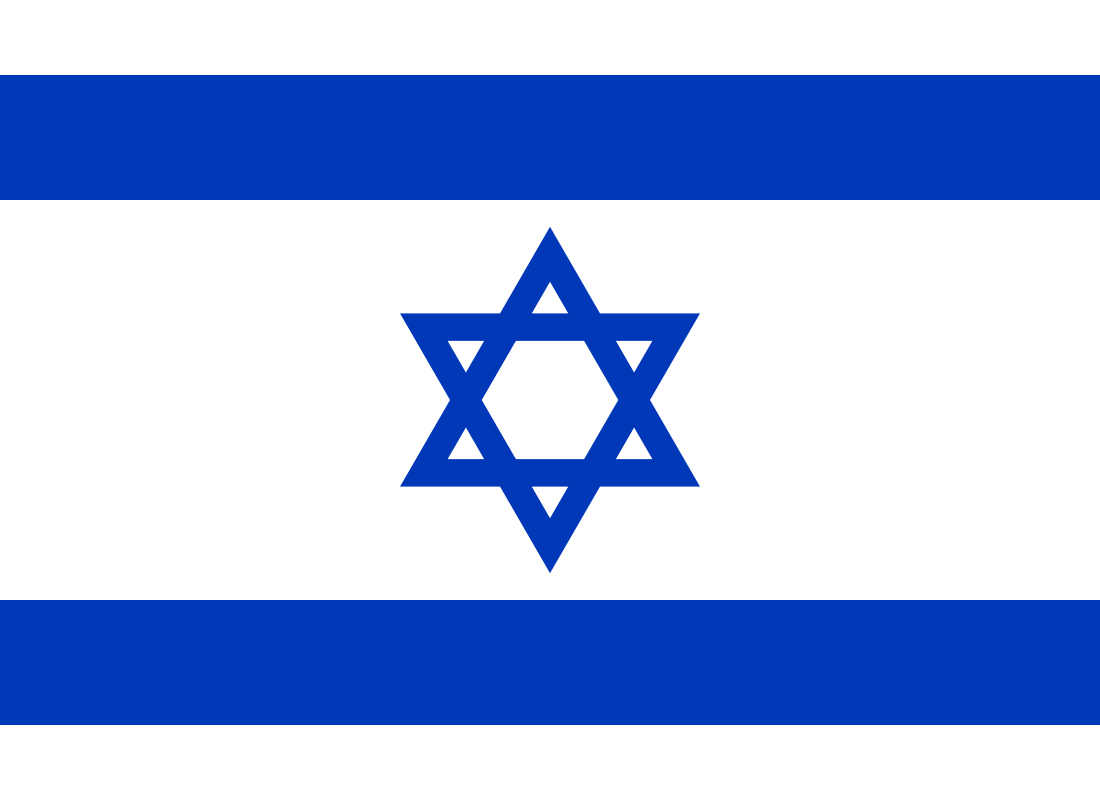
Flag

Israel

Israel

Capital

Jerusalem 👑

Continent

Asia

Time Zone

UTC+3 · Asia/Jerusalem

Coordinates

31.77°N, 35.21°E

Currency

ILS (₪)

Calling Code

+972

Driving Side

Right

Hemisphere

Northern

Language

Hebrew, Arabic

Measurement System

Metric

Did You Know?

A City Where Every Building Must Wear the Same Stone

In 1918, Ronald Storrs — then the British military governor of Jerusalem — issued a bylaw requiring that buildings in the city be faced with local limestone. It formed part of a master plan drawn up by Sir William McLean, at the time city engineer of Alexandria, with input from the Arts and Crafts architect C. R. Ashbee.

The rule outlived the administration that made it. It has been carried forward by every subsequent authority and remains in municipal law today.

The material is a family of pale limestones and dolomites quarried from the Judean Hills, formed in the Late Cretaceous. The archetypal variety is meleke, a white limestone that cuts cleanly into large blocks and has been used since antiquity — the Western Wall is built of it. When low sun strikes the cream and pink facades, the whole city takes on the golden cast behind the phrase Jerusalem of Gold.

The regulation has been amended repeatedly. The 1936 ordinance required that external walls be constructed of stone. The 1944 master plan required only that external walls, columns and any wall facing a road be faced with natural square-dressed stone — which reduced stone from structure to cladding, largely because reinforced concrete had become cheap and available.

It is still applied. The National Library of Israel, completed in 2023 to a design by Herzog & de Meuron, is clad in it. As of 2000, there were around 650 stone-cutting enterprises operating in the West Bank, producing pink, sand, gold and off-white stone.

Over a century, across several changes of administration, one rule about what the outside of a building must look like has held.

The clock: the question of when the hour changes has held less consistently.

Israel and the Palestinian territories both use UTC+2 in winter and UTC+3 in summer, under different names — Israel Standard Time and Israel Daylight Time on one side, Eastern European Time and Eastern European Summer Time on the other.

The dates have often differed.

Until 2013, Israeli standard time resumed on the Saturday night before Yom Kippur, so that the fast — which is set by nightfall — would both begin and end an hour earlier. Because the Hebrew calendar is lunisolar, Yom Kippur can fall anywhere from mid-September to mid-October, which meant Israel sometimes returned to standard time up to six weeks before most other countries. The date became a recurring subject of coalition negotiation. In 2013 the Knesset fixed the period to run from the Friday before the last Sunday in March to the last Sunday in October, close to Europe's dates.

The Palestinian territories set their own dates. In 2021 they ended daylight saving on 29 October, two days before Israel. In 2023 Palestine delayed summer time until after Ramadan, leaving the two an hour apart for about five weeks. And in 2011, the West Bank and Gaza ran on different times from each other, after the authorities in Ramallah moved the clocks following Ramadan and the authorities in Gaza did not follow.

A city where the law has been unambiguous for over a hundred years about what every wall must be made of, and where the answer to what time it is has sometimes depended on which office issued the notice.

Sources
  • Wikipedia, *Jerusalem stone* (Storrs ordinance passed in 1918; continued in municipal legislation)
  • MDPI *Heritage* magazine (2025), *The Lithic Journey of Jerusalem Stone* (1918 "Stone Decree"; banning materials such as plaster and tin; spread from the Old City to the whole city)
  • New Criterion (featuring McLean and Ashbee; covering by the National Library of Israel)
  • Areej Ashhab, *Mason Narrating Stone* (1936 decree's "construction" requirement; 1944 plan's reduction to "covering"; effect of reinforced concrete)
  • Wikipedia, *Jerusalem stone* and *National Library of Israel* (meleke; Late Cretaceous Turonian formation; design by Herzog & de Meuron in 2023)
  • Alchetron (650 stone-cutting operations in the West Bank in 2000; origin of the phrase "Golden Jerusalem")
  • The Times of Israel (2013 Knesset law; date tied to Yom Kippur before; up to six weeks difference due to lunisolar calendar; an hour apart for about five weeks in spring 2023)
  • Wikipedia, *Israel Summer Time* (coalition negotiations)
  • timeanddate.com (In 2021, Palestine ends on October 29 and Israel ends on October 31; in 2011, the separation of the West Bank and Gaza; in 2013, they start on the same date)

The sun and the clock in Jerusalem (2026)

Solar noon11:39on UTC+2 standard time
Longest day14h 14m22 June
Shortest day10h 4m22 December
Yearly average12h 10mof daylight a day
Earliest sunrise05:3312 June
Latest sunset19:491 July

Jerusalem lies at 35.2°E. Its time zone, UTC+2, is built around the 30°E meridian. The 5.2° gap between them means the clock runs roughly 21 minutes behind the sun: solar noon arrives at about 11:39 rather than 12:00. Under daylight saving the clocks move 60 minutes forward, widening the gap to 39 minutes and pushing solar noon to 12:39.

The longest day of 2026 is 22 June, with 14h 14m of daylight. The shortest is 22 December, with 10h 4m. The swing between them is 4h 9m. At this latitude the seasons are visible in the clock, but never dramatic.

The earliest sunrise and the latest sunset do not land on the longest day. In Jerusalem the sun comes up earliest on 12 June at 05:33, while the latest sunset waits until 1 July at 19:49. The equation of time is what separates them: the Earth's elliptical orbit and axial tilt move solar noon back and forth by several minutes over the year.

The sky stays usably light for a while after the sun goes down. In Jerusalem that civil twilight runs about 24 minutes at the equinox.

Every figure in this section is computed from the city's own latitude, longitude and IANA time zone using NOAA solar algorithms (Spencer, 1971), accurate to about ±2 arcminutes below 65° latitude.

Frequently asked questions

What is the current time and timezone in Jerusalem?

The official timezone for Jerusalem, Israel is Asia/Jerusalem with a current UTC offset of UTC+3.

What is the population and location of Jerusalem?

Jerusalem has an estimated population of 950K and is located at coordinates 31.77°N, 35.21°E. It is the capital city of Israel.

How many hours of daylight does Jerusalem get?

Jerusalem gets 14h 14m of daylight on its longest day and 10h 4m on its shortest, averaging 12h 10m a day across the year.

What time is solar noon in Jerusalem?

Solar noon in Jerusalem falls at about 11:39 on UTC+2 standard time, because the city sits 5.2° from the meridian its zone is built on.

What is an interesting fact or statistic about Jerusalem?

A City Where Every Building Must Wear the Same Stone: In 1918, Ronald Storrs — then the British military governor of Jerusalem — issued a bylaw requiring that buildings in the city be faced with local limestone.