카불
UTC+4:30아프가니스탄 · AFT
2026년 9월 22일 (화)
시간대 분석 & 주요 사실
아프가니스탄의 카불 현지 시각은 현재 UTC+4:30 표준시입니다. 이 시간대는 일년 내내 고정(UTC+4:30)되어 있으며 서머타임을 적용하지 않습니다. 카불보다 뉴욕시간 빠릅니다. 뉴욕와(과)의 업무 시간 겹침은 하루 0.5시간(undefined)입니다. 글로벌 협업을 위한 최적의 화상 회의 시간대는 카불입니다. 카불보다 런던시간 빠릅니다. 런던와(과)의 업무 시간 겹침은 하루 5.5시간(undefined)입니다. 글로벌 협업을 위한 최적의 화상 회의 시간대는 카불입니다. 카불보다 도쿄시간 빠릅니다. 도쿄와(과)의 업무 시간 겹침은 하루 4.5시간(undefined)입니다. 글로벌 협업을 위한 최적의 화상 회의 시간대는 카불입니다. WorldClock.info는 공식 IANA 데이터베이스를 기반으로 정확한 시간을 제공합니다.
도시 기본 정보
아프가니스탄 카불의 추정 인구는 약 4.4M입니다. 오늘의 일조 시간은 약 14.5시간입니다 (일출: 04:42, 일몰: 19:12). 이 시간대는 일년 내내 고정(UTC+4:30)되어 있으며 서머타임을 적용하지 않습니다. 북반구, 적도 북쪽 약 35°에 위치합니다. 차량은 우측 통행입니다.
국기
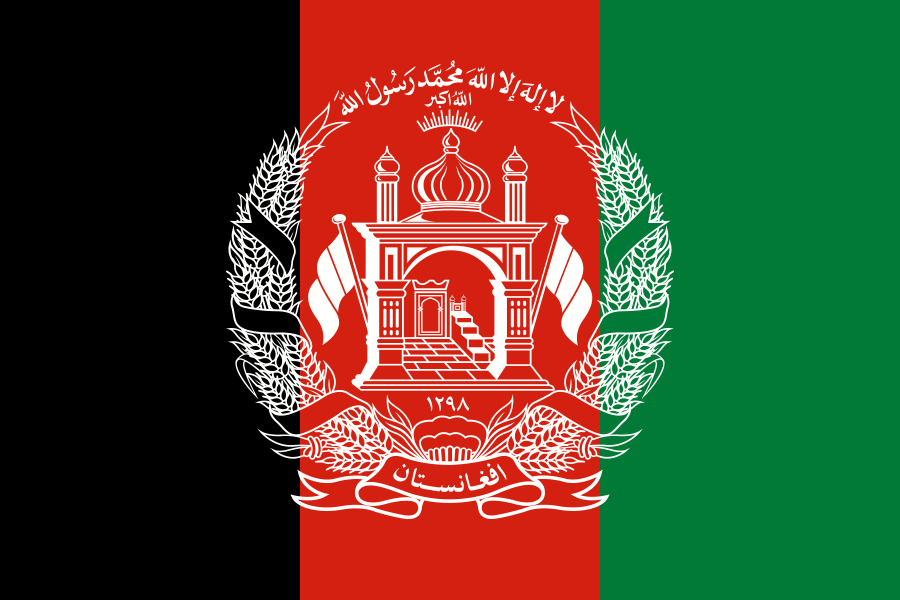
아프가니스탄
수도
카불 👑
대륙
아시아
시간대
AFT · Asia/Kabul
좌표
34.56°N, 69.21°E
통화
AFN (؋)
국가 번호
+93
통행 방향
우측
반구
북반구
공용어
파슈토어, 다리어
측량 단위
미터법
알고 계셨나요?
Afghanistan's Odd-Looking Time Zone Is One of the Most Accurate on Earth
The blue in Tutankhamun's funeral mask came from Afghanistan.
Specifically from Sar-e-Sang, a valley in Badakhshan province where lapis lazuli has been hand-dug out of a mountainside at nearly 3,000 metres. Mining there is archaeologically documented to at least 4,000 BCE — roughly six thousand years of more or less continuous operation, which makes it one of the oldest working mine sites known anywhere.
Isotopic fingerprinting has traced Sar-e-Sang stone to predynastic Egyptian burials, to the Royal Cemetery at Ur around 2600–2400 BCE, and to Tutankhamun's tomb — about five thousand kilometres from the mine, carried by land.
Then it happened again, two thousand years later. Ground lapis produces ultramarine, which was for centuries the most expensive pigment in Europe — at times worth more than gold. The name means "from beyond the sea." Renaissance contracts specified where it was to be used, and it was reserved for the most important passage in an altarpiece, usually the Virgin's mantle. The blue in those paintings came out of the same Afghan valley.
Marco Polo passed nearby and reported "the finest azure in the world is found" in a mountain there.
Six thousand years of one colour, out of one valley, in a country that would later choose its national clock by picking the meridian that ran through its own middle.
Afghanistan runs on UTC+4:30 — Afghanistan Time, AFT — for the whole country, all year. It has never observed daylight saving time.
On a world map that half hour looks like an eccentricity. It puts Kabul thirty minutes behind Pakistan, an hour and a half behind India, and an hour ahead of Iran. Anyone scheduling a call across the region has to remember it, and calendar software regularly gets it wrong.
But look at what it is actually doing.
The zone is calculated from a reference meridian of about 67°30′ east, running through the middle of the country. Kabul itself sits at about 69° east. The gap between the two is small enough that Kabul's clock is within roughly seven minutes of its own solar noon.
That is more accurate than almost every city on this site.
Afghanistan spans about 60° to 75° east — nearly two full geographical time zones — and covers all of it with one clock. A whole-hour zone would have been available: UTC+4 or UTC+5. Either would have left the capital more than twenty minutes out. The country picked the offset in between, which fits.
The clock: the calendar follows the same principle.
Afghanistan's official civil calendar is the Solar Hijri, the same system used in Iran — a calendar tied not to a formula but to the astronomical moment of the vernal equinox, with the new year, Nowruz, beginning at the equinox itself.
So Afghanistan uses a solar calendar anchored to an observed astronomical event, and a time zone chosen to match its own meridian rather than a convenient round number.
Two decisions, decades apart, in a country that has had very little continuity of anything else. Both of them chose accuracy over convenience.
출처 및 참고자료
- Wikipedia, *Sar-i Sang* (Badakhşan'daki konum; Ur Kral Hazinesi ve Tutankamun mezarındaki lapisin kaynağı)
- SkyJems Ansiklopedisi (MÖ 4.000'e tarihlenen arkeolojik kayıt; izotopik köken analizi; Ur Kral Mezarlığı MÖ 2600-2400; Rönesans sözleşmelerinde Meryem'in pelerini için şart koşulması; ~3.000 m rakım)
- Gondwana Talks (Mısır'a ~5.000 km mesafe; ultramarin'in "denizin ötesinden" anlamı)
- Pala International / Peter Bancroft (Marco Polo alıntısı; Kokça Vadisi)
- Grokipedia, *Time in Afghanistan* (67,5°D referans meridyeni; ülkenin 60°–75°D arası uzanımı; Güneş Hicri takvimi; Nevruz)
- General Blue, *Afghanistan Time* (AFT; yaz saati uygulanmaması)
- timezone.io (tek ulusal dilim, bölgesel istisna yok)
- timeanddate.com (2020–2029 arası hiçbir saat değişikliği olmaması)
- Boylam hesabı: Kabil 69,2°D, dilim meridyeni 67,5°D → ~7 dakika
연간 일조 시간
업무 시간
7.5시간 겹침