Did You Know?Afghanistan's Odd-Looking Time Zone Is One of the Most Accurate on EarthRead more →

Current local time in Kabul

Sponsor this page →
04:30:00
1 October 2026ThursdayThursday, 1 October 2026
Calling Code +93
Compare another city →
Embed clock

Time difference from Kabul

Compare any city →
CITYLOCAL TIMEDifferenceComing up
London
United Kingdom
01:00−3:30Becomes −4:30 on 25 Oct
Berlin
Germany
02:00−2:30Becomes −3:30 on 25 Oct
Dubai
UAE
04:00−0:30
Tokyo
Japan
09:00+4:30
Sydney
Australia
10:00+5:30Becomes +6:30 on 4 Oct
New York
United States
20:00Wed−8:30Becomes −9:30 on 1 Nov
Los Angeles
United States
17:00Wed−11:30Becomes −12:30 on 1 Nov
AD

Sun & moon in Kabul today

Sunrise
05:47
Sunset
17:39
Daylight
11.9hrs
Next full moon
26 Oct
Hunter's Moon

Annual daylight in Kabul

J10.1 hrsF10.9 hrsM11.9 hrsA13 hrsM13.9 hrsJ14.5 hrsJ14.3 hrsA13.5 hrsS12.4 hrsO11.4 hrsN10.4 hrsD9.9 hrs

Working hours in Kabul

4h 30m overlap
KabulUTC+4:30
06121824
Your locationUTC+0
06121824
Open the meeting planner →

Time zone guide for Kabul

Kabul, Afghanistan runs on UTC+4:30. This time zone stays fixed year-round at UTC+4:30 — daylight saving time is not observed. The time difference between Kabul and New York is 8 hours and 30 minutes. Standard 9-to-6 working hours overlap for about 30 minutes a day with New York. A good time to connect: 17:30–18:00 in Kabul lines up with 09:00–09:30 in New York. The time difference between Kabul and London is 3 hours and 30 minutes. Standard 9-to-6 working hours overlap for about 5 hours and 30 minutes a day with London. A good time to connect: 12:30–18:00 in Kabul lines up with 09:00–14:30 in London. The time difference between Kabul and Tokyo is 4 hours and 30 minutes. Standard 9-to-6 working hours overlap for about 4 hours and 30 minutes a day with Tokyo. A good time to connect: 09:00–13:30 in Kabul lines up with 13:30–18:00 in Tokyo. Keeping these offsets in mind makes it easier to schedule calls or travel to and from Kabul.

Practical information for Kabul

Kabul (Afghanistan) is home to roughly 4.4M people. Today brings about 11.9 hours of daylight: sunrise at 05:47, sunset at 17:39. This time zone stays fixed year-round at UTC+4:30 — daylight saving time is not observed. It sits in the Northern Hemisphere, about 35° north of the equator. Traffic drives on the right.

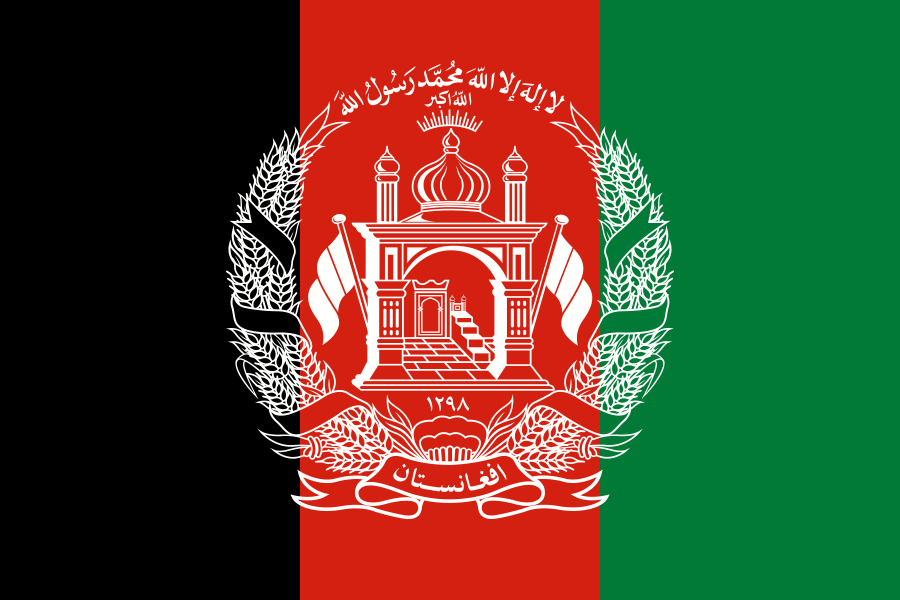
Flag

Afghanistan

Afghanistan

Capital

Kabul 👑

Continent

Asia

Time Zone

UTC+4:30 · Asia/Kabul

Coordinates

34.56°N, 69.21°E

Currency

AFN (؋)

Calling Code

+93

Driving Side

Right

Hemisphere

Northern

Language

Pashto, Dari

Measurement System

Metric

Did You Know?

Afghanistan's Odd-Looking Time Zone Is One of the Most Accurate on Earth

The blue in Tutankhamun's funeral mask came from Afghanistan.

Specifically from Sar-e-Sang, a valley in Badakhshan province where lapis lazuli has been hand-dug out of a mountainside at nearly 3,000 metres. Mining there is archaeologically documented to at least 4,000 BCE — roughly six thousand years of more or less continuous operation, which makes it one of the oldest working mine sites known anywhere.

Isotopic fingerprinting has traced Sar-e-Sang stone to predynastic Egyptian burials, to the Royal Cemetery at Ur around 2600–2400 BCE, and to Tutankhamun's tomb — about five thousand kilometres from the mine, carried by land.

Then it happened again, two thousand years later. Ground lapis produces ultramarine, which was for centuries the most expensive pigment in Europe — at times worth more than gold. The name means "from beyond the sea." Renaissance contracts specified where it was to be used, and it was reserved for the most important passage in an altarpiece, usually the Virgin's mantle. The blue in those paintings came out of the same Afghan valley.

Marco Polo passed nearby and reported "the finest azure in the world is found" in a mountain there.

Six thousand years of one colour, out of one valley, in a country that would later choose its national clock by picking the meridian that ran through its own middle.

Afghanistan runs on UTC+4:30 — Afghanistan Time, AFT — for the whole country, all year. It has never observed daylight saving time.

On a world map that half hour looks like an eccentricity. It puts Kabul thirty minutes behind Pakistan, an hour behind India, and an hour ahead of Iran. Anyone scheduling a call across the region has to remember it, and calendar software regularly gets it wrong.

But look at what it is actually doing.

The zone is calculated from a reference meridian of about 67°30′ east, running through the middle of the country. Kabul itself sits at about 69° east. The gap between the two is small enough that Kabul's clock is within roughly seven minutes of its own solar noon.

That is closer than about four in five cities on this site.

Afghanistan spans about 60° to 75° east — a full zone's width, straddling two geographical time zones — and covers all of it with one clock. A whole-hour zone would have been available: UTC+4 or UTC+5. Either would have left the capital more than twenty minutes out. The country picked the offset in between, which fits.

The clock: the calendar follows the same principle.

Afghanistan's traditional civil calendar is the Solar Hijri, the same system used in Iran — a calendar tied not to a formula but to the astronomical moment of the vernal equinox, with the new year, Nowruz, beginning at the equinox itself. Since 2022, however, the Taliban administration has used the lunar Hijri calendar for official business.

So Afghanistan long used a solar calendar anchored to an observed astronomical event, and a time zone chosen to match its own meridian rather than a convenient round number.

Two decisions, decades apart, in a country that has had very little continuity of anything else. Both of them chose accuracy over convenience.

Sources
  • Wikipedia, *Sar-i Sang* (Location in Badakhshan; source of lapis in the King's Treasury of Ur and Tutankhamun's tomb)
  • SkyJems Encyclopedia (archaeological record dating to 4,000 BC; isotopic provenance analysis; King's Tomb of Ur 2600-2400 BC; requirement for Mary's cloak in Renaissance charters; ~3,000 m altitude)
  • Gondwana Talks (~5,000 km from Egypt; ultramarine meaning "from beyond the sea")
  • Pala International / Peter Bancroft (Marco Polo quote; Kokcha Valley)
  • Wikipedia, *Solar Hijri calendar* and *List of extreme points of Afghanistan* (67.5°E reference meridian; country's extension between 60°–75°E; Solar Hijri calendar; Nowruz)
  • General Blue, *Afghanistan Time* (AFT; no daylight saving time)
  • timezone.io (single national zone, no regional exceptions)
  • timeanddate.com (no time changes between 2020–2029)
  • Longitude calculation: Kabul 69.2°E, slice meridian 67.5°E → ~7 minutes

The sun and the clock in Kabul (2026)

Solar noon11:53on UTC+4:30 standard time
Longest day14h 28m22 June
Shortest day9h 50m22 December
Yearly average12h 11mof daylight a day
Earliest sunrise04:4013 June
Latest sunset19:101 July

Kabul lies at 69.2°E. Its time zone, UTC+4:30, is built around the 67.5°E meridian. The 1.7° gap between them means the clock runs roughly 7 minutes behind the sun: solar noon arrives at about 11:53 rather than 12:00. The zone holds UTC+4:30 all year — there is no daylight saving here.

The longest day of 2026 is 22 June, with 14h 28m of daylight. The shortest is 22 December, with 9h 50m. The swing between them is 4h 38m. At this latitude the seasons are visible in the clock, but never dramatic.

The earliest sunrise and the latest sunset do not land on the longest day. In Kabul the sun comes up earliest on 13 June at 04:40, while the latest sunset waits until 1 July at 19:10. The equation of time is what separates them: the Earth's elliptical orbit and axial tilt move solar noon back and forth by several minutes over the year.

The sky stays usably light for a while after the sun goes down. In Kabul that civil twilight runs about 25 minutes at the equinox, stretching to 30 minutes at the solstice.

Every figure in this section is computed from the city's own latitude, longitude and IANA time zone using NOAA solar algorithms (Spencer, 1971), accurate to about ±2 arcminutes below 65° latitude.

Frequently asked questions

What is the current time and timezone in Kabul?

The official timezone for Kabul, Afghanistan is Asia/Kabul with a current UTC offset of UTC+4:30.

What is the population and location of Kabul?

Kabul has an estimated population of 4.4M and is located at coordinates 34.56°N, 69.21°E. It is the capital city of Afghanistan.

How many hours of daylight does Kabul get?

Kabul gets 14h 28m of daylight on its longest day and 9h 50m on its shortest, averaging 12h 11m a day across the year.

What time is solar noon in Kabul?

Solar noon in Kabul falls at about 11:53 on UTC+4:30 standard time, because the city sits 1.7° from the meridian its zone is built on.

What is an interesting fact or statistic about Kabul?

Afghanistan's Odd-Looking Time Zone Is One of the Most Accurate on Earth: The blue in Tutankhamun's funeral mask came from Afghanistan.