Did You Know?Honolulu, Measured in CansRead more →

Current local time in Honolulu

Sponsor this page →
14:00:00
30 September 2026WednesdayWednesday, 30 September 2026
Embed clock

Time difference from Honolulu

Compare any city →
CITYLOCAL TIMEDifferenceComing up
London
United Kingdom
01:00Thu+11hBecomes +10h on 25 Oct
Berlin
Germany
02:00Thu+12hBecomes +11h on 25 Oct
Dubai
UAE
04:00Thu+14h
Tokyo
Japan
09:00Thu+19h
Sydney
Australia
10:00Thu+20hBecomes +21h on 4 Oct
New York
United States
20:00+6hBecomes +5h on 1 Nov
Los Angeles
United States
17:00+3hBecomes +2h on 1 Nov
AD

Sun & moon in Honolulu today

Sunrise
06:22
Sunset
18:20
Daylight
12.0hrs
Next full moon
26 Oct
Hunter's Moon

Annual daylight in Honolulu

J11 hrsF11.4 hrsM12 hrsA12.6 hrsM13.1 hrsJ13.4 hrsJ13.3 hrsA12.9 hrsS12.3 hrsO11.7 hrsN11.1 hrsD10.8 hrs

Working hours in Honolulu

HonoluluUTC−10
06121824
Your locationUTC+0
06121824
Open the meeting planner →

Time zone guide for Honolulu

Honolulu, United States runs on UTC−10. This time zone stays fixed year-round at UTC−10 — daylight saving time is not observed. The time difference between Honolulu and New York is 6 hours. Standard 9-to-6 working hours overlap for about 3 hours a day with New York. A good time to connect: 09:00–12:00 in Honolulu lines up with 15:00–18:00 in New York. The time difference between Honolulu and London is 11 hours. Standard working hours don't overlap at all with London, so meetings need an early or late slot on one side. The time difference between Honolulu and Tokyo is 19 hours. Standard 9-to-6 working hours overlap for about 4 hours a day with Tokyo. A good time to connect: 14:00–18:00 in Honolulu lines up with 09:00–13:00 in Tokyo. This timezone is also shared with cities such as Papeete, Avarua, Bora Bora. Keeping these offsets in mind makes it easier to schedule calls or travel to and from Honolulu.

Practical information for Honolulu

Honolulu (United States) is home to roughly 1.0M people. Today brings about 12.0 hours of daylight: sunrise at 06:22, sunset at 18:20. This time zone stays fixed year-round at UTC−10 — daylight saving time is not observed. It sits in the Northern Hemisphere, about 21° north of the equator. Traffic drives on the right.

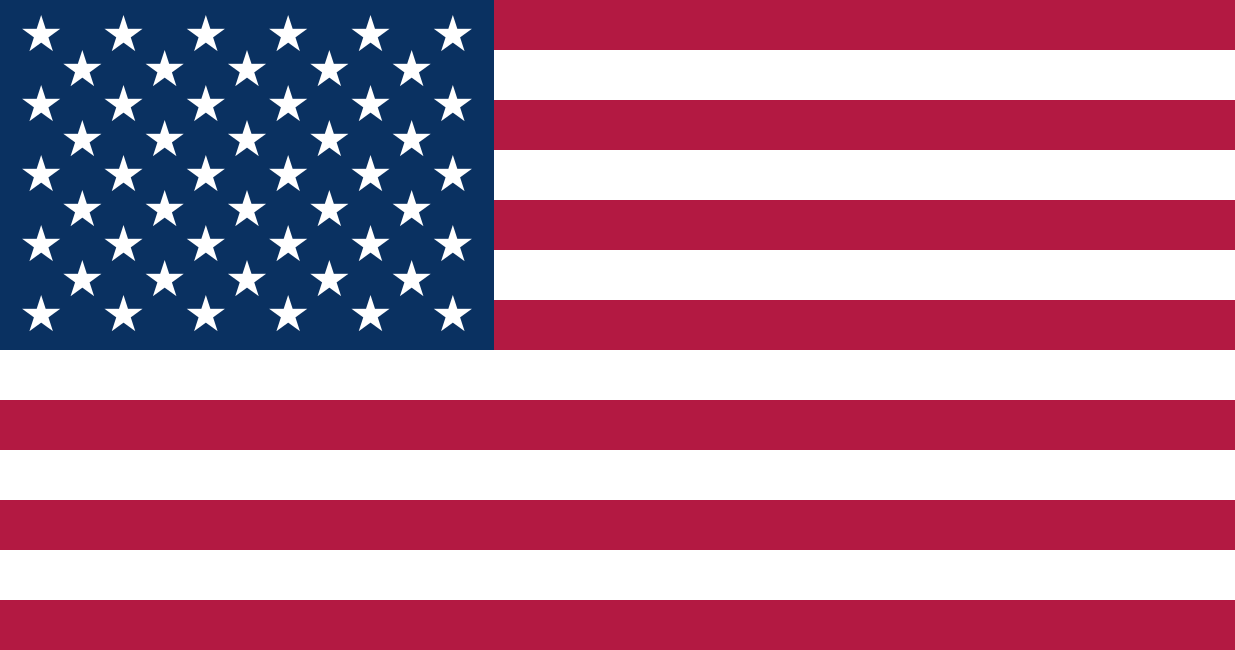
Flag

United States

United States

Capital

Washington DC

Continent

North America

Time Zone

HST · Pacific/Honolulu

Coordinates

21.31°N, 157.86°W

Currency

USD ($)

Calling Code

+1

Driving Side

Right

Hemisphere

Northern

Language

English

Measurement System

Imperial

Did You Know?

Honolulu, Measured in Cans

Hawaii gets through roughly seven million cans of Spam a year. Not ironically. Not as a novelty item. As a food group. That is about five cans for every resident, and if you prefer your absurdity by weight, it comes to somewhere around five million pounds of pressed pork annually — a figure National Geographic arrived at independently, which is how you know nobody is exaggerating.

Every single can of it crosses four thousand kilometres of open Pacific to get there.

That is the part worth sitting with. Honolulu is one of the most isolated population centres on Earth, roughly 2,400 miles from the mainland United States. An entire metropolis supplied across a distance that would comfortably cross a continent — and one of the things it has firmly decided is worth the freight is meat in a rectangle. Spam is also the single most requested item at Hawaii's food banks, which stops being funny about halfway through the sentence.

The clock: Hawaii opted out of daylight saving time in 1967 and has not touched a clock since. It sits at UTC−10, the furthest-behind time zone of any US state. When Tokyo is finishing Monday lunch, Honolulu is still somewhere in Sunday afternoon.

But the real reason Hawaii never needed daylight saving is simpler than politics. At 21° north, there is barely any seasonal daylight to save. The longest day of the year runs about 13 hours 26 minutes. The shortest runs about 10 hours 50 minutes. That is a swing of two and a half hours across an entire year — Anchorage swings by nearly fourteen. Honolulu doesn't adjust its clocks because the sun never gave it a reason to.

Sources
  • Hormel/SPAM official data (7M cans/year, ~5 cans per resident)
  • National Geographic, "How Spam Helped Shape Hawaii"
  • NBC News, Hormel statement (2023)
  • Uniform Time Act exemption (Hawaii does not observe DST)

The sun and the clock in Honolulu (2026)

Solar noon12:31on UTC−10 standard time
Longest day13h 26m22 June
Shortest day10h 50m22 December
Yearly average12h 9mof daylight a day
Earliest sunrise05:488 June
Latest sunset19:186 July

Honolulu lies at 157.9°W. Its time zone, UTC−10, is built around the 150°W meridian. The 7.9° gap between them means the clock runs roughly 31 minutes ahead of the sun: solar noon arrives at about 12:31 rather than 12:00. The zone holds UTC−10 all year — there is no daylight saving here.

The longest day of 2026 is 22 June, with 13h 26m of daylight. The shortest is 22 December, with 10h 50m. The swing between them is 2h 36m. Inside the tropics the day length stays within a narrow band all year.

The earliest sunrise and the latest sunset do not land on the longest day. In Honolulu the sun comes up earliest on 8 June at 05:48, while the latest sunset waits until 6 July at 19:18. The equation of time is what separates them: the Earth's elliptical orbit and axial tilt move solar noon back and forth by several minutes over the year.

The sky stays usably light for a while after the sun goes down. In Honolulu that civil twilight runs about 22 minutes at the equinox.

Every figure in this section is computed from the city's own latitude, longitude and IANA time zone using NOAA solar algorithms (Spencer, 1971), accurate to about ±2 arcminutes below 65° latitude.

Frequently asked questions

What is the current time and timezone in Honolulu?

The official timezone for Honolulu, United States is Pacific/Honolulu with a current UTC offset of UTC−10.

What is the population and location of Honolulu?

Honolulu has an estimated population of 1.0M and is located at coordinates 21.31°N, 157.86°W.

How many hours of daylight does Honolulu get?

Honolulu gets 13h 26m of daylight on its longest day and 10h 50m on its shortest, averaging 12h 9m a day across the year.

What time is solar noon in Honolulu?

Solar noon in Honolulu falls at about 12:31 on UTC−10 standard time, because the city sits 7.9° from the meridian its zone is built on.

What is an interesting fact or statistic about Honolulu?

Honolulu, Measured in Cans: Hawaii gets through roughly seven million cans of Spam a year. Not ironically. Not as a novelty item. As a food group.