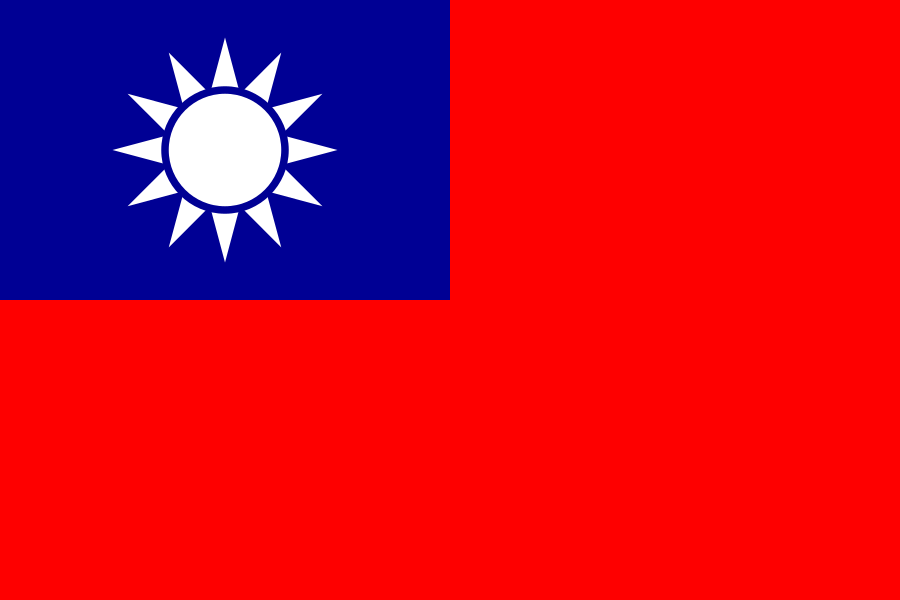
Did You Know?
In Taipei the Year Is 115
Taiwan has roughly 10,000 to 12,000 convenience stores for a population of 23 million — about one for every 2,000 to 2,500 people, among the highest densities in the world.
The average Taiwanese visits one 17 times a month. Once every two days.
In Taipei it is routine to see two 7-Elevens facing each other across a street, with a FamilyMart round the corner. The four main chains — 7-Eleven, FamilyMart, Hi-Life and OK Mart — cover the island so completely that only one township in Taiwan has neither a 7-Eleven nor a FamilyMart: Wuqiu, in Kinmen County, a small island that functions largely as a military base.
But the density is not really the point. What the stores do is.
At a Taiwanese convenience store counter, open 24 hours, you can pay your electricity bill, your water bill, your city parking fees, your credit card and your traffic fines. You can buy and top up an EasyCard for the metro. You can send and collect parcels, photocopy documents, and buy train and concert tickets. In 2020, 84% of Taiwanese named convenience stores their favourite offline shopping channel.
The state is reachable at three in the morning, from a shop that also sells instant noodles.
The clock: which is roughly how Taiwan handles its calendar too.
Taiwan's official calendar numbers its years from 1912, the founding of the Republic of China. That makes the Gregorian year 2026 the 115th year of the Republic — Minguo 115.
The conversion is simple: subtract 1911 from the Gregorian year.
Everything else is Gregorian. Same twelve months, same lengths, same leap years. Only the number at the end is different, and it appears on official documents, government forms and legal paperwork. The national standard for date formats, CNS 7648, explicitly permits either — so 3 May 2004 can correctly be written as either 2004-05-03 or ROC 93-05-03.
The idea comes from a very old habit. Chinese dynasties numbered years by the reigning emperor's era name and year of reign. When the Republic was founded there was no longer an emperor to count from, so the founding of the republic itself became the era. 民國 — Minguo, "the country of the people" — is a two-character abbreviation of 中華民國, because Chinese era names are traditionally two characters long.
Sun Yat-sen announced it by telegram, dating the message in the old style: the 13th day of the 11th month of the 4609th year of the Yellow Emperor's reign would be the first day of the first year of the Republic.
There is a coincidence here that nobody planned.
North Korea's Juche calendar also counts from 1912, because that is the year Kim Il-sung was born, although it was only adopted in 1997 and applied backwards. And Japan's Taishō era ran from 1912 to 1926. So for the fifteen years of the Taishō era, three completely unrelated national year-numbering systems in East Asia give each year the same number, for entirely different reasons.
1912 was a busy year for starting calendars.
Taipei runs on UTC+8, and sits at 121° east — which happens to be almost exactly the meridian that zone is built around. Taipei's clock is within a few minutes of its own solar noon, making it one of the best-aligned cities in this entire series.
Whatever else is disputed, the hour is not. It is the year that gets two answers.
Sources
- Statista (~12,000 convenience stores from five major operators at the end of 2020; second-highest concentration in the world after Korea; 7-Eleven's 47.9% market share; 84% choose convenience stores as their favorite channel)
- Taiwan Insights / Nielsen Taiwan (17 visits per person per month; one convenience store per 2,500 people)
- Mobility Plaza / Taiwan Ministry of Economy (one convenience store for every 2,304 people)
- Medium/Leila (bill payment, shipping and parking fee services; 7-Eleven and FamilyMart generating 96% of revenue in 2021)
- Alex Kunz Taipei (Wuqiu is the only township with neither a 7-Eleven nor a FamilyMart; one convenience store for every 625 people in Baoshan)
- taiwan.md (24 hours open; EasyCard and ibon services)
- Wikipedia, *Republic of China calendar* (2026 = Minguo 115; epoch 1912)
- Infogalactic / Calendar Wiki, *Minguo calendar* (CNS 7648 standard; Sun Yat-sen's telegram and Yellow Emperor dating; coincidence with Juche and Taishō)
- Alexander Lo, *Taiwan Cultural Insight: Minguo Calendar* (usage in official documents)
- Longitude calculation: Taipei 121.5°E, UTC+8 meridian 120°E