Did You Know?The City That Published the Date It Would Run Out of WaterRead more →

Current local time in Cape Town

Sponsor this page →
02:00:00
1 October 2026ThursdayThursday, 1 October 2026
Calling Code +27
Compare another city →
Embed clock

Time difference from Cape Town

Compare any city →
CITYLOCAL TIMEDifferenceComing up
London
United Kingdom
01:00−1hBecomes −2h on 25 Oct
Berlin
Germany
02:00±0hBecomes −1h on 25 Oct
Dubai
UAE
04:00+2h
Tokyo
Japan
09:00+7h
Sydney
Australia
10:00+8hBecomes +9h on 4 Oct
New York
United States
20:00Wed−6hBecomes −7h on 1 Nov
Los Angeles
United States
17:00Wed−9hBecomes −10h on 1 Nov
AD

Sun & moon in Cape Town today

Sunrise
06:24
Sunset
18:48
Daylight
12.4hrs
Next full moon
26 Oct
Hunter's Moon

Annual daylight in Cape Town

J14.2 hrsF13.3 hrsM12.4 hrsA11.3 hrsM10.4 hrsJ9.9 hrsJ10.1 hrsA10.8 hrsS11.8 hrsO12.9 hrsN13.9 hrsD14.4 hrs

Working hours in Cape Town

7h overlap
Cape TownUTC+2
06121824
Your locationUTC+0
06121824
Open the meeting planner →

Time zone guide for Cape Town

Cape Town, South Africa runs on UTC+2. This time zone stays fixed year-round at UTC+2 — daylight saving time is not observed. The time difference between Cape Town and New York is 6 hours. Standard 9-to-6 working hours overlap for about 3 hours a day with New York. A good time to connect: 15:00–18:00 in Cape Town lines up with 09:00–12:00 in New York. The time difference between Cape Town and London is 1 hour. Standard 9-to-6 working hours overlap for about 8 hours a day with London. A good time to connect: 10:00–18:00 in Cape Town lines up with 09:00–17:00 in London. The time difference between Cape Town and Tokyo is 7 hours. Standard 9-to-6 working hours overlap for about 2 hours a day with Tokyo. A good time to connect: 09:00–11:00 in Cape Town lines up with 16:00–18:00 in Tokyo. This timezone is also shared with cities such as Johannesburg, Windhoek, Tripoli. Keeping these offsets in mind makes it easier to schedule calls or travel to and from Cape Town.

Practical information for Cape Town

Cape Town (South Africa) is home to roughly 4.7M people. Today brings about 12.4 hours of daylight: sunrise at 06:24, sunset at 18:48. This time zone stays fixed year-round at UTC+2 — daylight saving time is not observed. It sits in the Southern Hemisphere, about 34° south of the equator. Traffic drives on the left.

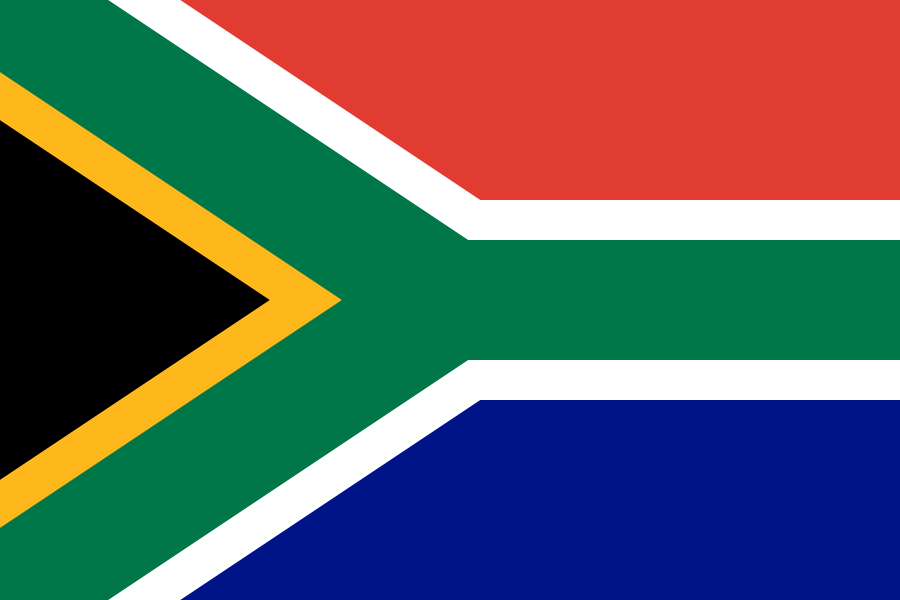
Flag

South Africa

South Africa

Capital

Pretoria

Continent

Africa

Time Zone

UTC+2 · Africa/Johannesburg

Coordinates

33.92°S, 18.42°E

Currency

ZAR (R)

Calling Code

+27

Driving Side

Left

Hemisphere

Southern

Language

English

Measurement System

Metric

Did You Know?

The City That Published the Date It Would Run Out of Water

1. In early 2018, Cape Town told four million people exactly which day the taps would be turned off.

They called it Day Zero. It was defined as the moment the city's dams fell to 13.5% of capacity — at which point municipal supply would be cut to hospitals and other critical services only, and everyone else would queue for water at 200 collection points.

After three consecutive years of poor rainfall, dam levels had fallen to 25% by late January 2018.

2. The ration was 25 litres a day. The target to avoid it was 50.

A typical urban resident uses around 200 litres a day. Cape Town asked its residents to live on 50 — the lowest target ever set during a drought anywhere, and in line with the WHO's minimum for maintaining health and safety. Under Day Zero itself, the figure would have dropped to 25 litres, collected by hand and carried home.

3. The city put a countdown on the motorway.

Electronic boards on the freeways, normally used for traffic information, displayed how many days of water the city had left. A public dashboard published weekly dam levels. A city-wide map let households compare their consumption with their neighbours'. The weekly water report became a topic on the radio and at dinner tables.

4. And then the date kept moving.

Day Zero was first projected for April. Then fixed at 12 April 2018. Then pushed to 11 May. Then to 4 June. Then to 9 July.

In June 2018 the region received average rainfall for the first time in four years, dam levels rose, and the city called Day Zero off indefinitely.

By then Capetonians had cut their water use by almost 60% from 2015 levels, giving the city one of the lowest per capita consumption rates of any major city in the world.

The clock: South Africa runs a single time zone, UTC+2, calculated for the 30th meridian east. Johannesburg sits close to that line and is only about eight minutes off its own solar noon.

Cape Town is at 18.4° east — nearly twelve degrees west of the 30th meridian — which leaves it roughly 46 minutes ahead of its own sun. Same country, same clock, a thirty-eight minute difference in what that clock actually means.

So: a city that scheduled its own catastrophe, published the date, watched it move four times, and then cancelled it — by getting four million people to use less than half the water they had used three years earlier.

Sources
  • Northeastern Global Resilience Institute (Dams reduced to 25% by the end of January 2018; Day Zero defined at 13.5% capacity; 25 liters per person at 200 distribution points; April 12, 2018)
  • ScienceDirect, Brühl & Visser (Target of 50 liters per person per day in the 2016-2018 drought — the lowest target ever set in a drought; compliance with WHO minimum)
  • Grist (number of remaining water days on electronic signs on highways; weekly dam reports; citywide consumption map; first average rainfall in four years in June 2018)
  • Princeton Successful Societies (approximately 60% decrease from 2015 levels; one of the lowest per capita consumption rates in the world)
  • AP/Fox News (date postponed from April 12 to May 11, June 4, and July 9)
  • National Geographic Education (population of four million; typical urban consumption is ~200 liters)
  • Longitude calculation: Cape Town 18.4°E and Johannesburg 28.0°E, UTC+2 meridian 30°E

The sun and the clock in Cape Town (2026)

Solar noon12:46on UTC+2 standard time
Longest day14h 25m22 December
Shortest day9h 53m22 June
Yearly average12h 6mof daylight a day
Earliest sunrise05:296 December
Latest sunset20:018 January

Cape Town lies at 18.4°E. Its time zone, UTC+2, is built around the 30°E meridian. The 11.6° gap between them means the clock runs roughly 46 minutes ahead of the sun: solar noon arrives at about 12:46 rather than 12:00. The zone holds UTC+2 all year — there is no daylight saving here.

The longest day of 2026 is 22 December, with 14h 25m of daylight. The shortest is 22 June, with 9h 53m. The swing between them is 4h 31m. At this latitude the seasons are visible in the clock, but never dramatic.

The earliest sunrise and the latest sunset do not land on the longest day. In Cape Town the sun comes up earliest on 6 December at 05:29, while the latest sunset waits until 8 January at 20:01. The equation of time is what separates them: the Earth's elliptical orbit and axial tilt move solar noon back and forth by several minutes over the year.

The sky stays usably light for a while after the sun goes down. In Cape Town that civil twilight runs about 25 minutes at the equinox.

Every figure in this section is computed from the city's own latitude, longitude and IANA time zone using NOAA solar algorithms (Spencer, 1971), accurate to about ±2 arcminutes below 65° latitude.

Frequently asked questions

What is the current time and timezone in Cape Town?

The official timezone for Cape Town, South Africa is Africa/Johannesburg with a current UTC offset of UTC+2.

What is the population and location of Cape Town?

Cape Town has an estimated population of 4.7M and is located at coordinates 33.92°S, 18.42°E.

How many hours of daylight does Cape Town get?

Cape Town gets 14h 25m of daylight on its longest day and 9h 53m on its shortest, averaging 12h 6m a day across the year.

What time is solar noon in Cape Town?

Solar noon in Cape Town falls at about 12:46 on UTC+2 standard time, because the city sits 11.6° from the meridian its zone is built on.

What is an interesting fact or statistic about Cape Town?

The City That Published the Date It Would Run Out of Water: 1. In early 2018, Cape Town told four million people exactly which day the taps would be turned off.