Did You Know?Singapore Has Used Six Different Time Zones in One CenturyRead more →

Current local time in Singapore

Sponsor this page →
08:00:00
1 October 2026ThursdayThursday, 1 October 2026
Calling Code +65
Compare another city →
Embed clock

Time difference from Singapore

Compare any city →
CITYLOCAL TIMEDifferenceComing up
London
United Kingdom
01:00−7hBecomes −8h on 25 Oct
Berlin
Germany
02:00−6hBecomes −7h on 25 Oct
Dubai
UAE
04:00−4h
Tokyo
Japan
09:00+1h
Sydney
Australia
10:00+2hBecomes +3h on 4 Oct
New York
United States
20:00Wed−12hBecomes −13h on 1 Nov
Los Angeles
United States
17:00Wed−15hBecomes −16h on 1 Nov
AD

Sun & moon in Singapore today

Sunrise
06:51
Sunset
18:57
Daylight
12.1hrs
Next full moon
26 Oct
Hunter's Moon

Annual daylight in Singapore

J12 hrsF12.1 hrsM12.1 hrsA12.1 hrsM12.2 hrsJ12.2 hrsJ12.2 hrsA12.2 hrsS12.1 hrsO12.1 hrsN12.1 hrsD12 hrs

Working hours in Singapore

1h overlap
SingaporeUTC+8
06121824
Your locationUTC+0
06121824
Open the meeting planner →

Time zone guide for Singapore

Singapore, Singapore runs on UTC+8. This time zone stays fixed year-round at UTC+8 — daylight saving time is not observed. The time difference between Singapore and New York is 12 hours. Standard working hours don't overlap at all with New York, so meetings need an early or late slot on one side. The time difference between Singapore and London is 7 hours. Standard 9-to-6 working hours overlap for about 2 hours a day with London. A good time to connect: 16:00–18:00 in Singapore lines up with 09:00–11:00 in London. The time difference between Singapore and Tokyo is 1 hour. Standard 9-to-6 working hours overlap for about 8 hours a day with Tokyo. A good time to connect: 09:00–17:00 in Singapore lines up with 10:00–18:00 in Tokyo. This timezone is also shared with cities such as Kuala Lumpur, Manila, Hong Kong. Keeping these offsets in mind makes it easier to schedule calls or travel to and from Singapore.

Practical information for Singapore

Singapore (Singapore) is home to roughly 5.9M people. Today brings about 12.1 hours of daylight: sunrise at 06:51, sunset at 18:57. This time zone stays fixed year-round at UTC+8 — daylight saving time is not observed. It sits in the Northern Hemisphere, about 1° north of the equator. Traffic drives on the left.

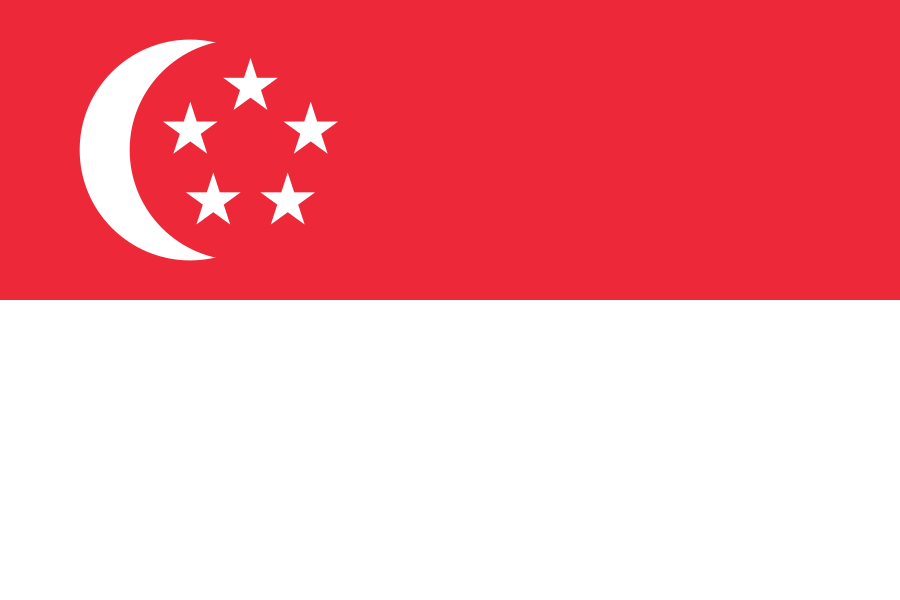
Flag

Singapore

Singapore

Capital

Singapore 👑

Continent

Asia

Time Zone

UTC+8 · Asia/Singapore

Coordinates

1.35°N, 103.82°E

Currency

SGD ($)

Calling Code

+65

Driving Side

Left

Hemisphere

Northern

Language

English, Malay, Mandarin, Tamil

Measurement System

Metric

Did You Know?

Singapore Has Used Six Different Time Zones in One Century

Most cities on this list have changed their clock once or twice. Singapore has done it six times.

  • Before June 1905: GMT+6:55:25 — Singapore mean time, calculated from the sun
  • June 1905 – December 1932: GMT+7:00
  • January 1933 – August 1941: GMT+7:20
  • September 1941 – February 1942: GMT+7:30
  • February 1942 – September 1945: GMT+9:00
  • September 1945 – December 1981: GMT+7:30
  • January 1982 – today: GMT+8:00

That fifth line is the Japanese Occupation. For three and a half years Singapore was moved onto Tokyo time, an hour and a half ahead of where it had been — because a time zone is a straightforward way of drawing an empire's borders through the day as well as across the map.

There is a small, human record of what that meant. In 1985, forty years after the Occupation ended, a reader wrote to a Singapore newspaper asking for help: they had been born during those years, their birth certificate recorded a time of 5:30 pm, and they wanted to know what time they had actually been born.

The clock: the last change is the one Singapore lives with now, and it was somebody else's decision.

On 31 December 1981, Malaysia unified its own two time zones by moving Peninsular Malaysia forward half an hour. Singapore followed suit at the same moment, citing business and travel schedules, and has been on UTC+8 ever since.

UTC+8 is built for the 120th meridian. Singapore sits at 104° east. The city therefore runs about sixty-five minutes ahead of its own sun — about the same gap as Istanbul's, and one of the larger ones on this list.

You can see it if you know to look. Singapore is almost exactly on the equator, where sunrise should be near six and sunset near six, all year, forever. Instead the sun comes up around seven and goes down around seven.

An equatorial city with the most predictable sky on Earth, running permanently an hour late, because of a decision taken in Kuala Lumpur that took effect on New Year's Eve 1981.

Sources
  • BiblioAsia (National Library of Singapore), *Daylight Robbery: Singapore's Shifting Time Zones* (full list of the seven zones and their dates; reader wrote to the paper in 1985)
  • Wikipedia, *Singapore Time* (1 January 1982 change; business and travel reason)
  • Longitude calculation: Singapore 103.8°E, UTC+8 meridian 120°E → ~65 minutes

The sun and the clock in Singapore (2026)

Solar noon13:05on UTC+8 standard time
Longest day12h 12m22 June
Shortest day12h 3m22 December
Yearly average12h 7mof daylight a day
Earliest sunrise06:4630 October
Latest sunset19:2116 February

Singapore lies at 103.8°E. Its time zone, UTC+8, is built around the 120°E meridian. The 16.2° gap between them means the clock runs roughly 65 minutes ahead of the sun: solar noon arrives at about 13:05 rather than 12:00. The zone holds UTC+8 all year — there is no daylight saving here.

The longest day of 2026 is 22 June, with 12h 12m of daylight. The shortest is 22 December, with 12h 3m. The swing between them is 9 minutes. Within a few degrees of the equator the length of the day barely moves all year.

The earliest sunrise and the latest sunset do not land on the longest day. In Singapore the sun comes up earliest on 30 October at 06:46, while the latest sunset waits until 16 February at 19:21. The equation of time is what separates them: the Earth's elliptical orbit and axial tilt move solar noon back and forth by several minutes over the year.

The sky stays usably light for a while after the sun goes down. In Singapore that civil twilight runs about 21 minutes at the equinox.

Every figure in this section is computed from the city's own latitude, longitude and IANA time zone using NOAA solar algorithms (Spencer, 1971), accurate to about ±2 arcminutes below 65° latitude.

Frequently asked questions

What is the current time and timezone in Singapore?

The official timezone for Singapore, Singapore is Asia/Singapore with a current UTC offset of UTC+8.

What is the population and location of Singapore?

Singapore has an estimated population of 5.9M and is located at coordinates 1.35°N, 103.82°E. It is the capital city of Singapore.

How many hours of daylight does Singapore get?

Singapore gets 12h 12m of daylight on its longest day and 12h 3m on its shortest, averaging 12h 7m a day across the year.

What time is solar noon in Singapore?

Solar noon in Singapore falls at about 13:05 on UTC+8 standard time, because the city sits 16.2° from the meridian its zone is built on.

What is an interesting fact or statistic about Singapore?

Singapore Has Used Six Different Time Zones in One Century: Most cities on this list have changed their clock once or twice. Singapore has done it six times.