Windhoek
UTC+2Namibia · CAT
Sun, 9 Aug 2026
Timezone Guide
Windhoek, Namibia runs on UTC+2. This time zone stays fixed year-round at UTC+2 — daylight saving time is not observed. There is a 6-hour difference between Windhoek and New York. Standard 9-to-6 working hours overlap for about 3 hours a day with New York. A good time to connect: 15:00–18:00 in Windhoek lines up with 09:00–12:00 in New York. There is a 1-hour difference between Windhoek and London. Standard 9-to-6 working hours overlap for about 8 hours a day with London. A good time to connect: 10:00–18:00 in Windhoek lines up with 09:00–17:00 in London. There is a 7-hour difference between Windhoek and Tokyo. Standard 9-to-6 working hours overlap for about 2 hours a day with Tokyo. A good time to connect: 09:00–11:00 in Windhoek lines up with 16:00–18:00 in Tokyo. This timezone is also shared with cities such as Madrid, Paris, Amsterdam. Keeping these offsets in mind makes it easier to schedule calls or travel to and from Windhoek.
Practical Info
Windhoek (Namibia) is home to roughly 430K people. Today brings about 10.6 hours of daylight: sunrise at 07:18, sunset at 17:54. This time zone stays fixed year-round at UTC+2 — daylight saving time is not observed. It sits in the Southern Hemisphere, about 23° south of the equator. Traffic drives on the left.
Flag
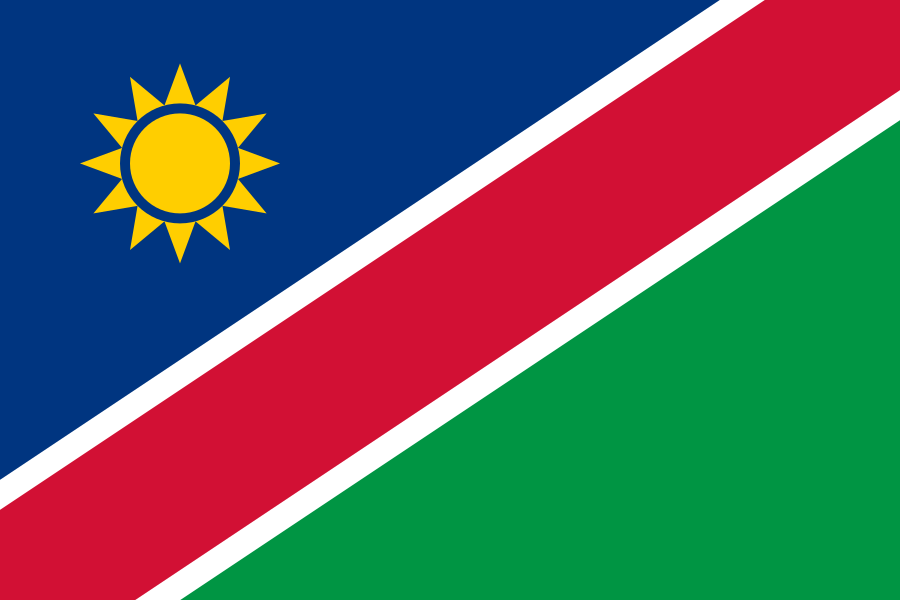
Namibia
Capital
Windhoek 👑
Continent
Africa
Time Zone
CAT · Africa/Windhoek
Coordinates
22.56°S, 17.07°E
Currency
NAD ($)
Calling Code
+264
Driving Side
Left
Hemisphere
Southern
Language
English
Measurement System
Metric
Did You Know?
Namibia Abolished Daylight Saving by Springing Forward Permanently
Namibia covers 825,615 square kilometres — roughly the size of Spain and Germany combined — with a population density of about three people per square kilometre. After Mongolia, it is the least densely populated country in the world.
In the ǁKharas Region in the south, 161,514 square kilometres hold 109,893 people: a density of 0.68 per square kilometre. Fewer than one person for every square kilometre, across an area larger than England and Wales together.
What fills the space instead is worth counting. More than 40% of Namibia's land area is under some form of conservation. It was the first country in the world to write environmental protection into its constitution. It holds the world's largest population of free-roaming cheetah, estimated at around 2,500, and the largest free-roaming population of black rhino.
The recovery figures from the Kunene region are the striking ones. In 1982 the area held as few as 400 oryx, 600 springbok and 450 zebra. Today the numbers are around 29,000 oryx, 175,000 springbok and 18,800 zebra. Desert-adapted lions, down to fewer than 25 by the mid-1990s, now number over 150.
The clock: and in 2017 Namibia solved its daylight saving problem with a manoeuvre that almost nobody notices.
The country had observed DST since 1994, running on West Africa Time (UTC+1) in winter and moving to UTC+2 each summer. The Namibian Time Bill was approved by the National Council on 8 August 2017, after public hearings in which the majority supported it.
The change took effect on 3 September 2017 — the exact date on which Namibians would have put their clocks forward for summer anyway. Except this time they did not put them back. The country adopted Central Africa Time, UTC+2, as its permanent year-round standard.
The last act is the neat part. On 24 October 2017, daylight saving officially ended in Namibia. No clocks were changed, because the country had already switched zones.
It is the same move Iceland made in 1968: abolish the clock change by keeping summer time forever. Namibia did it forty-nine years later, and now shares a permanent clock with South Africa.
A country with fewer than three people per square kilometre decided that changing the clock twice a year was more coordination than it needed.
Sources
- timeanddate.com, *Namibia Adopts New Time Zone* (8 Ağustos 2017'de Ulusal Konsey onayı; kamu dinlemeleri; WAT'tan CAT'e kalıcı geçiş; 3 Eylül tarihi)
- timeanddate.com, *Time Change 2017 in Namibia* (**24 Ekim 2017'de DST resmen bitti ama saatler değiştirilmedi, çünkü Windhoek aynı anda dilim değiştirmişti**)
- time.now (1994-2017 arası DST; kalıcı UTC+02:00; Africa/Windhoek)
- Wikipedia, *Geography of Namibia* (825.615 km²; Moğolistan'dan sonra en seyrek nüfuslu; km² başına 2,7 kişi)
- Wikipedia, *ǁKharas Region* (161.514 km², 109.893 nüfus, 0,68/km²)
- arebbusch.com (koruma alanlarının kara alanının %40'ından fazlasını kaplaması)
- booknamibia.com (dünyanın en büyük serbest dolaşan çita popülasyonu, ~2.500; anayasada çevre koruması)
- Natural Habitat Adventures / WWF (Kunene'de 1982'de 400 oriks, 600 springbok, 450 zebra → bugün 29.000, 175.000, 18.800; çöl aslanlarının 25'ten 150'ye çıkması)
Annual Daylight
Working Hours
7h overlap