Washington DC
UTC−4United States · EDT
Sat, 8 Aug 2026
Timezone Guide
Washington DC, United States runs on UTC−4. Clocks move forward each spring and back each autumn: UTC−5 in winter, UTC−4 in summer. Next change: 1 Nov. Washington DC and New York currently share the same clock. Standard 9-to-6 working hours overlap for about 9 hours a day with New York. A good time to connect: 09:00–18:00 in Washington DC lines up with 09:00–18:00 in New York. There is a 5-hour difference between Washington DC and London. Standard 9-to-6 working hours overlap for about 4 hours a day with London. A good time to connect: 09:00–13:00 in Washington DC lines up with 14:00–18:00 in London. There is a 13-hour difference between Washington DC and Tokyo. Standard working hours don't overlap at all with Tokyo, so meetings need an early or late slot on one side. This timezone is also shared with cities such as Toronto, Caracas, Havana. Keeping these offsets in mind makes it easier to schedule calls or travel to and from Washington DC.
Practical Info
Washington DC (United States) is home to roughly 6.4M people. Today brings about 14.7 hours of daylight: sunrise at 05:42, sunset at 20:24. Clocks move forward each spring and back each autumn: UTC−5 in winter, UTC−4 in summer. Next change: 1 Nov. It sits in the Northern Hemisphere, about 39° north of the equator. Traffic drives on the right.
Flag
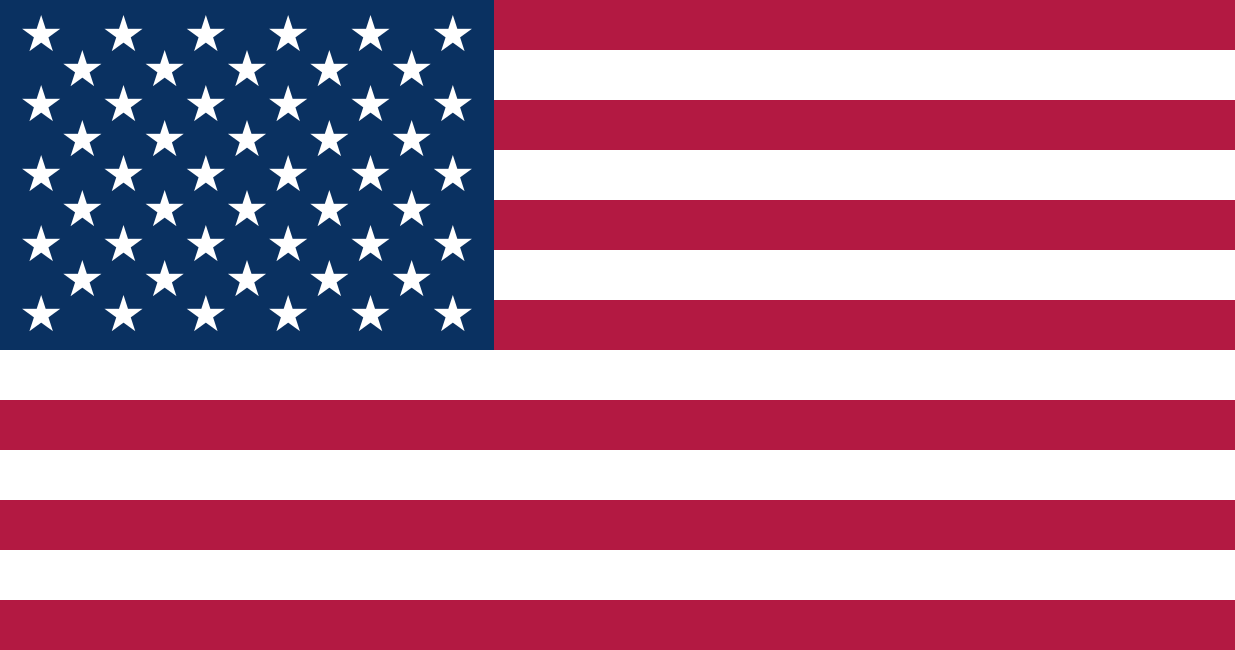
United States
Capital
Washington, D.C.
Continent
North America
Time Zone
EDT · America/New_York
Coordinates
38.90°N, 77.04°W
Currency
USD ($)
Calling Code
+1
Driving Side
Right
Hemisphere
Northern
Language
English
Measurement System
Imperial
Did You Know?
Four Numbers That Explain a Capital
1. The library adds 10,000 items every working day.
The Library of Congress holds more than 178 million items across roughly 838 miles of shelving — further than the distance from Washington to Chicago. It receives around 15,000 items a day and keeps more than 10,000 of them, most arriving through copyright registration. That is roughly two million a year, permanently.
The collection includes 25.7 million catalogued books, 75 million manuscripts, 15 million photographs, 5.6 million maps and material in more than 470 languages. It began in 1800 with a small congressional collection, which British troops burned in 1814. Congress replaced it in 1815 by buying Thomas Jefferson's personal library — 6,487 books for $23,950.
2. No building may exceed the width of the street it faces, plus twenty feet.
The Height of Buildings Act of 1910 is still in force. It is why Washington has no skyscrapers: the limit is set by street width, not by a fixed ceiling. Individual exceptions have required acts of Congress — St Matthew's Church got 95 feet in 1910, the Harrington Hotel 130 feet in 1924.
3. There are more than 3,000 cherry trees, and they were a gift.
The mayor of Tokyo sent them in 1912. They are still there, around the Tidal Basin, and the city still schedules a festival around when they open.
4. About 80 atomic clocks sit in a compound on Embassy Row, and they define what time it is in the United States.
The US Naval Observatory has kept time for the Navy since 1830 and moved to its present site in 1893. Its Master Clock is the source of UTC(USNO), and it has stayed within 5 nanoseconds of international UTC since 1999.
The ensemble behind it runs to roughly 57 caesium atomic clocks and 24 hydrogen masers, held in 19 environmental chambers where the temperature is kept constant to within 0.1°C and the humidity to within 1%. A US Defense Department paper describes it as the largest assembly of atomic clocks for any single timing operation in the world.
Its output feeds the GPS satellite constellation. And in the international average that produces official world time, the Washington site alone carries about 35% of the weight; with its Colorado backup, more than half.
The Time Service Department that runs all this employs fewer than thirty people.
So: a library that keeps 10,000 things a day, a law that has stopped the skyline growing for 115 years, three thousand trees from another country, and thirty people whose clocks carry a third of the world's official time.
Washington is a city organised almost entirely around keeping things exactly as they are.
Sources
- Library of Congress, *General Information* ve *Fascinating Facts* (178,2 milyondan fazla parça; 25,77 milyon kataloglanmış kitap; günde ~15.000 parça alınması, 10.000'den fazlasının koleksiyona katılması; 470'ten fazla dil; 23 başkanın evrakı; 1814'te koleksiyonun yakılması; 1815'te Jefferson'ın 6.487 kitabının 23.950 dolara alınması)
- Guinness World Records (838 mil raf; 41 milyon kitap ve basılı malzeme, 4,1 milyon kayıt, 15 milyon fotoğraf, 5,6 milyon harita, 75 milyon el yazması; günde ~12.000 parça)
- National Capital Planning Commission, *Historical Background on the Height of Buildings Act* (1910 kanunu ve yürürlükte olması; cadde genişliği kuralı; St Matthew's 1910'da 95 fit, Harrington Oteli 1924'te 130 fit istisnaları)
- travel-and-eat.com (1912'de Tokyo belediye başkanının hediyesi, Tidal Basin çevresinde 3.000'den fazla ağaç)
- Matsakis, *Time and Frequency Activities at the U.S. Naval Observatory*, DTIC ve Wiley (1830'dan beri zaman tutma; 1999'dan beri UTC'nin 5 ns içinde kalması; 19 iklim odası, 0,1°C ve %1 hassasiyet; Washington sahasının uluslararası ortalamadaki ~%35 ağırlığı, Colorado ile birlikte %50'yi aşması; Zaman Servisi'nin 26-28 kişilik kadrosu)
- CLUI ve GPS Clocks 2017 (1893'te bugünkü yerine taşınma; ~57 sezyum saati ve 24 mazer; GPS takımyıldızına zaman sağlaması)
- DTIC ADA502461 ("tek bir zaman tutma operasyonu için dünyadaki en büyük atom saati topluluğu")
Annual Daylight
Working Hours
5h overlap