Tarawa
UTC−12Kiribati · GILT
Sun, 9 Aug 2026
Timezone Guide
Tarawa, Kiribati runs on UTC−12. This time zone stays fixed year-round at UTC−12 — daylight saving time is not observed. There is a 8-hour difference between Tarawa and New York. Standard 9-to-6 working hours overlap for about 1 hours a day with New York. A good time to connect: 09:00–10:00 in Tarawa lines up with 17:00–18:00 in New York. There is a 13-hour difference between Tarawa and London. Standard working hours don't overlap at all with London, so meetings need an early or late slot on one side. There is a 21-hour difference between Tarawa and Tokyo. Standard 9-to-6 working hours overlap for about 6 hours a day with Tokyo. A good time to connect: 12:00–18:00 in Tarawa lines up with 09:00–15:00 in Tokyo. This timezone is also shared with cities such as Auckland. Keeping these offsets in mind makes it easier to schedule calls or travel to and from Tarawa.
Practical Info
Tarawa (Kiribati) is home to roughly 63K people. Today brings about 12.1 hours of daylight: sunrise at 06:12, sunset at 18:18. This time zone stays fixed year-round at UTC−12 — daylight saving time is not observed. It sits in the Northern Hemisphere, about 1° north of the equator. Traffic drives on the left.
Flag
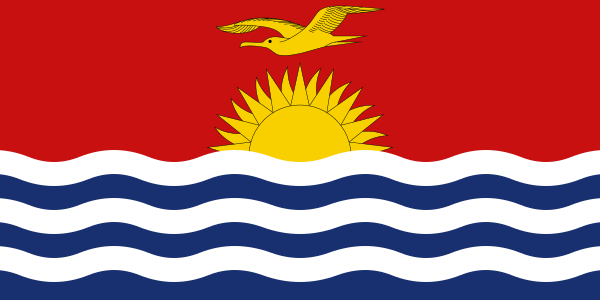
Kiribati
Capital
Tarawa 👑
Continent
Oceania
Time Zone
GILT · Pacific/Tarawa
Coordinates
1.45°N, 173.02°E
Currency
AUD ($)
Calling Code
+686
Driving Side
Left
Hemisphere
Northern
Language
English, Gilbertese
Measurement System
Metric
Did You Know?
A Country That Is 99.98% Water Redrew the Date Line
Kiribati consists of 33 coral atolls and islands with a total land area of 726 square kilometres, scattered across roughly 3.5 million square kilometres of ocean.
Work out the ratio and the country is about one part land to four thousand eight hundred parts sea. Around twenty of the atolls are habitable, and about 105,000 people live on them. Kiribati straddles both the equator and the 180th meridian, and is the only country on Earth that lies in all four hemispheres.
That geography created a problem that took a century to fix.
The clock: when Kiribati became independent in 1979, the International Date Line ran straight through it.
The Gilbert Islands, including the capital Tarawa, were on UTC+12. The Phoenix and Line Islands, to the east, were on UTC−11 and UTC−10 — on the other side of the line. When it was Monday in Tarawa, it was Sunday on Kiritimati, a difference of 23 hours inside a single country.
Banking, shipping, government coordination and inter-island business all had to work across a gap where the two halves of the nation barely shared a working day.
President Teburoro Tito announced that from 1 January 1995 the date line would instead run along the eastern boundary of the republic.
The mechanism was simple and final. In the eastern islands, Friday 30 December 1994 was followed by Sunday 1 January 1995. They skipped 31 December entirely. The Phoenix Islands went to UTC+13 and the Line Islands to UTC+14 — the most advanced time zone in the world.
It was only realised afterwards what else this had done. The Line Islands were now the first inhabited places on Earth to enter each new day — which meant that five years later, Kiritimati would be first into the year 2000. The government marketed it accordingly.
One consequence is permanent. Between UTC+14 in Kiribati and UTC−12 at Baker Island, the maximum time difference on Earth is 26 hours. The two places are never on the same date.
A country that is almost entirely ocean moved the date line, to make its own islands agree what day it was.
Sources
- Utrecht Üniversitesi, *A History of the International Date Line* (Cumhurbaşkanı Teburoro Tito'nun duyurusu; 30 Aralık 1994 Cuma'yı 1 Ocak 1995 Pazar'ın izlemesi; 33 atol, 726 km² kara, 5 milyon km² okyanus; ~105.000 nüfus; milenyum yarışının sonradan fark edilmesi)
- timeanddate.com, *Time Zone in Kiribati* (1979 bağımsızlığı ve 23 saatlik iç fark; dört yarımkürede birden bulunan tek ülke)
- Grokipedia, *Time in Kiribati* (üç dilim: UTC+12, +13, +14; 3,5 milyon km²; birleştirmenin idari gerekçeleri)
- timezone.io (Aralık 1994 kaydırması; UTC+14'ün dünyanın en ileri dilimi olması; DST kullanılmaması)
- universaltimedate.com (UTC+14 ile UTC−12 arasında azami 26 saat farkı; Baker Adası)
Annual Daylight
Working Hours