Seattle
UTC−7United States · PDT
Sat, 8 Aug 2026
Timezone Guide
Seattle, United States runs on UTC−7. Clocks move forward each spring and back each autumn: UTC−8 in winter, UTC−7 in summer. Next change: 1 Nov. There is a 3-hour difference between Seattle and New York. Standard 9-to-6 working hours overlap for about 6 hours a day with New York. A good time to connect: 09:00–15:00 in Seattle lines up with 12:00–18:00 in New York. There is a 8-hour difference between Seattle and London. Standard 9-to-6 working hours overlap for about 1 hours a day with London. A good time to connect: 09:00–10:00 in Seattle lines up with 17:00–18:00 in London. There is a 16-hour difference between Seattle and Tokyo. Standard 9-to-6 working hours overlap for about 1 hours a day with Tokyo. A good time to connect: 17:00–18:00 in Seattle lines up with 09:00–10:00 in Tokyo. This timezone is also shared with cities such as Vancouver, Los Angeles, Phoenix. Keeping these offsets in mind makes it easier to schedule calls or travel to and from Seattle.
Practical Info
Seattle (United States) is home to roughly 4.0M people. Today brings about 15.9 hours of daylight: sunrise at 05:12, sunset at 21:06. Clocks move forward each spring and back each autumn: UTC−8 in winter, UTC−7 in summer. Next change: 1 Nov. It sits in the Northern Hemisphere, about 48° north of the equator. Traffic drives on the right.
Flag
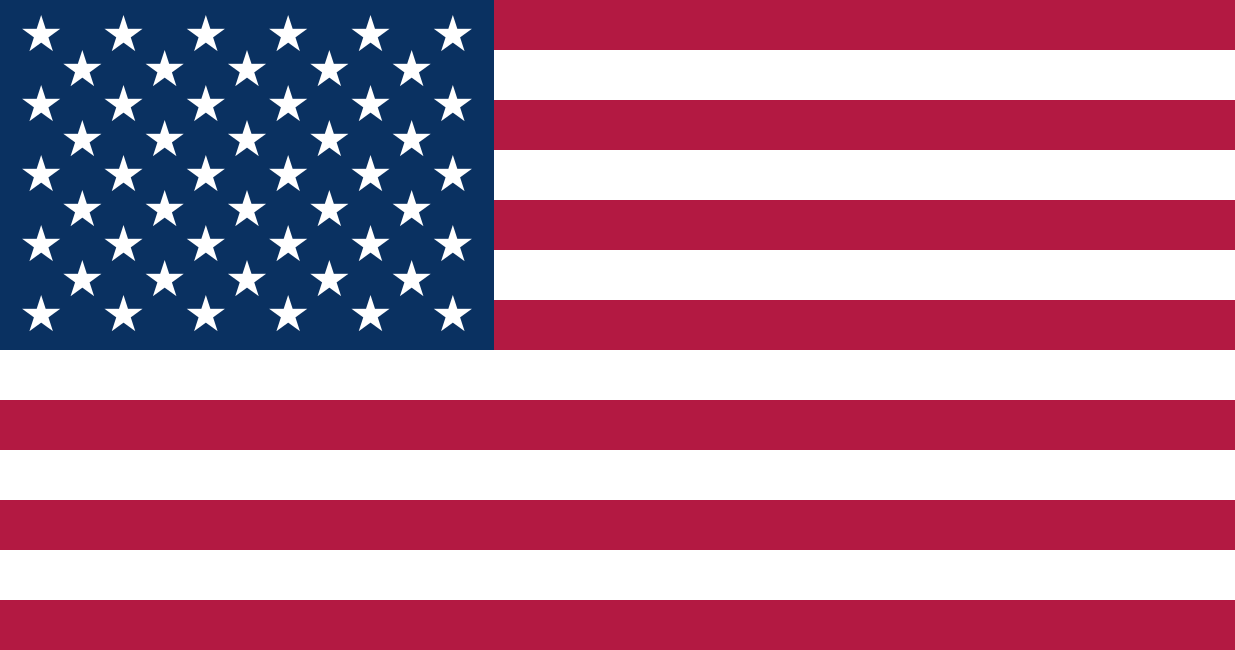
United States
Capital
Washington, D.C.
Continent
North America
Time Zone
PDT · America/Los_Angeles
Coordinates
47.61°N, 122.33°W
Currency
USD ($)
Calling Code
+1
Driving Side
Right
Hemisphere
Northern
Language
English
Measurement System
Imperial
Did You Know?
A Building So Big It Rained Inside
1. The largest building in the world by volume is thirty-five kilometres north of Seattle.
Boeing's Everett factory holds the Guinness record at 472,370,319 cubic feet — about 13.4 million cubic metres — under one roof. The floor covers 98.3 acres, enough to fit the entire Disneyland resort with about twelve acres left over, or 75 American football fields.
It was built in 1967 for the 747, whose 225-foot wingspan would not fit in any existing Boeing plant. Inside there are 26 overhead cranes running on more than 30 miles of track, and six doors on the south face, four of them 82 feet high and 300 feet wide. Around 30,000 people work there. The site has its own fire department, medical clinic, daycare and water treatment plant.
2. When it opened, the building generated its own weather.
The volume was large enough that warm, moist air collected under the ceiling and formed clouds. It rained indoors, until circulation equipment was installed to stop it.
3. More than 5,000 wide-body aircraft have been assembled in it.
Including over 1,500 Boeing 747s, before that production line closed in 2022. The factory now builds the 767, 777 and 777X.
4. One coffee shop opened here in 1971 and there are now more than 40,000 of them.
Starbucks opened at Pike Place Market on 30 March 1971, selling roasted beans and equipment. It had 17 stores in 1987, 84 in 1990, 165 when it went public in 1992, 425 in 1994, and passed a thousand in 1996. There are now more than 40,000 locations in over 80 countries.
One honest correction, because it is the kind of fact everyone repeats: Seattle no longer has the most coffee shops per capita in the United States. It keeps the reputation, and the headquarters, but not the ranking.
The clock: Seattle sits at about 122° west on Pacific Time, within roughly nine minutes of its own solar noon — well aligned, like San Francisco.
What is not steady is the daylight. At 47.6° north, Seattle runs from around sixteen hours of light at midsummer down to roughly eight and a half in December — a swing of some seven and a half hours across the year.
So: a city whose two defining industries are a shed large enough to make its own rain, and a shop that turned coffee into a chain of forty thousand. Both started with a single site. One of them is still on it.
Sources
- Guinness World Records, *Largest factory (by volume)* (472.370.319 fit küp / 13.385.378 m³; 399.480 m² / 98,3 dönüm taban alanı; 1967 açılışı)
- Wikipedia, *Boeing Everett Factory* (Disneyland ya da 75 futbol sahası karşılaştırması; altı üretim hattı; 1966'da 747 programı için ~780 dönüm arazi alımı; 225 fitlik kanat açıklığının mevcut tesislere sığmaması)
- HowStuffWorks (26 tavan vinci, 39 mil ray; 36.000 çalışan; kendi itfaiyesi, kliniği, kreşi ve su arıtma tesisi; **açılışta tavanın altında bulut oluşup içeride yağmur yağması**; güney cephesindeki 82 fit × 300 fit kapılar)
- World Record Academy / Boeing (30.000'den fazla çalışan; kompleksin ~1.000 dönümü)
- Grokipedia ve Futurowise (1967'den beri 5.000'den fazla geniş gövdeli uçak; 2022'de üretimi biten 1.500'den fazla 747)
- Starbucks kurumsal tarihçesi ve Statista (30 Mart 1971 Pike Place açılışı; 1987'de 17, 1990'da 84, 1992 halka arzında 165, 1994'te 425 mağaza)
- Grokipedia (2025 itibarıyla 40.000'den fazla şube)
- Tasting Table (**Seattle'ın artık ABD'de kişi başına en çok kahve dükkânına sahip şehir olmaması**)
- Boylam hesabı: Seattle 122,3°B, Pasifik Saati meridyeni 120°B → ~9 dakika
Annual Daylight
Working Hours
2h overlap