Rio de Janeiro
UTC−3Brazil · BRT
Sat, 8 Aug 2026
Timezone Guide
Rio de Janeiro, Brazil runs on UTC−3. This time zone stays fixed year-round at UTC−3 — daylight saving time is not observed. There is a 1-hour difference between Rio de Janeiro and New York. Standard 9-to-6 working hours overlap for about 8 hours a day with New York. A good time to connect: 10:00–18:00 in Rio de Janeiro lines up with 09:00–17:00 in New York. There is a 4-hour difference between Rio de Janeiro and London. Standard 9-to-6 working hours overlap for about 5 hours a day with London. A good time to connect: 09:00–14:00 in Rio de Janeiro lines up with 13:00–18:00 in London. There is a 12-hour difference between Rio de Janeiro and Tokyo. Standard working hours don't overlap at all with Tokyo, so meetings need an early or late slot on one side. This timezone is also shared with cities such as Buenos Aires, São Paulo, Brasília. Keeping these offsets in mind makes it easier to schedule calls or travel to and from Rio de Janeiro.
Practical Info
Rio de Janeiro (Brazil) is home to roughly 13.7M people. Today brings about 10.9 hours of daylight: sunrise at 06:42, sunset at 17:36. This time zone stays fixed year-round at UTC−3 — daylight saving time is not observed. It sits in the Southern Hemisphere, about 23° south of the equator. Traffic drives on the right.
Flag
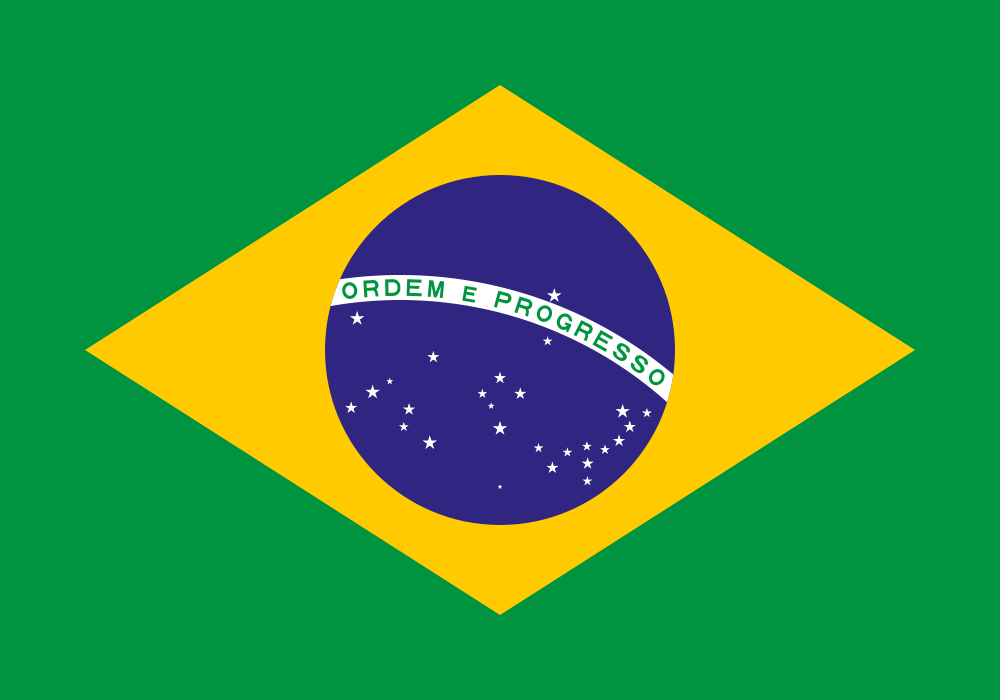
Brazil
Capital
Brasília
Continent
South America
Time Zone
BRT · America/Sao_Paulo
Coordinates
22.91°S, 43.17°W
Currency
BRL (R$)
Calling Code
+55
Driving Side
Right
Hemisphere
Southern
Language
Portuguese
Measurement System
Metric
Did You Know?
A City Whose Biggest Event Is Scheduled by the Moon
1. Rio's Carnival has no fixed date, and never has.
It falls 46 to 47 days before Easter Sunday. Easter is set by the ecclesiastical lunar calendar — the first Sunday after the first full moon following the vernal equinox — so Carnival drifts across a five-week window every year.
In 2026 it ran 13–21 February. In 2027 it falls 29 January – 2 February. It has landed as late as early March.
A city of six million people plans its largest annual event, a year in advance, around the phase of the moon.
2. Twelve samba schools, more than 3,000 performers each.
The Grupo Especial parades at the Sambadrome Marquês de Sapucaí, a purpose-built concrete runway flanked by grandstands holding 72,500 spectators. Twelve elite schools compete across three nights, starting at 10 p.m. Each fields 3,000 or more costumed performers on floats that cost millions to produce, telling a single story.
The schools represent entire neighbourhoods and spend the whole year preparing.
3. Over 500 free street parties, and one of them has drawn 2.5 million people.
Rio hosts more than 500 blocos — free neighbourhood street parties. Cordão da Bola Preta, founded in 1918 and the oldest of them, has gathered 2.5 million revellers in a single outing. Several others regularly draw over 200,000.
Around six to seven million visitors come to the city for it.
4. And it is not even Brazil's largest.
São Paulo ran over 600 official blocos in 2025, drawing more than 16 million people. Salvador's Carnival puts two million on the streets every day of the festival, following sound trucks called trios elétricos.
The clock: Rio sits at about 43° west, on UTC−3, which is calculated for the 45th meridian — putting the city roughly seven minutes behind its own solar noon. The sun gets to midday over Rio slightly before the clock does.
Brazil abolished daylight saving in 2019, so that offset no longer changes at all. The clock is now the most fixed thing about the Brazilian year.
So: a country that stopped moving its clocks entirely, and whose biggest event still moves five weeks in either direction because of the moon.
Sources
- Mobimatter ve Radical Storage (Karnavalın Paskalya'dan 46-47 gün önce olması ve tarihinin her yıl değişmesi; 2026'da 13-21 Şubat; 2027'de 29 Ocak – 2 Şubat; 500'den fazla ücretsiz bloco; okul başına 3.000+ performansçı)
- Saily (tarihlerin ay takvimine ve Paskalya'ya bağlı olması; 12 seçkin samba okulu; Sambadrome Marquês de Sapucaí)
- LatamTravellers (Sambadrome'un 72.500 seyirci kapasitesi; yılda 7 milyondan fazla ziyaretçi; Salvador'da günde 2 milyon kişi)
- Mundo Incrível (Cordão da Bola Preta'nın 1918'de kurulması ve 2,5 milyon kişi toplaması; 100.000+ kişilik mega-blocolar)
- Rio Times (2026 için altı milyon ziyaretçi beklentisi; geçitlerin 22.00'de başlaması; üç gece boyunca 12 okul)
- Beach.com (São Paulo'da 2025'te 600'den fazla bloco ve 16 milyondan fazla katılımcı)
- Boylam hesabı: Rio 43,2°B, UTC−3 meridyeni 45°B → ~7 dakika **geride**
Annual Daylight
Working Hours
6h overlap