Pyongyang
UTC+9North Korea · KST
Sun, 9 Aug 2026
Timezone Guide
Pyongyang, North Korea runs on UTC+9. This time zone stays fixed year-round at UTC+9 — daylight saving time is not observed. There is a 13-hour difference between Pyongyang and New York. Standard working hours don't overlap at all with New York, so meetings need an early or late slot on one side. There is a 8-hour difference between Pyongyang and London. Standard 9-to-6 working hours overlap for about 1 hours a day with London. A good time to connect: 17:00–18:00 in Pyongyang lines up with 09:00–10:00 in London. Pyongyang and Tokyo currently share the same clock. Standard 9-to-6 working hours overlap for about 9 hours a day with Tokyo. A good time to connect: 09:00–18:00 in Pyongyang lines up with 09:00–18:00 in Tokyo. This timezone is also shared with cities such as Seoul. Keeping these offsets in mind makes it easier to schedule calls or travel to and from Pyongyang.
Practical Info
Pyongyang (North Korea) is home to roughly 3.3M people. Today brings about 14.6 hours of daylight: sunrise at 05:00, sunset at 19:36. This time zone stays fixed year-round at UTC+9 — daylight saving time is not observed. It sits in the Northern Hemisphere, about 39° north of the equator. Traffic drives on the right.
Flag
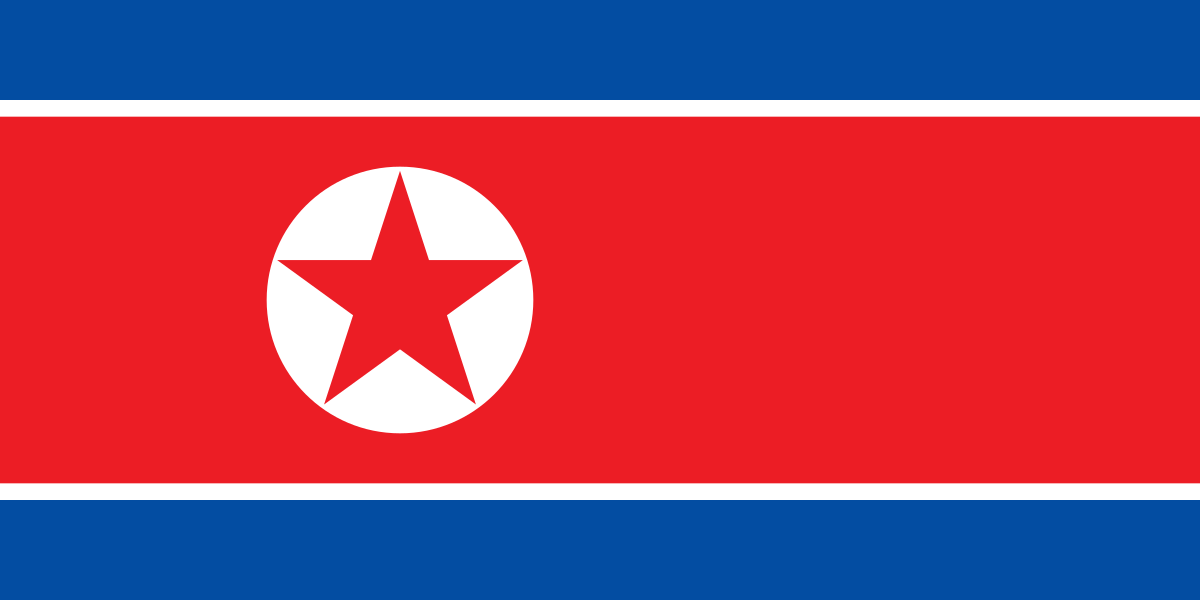
North Korea
Capital
Pyongyang 👑
Continent
Asia
Time Zone
KST · Asia/Pyongyang
Coordinates
39.04°N, 125.76°E
Currency
KPW (₩)
Calling Code
+850
Driving Side
Right
Hemisphere
Northern
Language
Korean
Measurement System
Metric
Did You Know?
A Time Zone That Lasted Exactly 993 Days
The Pyongyang Metro opened on 6 September 1973. Its platforms sit more than 110 metres below ground — among the deepest anywhere — and the descent by escalator takes roughly three and a half to four minutes. The stations were built to double as shelters, with heavy steel blast doors, and the depth holds the temperature at about 20°C all year regardless of the season outside.
The network is two lines, 16 stations, 22.5 kilometres. Daily ridership is estimated at somewhere between 300,000 and 700,000 — the range is wide because reliable figures are hard to obtain. The station names translate as Reunification, Rejuvenation, Glory, Triumph, Red Star, Liberation, Construction.
Above ground, the city holds a different kind of record. On 14 August 2007, Guinness World Records recognised the Arirang Mass Games as the largest gymnastic display ever staged, with 100,090 participants at the Rungrado 1st of May Stadium. The count was adjudicated on site. The card-stunt mosaics on the stadium's north side are formed by more than 30,000 schoolchildren, each holding coloured cards. Participants are largely students who rehearse for months, which has drawn concern from outside observers.
The clock: a hundred thousand people moving in unison is one form of synchronisation. Moving a country's clocks by decree is another, and Pyongyang has done that twice in a decade.
On 5 August 2015, the government announced that from 15 August the country would move from UTC+9 to UTC+8:30, under the name Pyongyang Time. The date was the 70th anniversary of Korea's liberation from Japanese colonial rule, and state media presented the change as removing a standard imposed during the 1910–1945 occupation. Before 1912, the peninsula had used a local time close to UTC+8:28.
It put North Korea half an hour behind South Korea, which had itself used UTC+8:30 between 1954 and 1961.
It lasted exactly 993 days.
On 27 April 2018, at the inter-Korean summit at Panmunjom, Kim Jong Un met South Korean President Moon Jae-in. According to the state news agency KCNA, he remarked on the two clocks on the wall of the summit venue — one labelled Pyongyang, one Seoul — describing the sight as <cite index="284-1">"a painful wrench"</cite>.
Two days later the reversal was announced. On 5 May 2018 the Presidium of the Supreme People's Assembly adopted a decree titled On Resetting Pyongyang Time, and the clocks moved forward thirty minutes to rejoin UTC+9.
Very few countries have created a time zone and abolished it again in the same decade.
Sources
- Wikipedia, *Time in North Korea* (5 Ağustos 2015 kararı, 15 Ağustos yürürlük; "Pyongyang Saati" adı; Güney Kore yetkililerinin Kaesong Sanayi Bölgesi'ne dair endişeleri)
- Geography Worlds (dilimin tam **993 gün** sürmesi: 15 Ağustos 2015 – 5 Mayıs 2018; 1912 öncesi ~UTC+8:28; Güney Kore'nin 1954-1961 arası UTC+8:30 kullanımı)
- People's Daily/Xinhua ve GlobalSecurity (5 Mayıs 2018 tarihi; Yüksek Halk Meclisi Prezidyumu'nun *On Resetting Pyongyang Time* kararnamesi; Kim Jong Un'un iki saate dair KCNA'ya yansıyan ifadesi)
- Newsweek ve World Economic Forum (29 Nisan 2018 duyurusu; Panmunjom zirvesi bağlamı)
- Grokipedia, *Time in North Korea* (KCNA'nın çerçevelemesi)
- mapa-metro.com ve Young Pioneer Tours (metronun 6 Eylül 1973 açılışı; 110 m derinlik; 2 hat, 16 istasyon, 22,5 km; 300.000-700.000 günlük yolcu; sığınak tasarımı; yıl boyu ~20°C)
- Wikipedia ve Grokipedia, *Arirang Mass Games* (14 Ağustos 2007'de Guinness tescili, 100.090 katılımcı; 30.000'den fazla kart tutan öğrenci; 2002'de başlaması)
Annual Daylight
Working Hours