Kathmandu
UTC+5:45Nepal · NPT
Sun, 9 Aug 2026
Timezone Guide
Kathmandu, Nepal runs on UTC+5:45. This time zone stays fixed year-round at UTC+5:45 — daylight saving time is not observed. There is a 9.8-hour difference between Kathmandu and New York. Standard working hours don't overlap at all with New York, so meetings need an early or late slot on one side. There is a 4.8-hour difference between Kathmandu and London. Standard 9-to-6 working hours overlap for about 4.3 hours a day with London. A good time to connect: 13:45–18:00 in Kathmandu lines up with 09:00–13:15 in London. There is a 3.3-hour difference between Kathmandu and Tokyo. Standard 9-to-6 working hours overlap for about 5.8 hours a day with Tokyo. A good time to connect: 09:00–14:45 in Kathmandu lines up with 12:15–18:00 in Tokyo. Keeping these offsets in mind makes it easier to schedule calls or travel to and from Kathmandu.
Practical Info
Kathmandu (Nepal) is home to roughly 1.5M people. Today brings about 14.0 hours of daylight: sunrise at 05:06, sunset at 19:06. This time zone stays fixed year-round at UTC+5:45 — daylight saving time is not observed. It sits in the Northern Hemisphere, about 28° north of the equator. Traffic drives on the left.
Flag
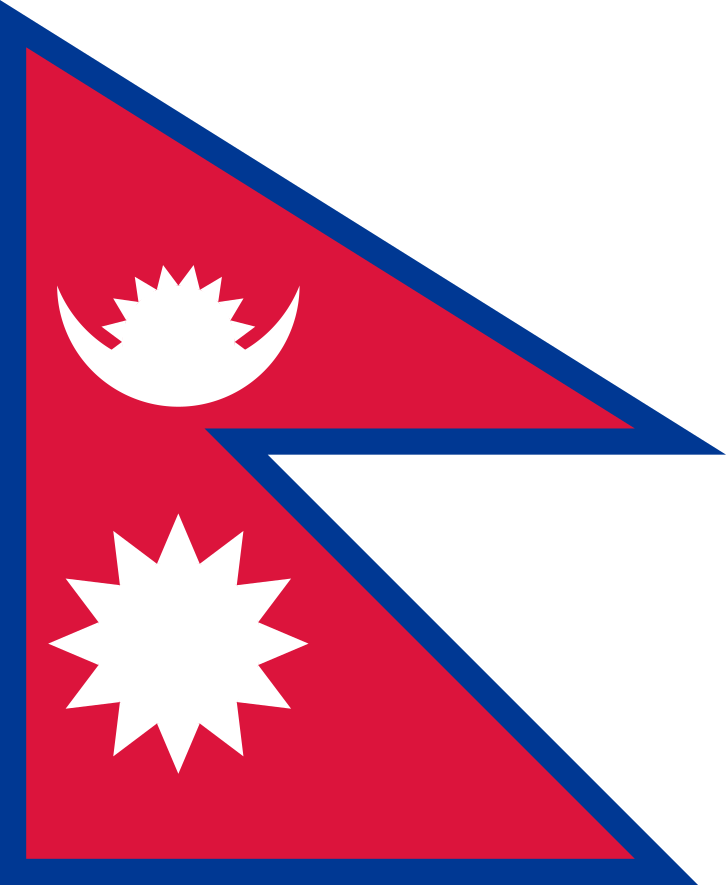
Nepal
Capital
Kathmandu 👑
Continent
Asia
Time Zone
NPT · Asia/Kathmandu
Coordinates
27.72°N, 85.32°E
Currency
NPR (रू)
Calling Code
+977
Driving Side
Left
Hemisphere
Northern
Language
Nepali
Measurement System
Metric
Did You Know?
Nepal Is Fifteen Minutes Ahead of India, and Fifty-Seven Years Ahead of Everyone
UNESCO's World Heritage listing for the Kathmandu Valley is a single entry. Inside it are seven separate monument groups: the Durbar Squares of Kathmandu, Patan and Bhaktapur; the Buddhist stupas of Swayambhu and Bauddhanath; and the Hindu temples of Pashupati and Changu Narayan.
All seven sit within a radius of roughly twenty kilometres. You can visit every one of them in a day or two without leaving the valley, which also contains at least 130 other monuments considered significant, three of Nepal's largest cities, and about 2.5 million people.
The country around it is doing something similar with mountains. Nepal contains eight of the world's fourteen peaks over 8,000 metres — Everest, Kanchenjunga, Lhotse, Makalu, Cho Oyu, Dhaulagiri, Manaslu and Annapurna I. A country roughly the size of England and Wales combined holds more than half of the highest places on Earth.
Nepal packs an improbable amount into a small space, and then does the same thing with its clock — which is where the fifteen minutes come in.
Almost every country in the world rounds its clock to the nearest hour. A handful round to the nearest half hour. Nepal is the only country on Earth whose national time zone is set to a quarter past — UTC+5:45.
The history explains how, and the geography explains why.
Nepal ran on local solar time until 1920, when Kathmandu's own mean time was UTC+5:41:16. In 1920 the country adopted Indian Standard Time, UTC+5:30, to align with British India for administration and trade.
Then on 1 January 1986, Nepal advanced its clocks by fifteen minutes and has kept them there ever since.
The new reference meridian was 86°15′ east, which runs through the peak of Gaurishankar — a sacred mountain about a hundred kilometres east of Kathmandu. The arithmetic is exact: 86.25 divided by 15 gives 5.75 hours, which is five hours and forty-five minutes precisely.
Everest was not chosen. Gaurishankar sits closer to the country's centre, and the meridian India was using would have divided Nepal too unevenly.
The result is a country that is fifteen minutes ahead of the neighbour that surrounds it on three sides, and 2 hours 15 minutes behind the one along its northern border. Crossing from Nepal into China moves the clock by two and a quarter hours in a single step.
Nepal is one of only three places in the world using a 45-minute offset. The others are New Zealand's Chatham Islands at UTC+12:45, and a small unofficial zone around Eucla in Australia. Nepal is the only country.
The clock: and the fifteen minutes are not the largest gap between Nepal and the rest of the world.
Nepal's official calendar is Bikram Sambat, which runs roughly fifty-seven years ahead of the Gregorian calendar.
So a Nepali business dealing with an Indian partner is fifteen minutes ahead in the day, and about fifty-seven years ahead in the year. Neither of those numbers is an accident, and neither of them is going to change. Nepal was never colonised, and its clock and its calendar both say so.
Sources
- UNESCO Dünya Mirası Merkezi, *Kathmandu Valley* (yedi anıt grubunun resmî listesi)
- Escape Himalaya (vadideki en az 130 önemli anıt)
- Wandersmiles (vadinin nüfusu ~2,5 milyon; üç büyük şehir)
- Matterhorn Treks (yedi alanın ~20 km yarıçap içinde olması)
- nepaltour.info (8.000 m üzeri on dört zirvenin sekizi ve isimleri)
- Wikipedia, *Nepal Standard Time* (1920'ye kadar UTC+05:41:16; 1920'de IST'ye geçiş; 1986'da 15 dakika ileri alma; Gaurishankar meridyeni)
- Wikipedia, *UTC+05:45* (1 Ocak 1986; 45 dakikalık üç dilim)
- Grokipedia, *Nepal Standard Time* (86,25 / 15 = 5,75 hesabı)
- Kathmandu Valley Co. (Everest yerine Gaurishankar'ın seçilme gerekçesi; ülkenin 80°–88°D arası uzanımı)
- Geography Worlds (Bikram Sambat takviminin ~57 yıl ileride olması; Çin'le 2:15 fark)
Annual Daylight
Working Hours
3.3h overlap