Havana
UTC−4Cuba · CDT
Sat, 8 Aug 2026
Timezone Guide
Havana, Cuba runs on UTC−4. Clocks move forward each spring and back each autumn: UTC−5 in winter, UTC−4 in summer. Next change: 1 Nov. Havana and New York currently share the same clock. Standard 9-to-6 working hours overlap for about 9 hours a day with New York. A good time to connect: 09:00–18:00 in Havana lines up with 09:00–18:00 in New York. There is a 5-hour difference between Havana and London. Standard 9-to-6 working hours overlap for about 4 hours a day with London. A good time to connect: 09:00–13:00 in Havana lines up with 14:00–18:00 in London. There is a 13-hour difference between Havana and Tokyo. Standard working hours don't overlap at all with Tokyo, so meetings need an early or late slot on one side. This timezone is also shared with cities such as Toronto, Caracas, Washington DC. Keeping these offsets in mind makes it easier to schedule calls or travel to and from Havana.
Practical Info
Havana (Cuba) is home to roughly 2.1M people. Today brings about 14.0 hours of daylight: sunrise at 05:54, sunset at 19:54. Clocks move forward each spring and back each autumn: UTC−5 in winter, UTC−4 in summer. Next change: 1 Nov. It sits in the Northern Hemisphere, about 23° north of the equator. Traffic drives on the right.
Flag
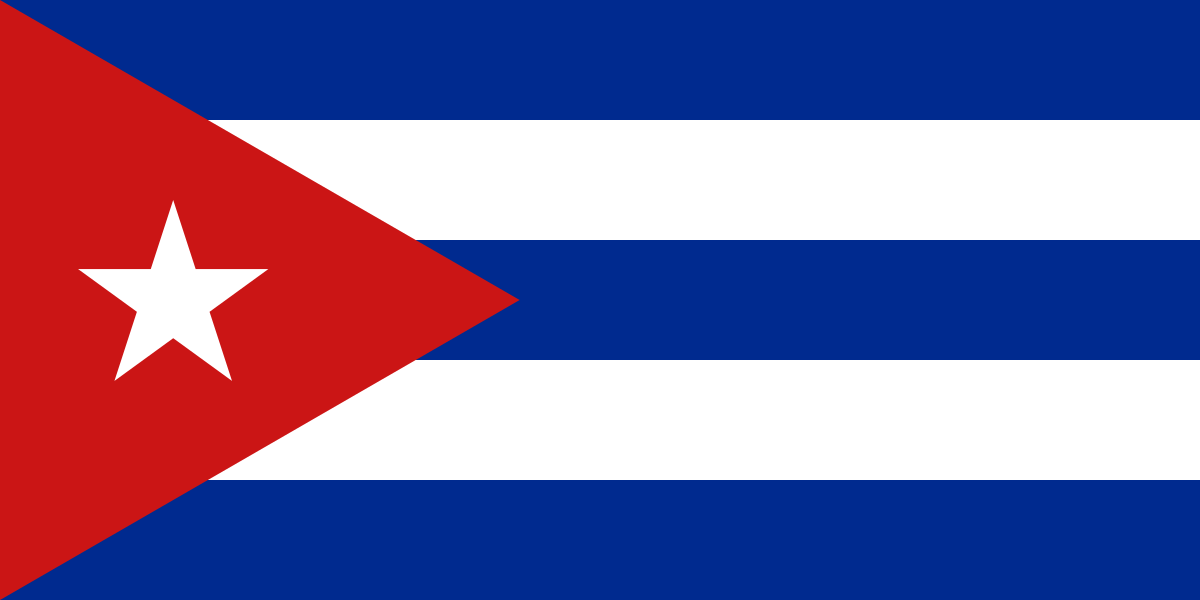
Cuba
Capital
Havana 👑
Continent
North America
Time Zone
CDT · America/Havana
Coordinates
23.11°N, 82.37°W
Currency
CUP ($)
Calling Code
+53
Driving Side
Right
Hemisphere
Northern
Language
Spanish
Measurement System
Metric
Did You Know?
A City Where the Cars Stopped in 1960 and the Clocks Never Did
There are roughly 60,000 pre-1960 American cars still on the road in Cuba, nearly all privately owned. Cubans call them almendrones — big almonds.
For context: in 1956 there were about 143,000 cars on Cuban roads, 95,000 of them in Havana alone. The United States was the primary supplier. The most significant American restrictions on car and parts imports began in 1960, and in February 1962 Kennedy declared a full trade blockade.
The supply stopped overnight. Roughly two-thirds of that pre-revolution fleet is still running, sixty-five years later.
It runs because Cuban mechanics stopped treating the cars as American. A 1950s Chevrolet with a Soviet engine is unremarkable. Cars have been converted from V8 petrol to diesel, fitted with disc brakes scavenged from Ladas, and repaired with parts machined from scratch. Only about 5–10% of the surviving classics have been kept original.
A 2010 law prevents foreigners from exporting them, so the fleet stays. Old Soviet cars sell from around $10,000; American ones from $30,000 to $100,000.
The clock: so the cars have not changed since 1960. The clocks have changed constantly.
Cuba sits at about 21°30′ north, which is unusually close to the equator for a country that bothers with daylight saving. It bothers anyway. According to one count, Cuba has introduced daylight saving five separate times since 1928 — in 1928, 1940–42, 1945–46, 1965–2004, and 2007 to the present. The stated reason is always the same: electricity, and specifically the artificial light used for cooking at peak hours.
And then there is the gap in that list.
In 2004 Cuba went onto daylight saving time and stayed there. Not for a season. For two years. The country remained in a permanent state of summer time until 29 October 2006, when it decided to re-establish standard time.
One more oddity: the Guantánamo Bay naval base observes daylight saving in synchronisation with its headquarters in Florida, regardless of what the rest of the island is doing.
Cars frozen at 1960. A clock that has been picked up and put down five times in a century, and once left running for two years by omission.
Sources
- Wikipedia, *Vintage automobiles in Cuba* (60.000'e varan Amerikan aracı, neredeyse tamamı özel mülkiyette; Sovyet parçalarıyla modifikasyon)
- Cuba Private Travel (1956'da 143.000 araba, 95.000'i Havana'da)
- Supercar Blondie ve insightCuba (1960'ta başlayan kısıtlamalar; Şubat 1962'de Kennedy'nin tam ablukası; ~60.000 rakamı)
- Love Cuba (orijinal parçayla korunanların %5-10'u; 2010 ihracat yasağı; fiyat aralıkları)
- worlddata.info (1928'den beri beş ayrı yaz saati denemesi; Küba'nın 10,1 derecelik doğu-batı uzanımı)
- timeanddate.com, *Cuba Starts Daylight Saving 2009* ve *2011* (2004'ten 29 Ekim 2006'ya kadar kalıcı yaz saati; Elektrik Birliği'nin gerekçesi; Guantánamo'nun Florida'yla senkronize olması)
- clocks.world (Küba'nın 21°30′K enlemi)
Annual Daylight
Working Hours
5h overlap