Chatham Islands
UTC−11:15New Zealand · CHAST
Sun, 9 Aug 2026
Timezone Guide
Chatham Islands, New Zealand runs on UTC−11:15. Clocks move forward each spring and back each autumn: UTC−11:15 in winter, UTC−10:15 in summer. Next change: 26 Sept. There is a 7.3-hour difference between Chatham Islands and New York. Standard 9-to-6 working hours overlap for about 1.8 hours a day with New York. A good time to connect: 09:00–10:45 in Chatham Islands lines up with 16:15–18:00 in New York. There is a 12.3-hour difference between Chatham Islands and London. Standard working hours don't overlap at all with London, so meetings need an early or late slot on one side. There is a 20.3-hour difference between Chatham Islands and Tokyo. Standard 9-to-6 working hours overlap for about 5.3 hours a day with Tokyo. A good time to connect: 12:45–18:00 in Chatham Islands lines up with 09:00–14:15 in Tokyo. Keeping these offsets in mind makes it easier to schedule calls or travel to and from Chatham Islands.
Practical Info
Chatham Islands (New Zealand) is home to roughly 600 people. Today brings about 9.0 hours of daylight: sunrise at 07:54, sunset at 16:54. Clocks move forward each spring and back each autumn: UTC−11:15 in winter, UTC−10:15 in summer. Next change: 26 Sept. It sits in the Southern Hemisphere, about 44° south of the equator. Traffic drives on the left.
Flag
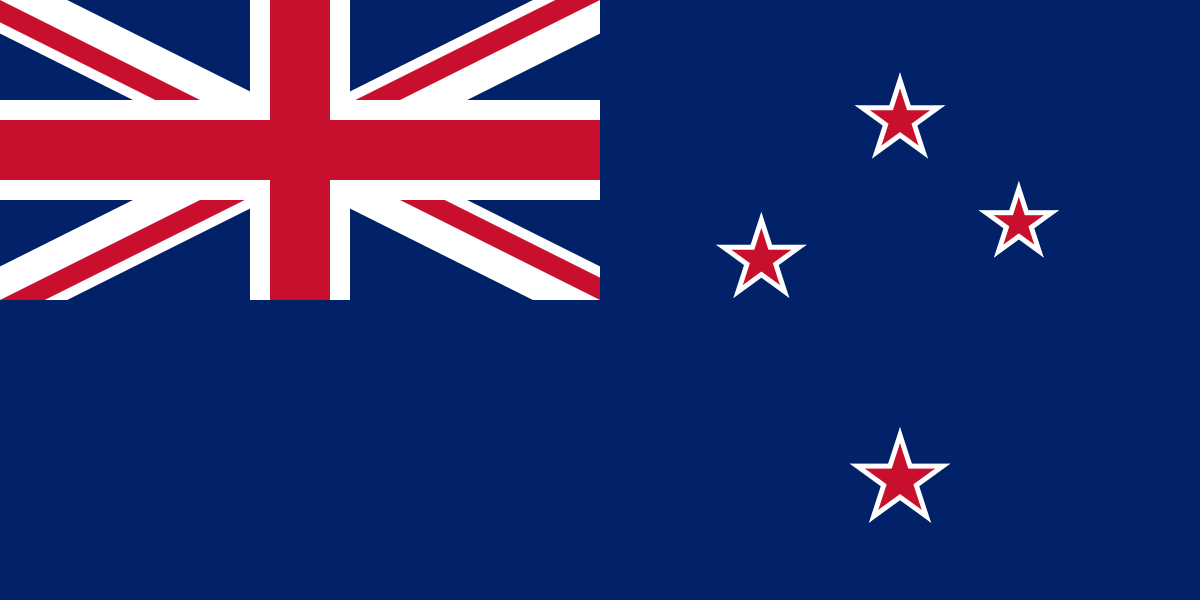
New Zealand
Capital
Wellington
Continent
Oceania
Time Zone
CHAST · Pacific/Chatham
Coordinates
43.95°S, 176.50°W
Currency
NZD ($)
Calling Code
+64
Driving Side
Left
Hemisphere
Southern
Language
English, Māori
Measurement System
Metric
Did You Know?
Six Hundred People Invented a Time Zone and Parliament Legalised It Twenty-Nine Years Later
In 1980 there were five Chatham Island black robins left alive in the world.
Not five hundred. Five. All on Little Mangere Island, a fifteen-hectare rock ringed by cliffs. Among them was exactly one breeding female, banded and known thereafter as Old Blue. The species had no other future.
It had been the world's rarest bird for some time. Wildlife officers counted around thirty in 1968. By 1976 there were seven, and Don Merton's New Zealand Wildlife Service team moved them to the larger Mangere Island — descending rock faces with birds in hand — where over 100,000 trees had been planted to make habitat. Two more died anyway.
What saved the species was a technique. Eggs were taken from the nest and cross-fostered to Chatham Island tomtits, which raised the chicks, which induced the robin to lay again. The team also pushed eggs back into the centre of nests, because some females had a habit of laying them on the rim where they rolled out.
Old Blue lived to thirteen or fourteen — extraordinary for a robin — and vanished in 1983 or 1984.
There are now around 350 black robins, and every single one is descended from her. In 2022 the species was downlisted from Endangered to Vulnerable.
So the Chathams hold roughly 600 human residents and 350 birds that exist because of one female that died forty years ago. It is a place where very small numbers have a habit of holding — which is also, as it happens, how the islands got their time zone.
About 800 kilometres east of New Zealand's South Island, roughly along the 176th meridian west, sit the Chatham Islands. Permanent population: around 600.
They have their own time zone.
Chatham Standard Time is UTC+12:45 — forty-five minutes ahead of mainland New Zealand. In summer it becomes UTC+13:45. It is one of only three offsets on Earth ending in :45, the others being Nepal at UTC+5:45 and an unofficial zone around Eucla in Australia.
The history is the good part. The Standard Time Act 1945 set New Zealand's clock to UTC+12. The Chathams simply put their clocks forty-five minutes ahead of that and carried on. There was no legal basis for it. It was just what the islands did.
Parliament caught up in 1974, when the Time Act formally recognised the offset that had already been in daily use for nearly three decades.
Six hundred people invented a time zone by agreeing among themselves, and the country ratified it afterwards.
The clock: the forty-five minutes are not arbitrary. UTC+12:45 corresponds to a meridian at 168°45′ west. The Chathams sit at about 176°30′ west, which leaves the islands roughly half an hour ahead of their own sun — closer than a whole-hour zone would have managed in either direction.
Even the clock changes carry the offset. Daylight saving on the Chathams begins on the last Sunday in September at 2:45 a.m., and ends on the first Sunday in April at 3:45 a.m. The islands do not round anything, ever.
And because of where they sit, the Chathams are among the first inhabited places on Earth to see each sunrise — competing for that title with Kiribati, Tonga and, since 2011, Samoa.
Six hundred people, forty-five minutes, and a permanent place at the front of the world's day.
Sources
- Yeni Zelanda Koruma Departmanı (DOC), *Karure / Kakaruia / Chatham Island black robin* (2025'te ~350 birey; hepsinin Old Blue'dan gelmesi; Old Blue'nun 14 yaşına ulaşması)
- BirdLife International (1976'da yedi kuş; Mangere'ye taşıma ve 100.000 ağaç; yumurtaları yuvanın ortasına itme tekniği; 2022'de Hassas kategorisine indirilme)
- Connovation/DOC (1980'de beş birey, tek üreyen dişi)
- Predator Free NZ (1968'de ~30 birey; Little Mangere'nin ~15 hektar olması; Old Blue'nun 1983-84'te kaybolması)
- Creation.com (Old Yellow; çapraz kuluçka tekniği)
- Wikipedia, *Chatham Standard Time Zone* (UTC+12:45; üç adet :45 kayması; 1974 Time Act)
- General Blue (1945 Standart Saat Kanunu ve adaların gayriresmî 45 dakikalık kaydırması; DST'nin 02:45 ve 03:45'te başlaması/bitmesi)
- Geography Worlds (~600 nüfus; anakaradan 800 km; 176. meridyen)
- time.is/Chatham_Islands (görünür güneş saatine göre 37 dakika ileri; enlem −44,0, boylam −176,5)
- Wikipedia, *Time in New Zealand*
Annual Daylight
Working Hours