Casablanca
UTC+1Morocco · +01
Sat, 8 Aug 2026
Timezone Guide
Casablanca, Morocco runs on UTC+1. This time zone stays fixed year-round at UTC+1 — daylight saving time is not observed. There is a 5-hour difference between Casablanca and New York. Standard 9-to-6 working hours overlap for about 4 hours a day with New York. A good time to connect: 14:00–18:00 in Casablanca lines up with 09:00–13:00 in New York. Casablanca and London currently share the same clock. Standard 9-to-6 working hours overlap for about 9 hours a day with London. A good time to connect: 09:00–18:00 in Casablanca lines up with 09:00–18:00 in London. There is a 8-hour difference between Casablanca and Tokyo. Standard 9-to-6 working hours overlap for about 1 hours a day with Tokyo. A good time to connect: 09:00–10:00 in Casablanca lines up with 17:00–18:00 in Tokyo. This timezone is also shared with cities such as Lisbon, Lagos, Dublin. Keeping these offsets in mind makes it easier to schedule calls or travel to and from Casablanca.
Practical Info
Casablanca (Morocco) is home to roughly 4.3M people. Today brings about 14.0 hours of daylight: sunrise at 06:00, sunset at 20:00. This time zone stays fixed year-round at UTC+1 — daylight saving time is not observed. It sits in the Northern Hemisphere, about 34° north of the equator. Traffic drives on the right.
Flag
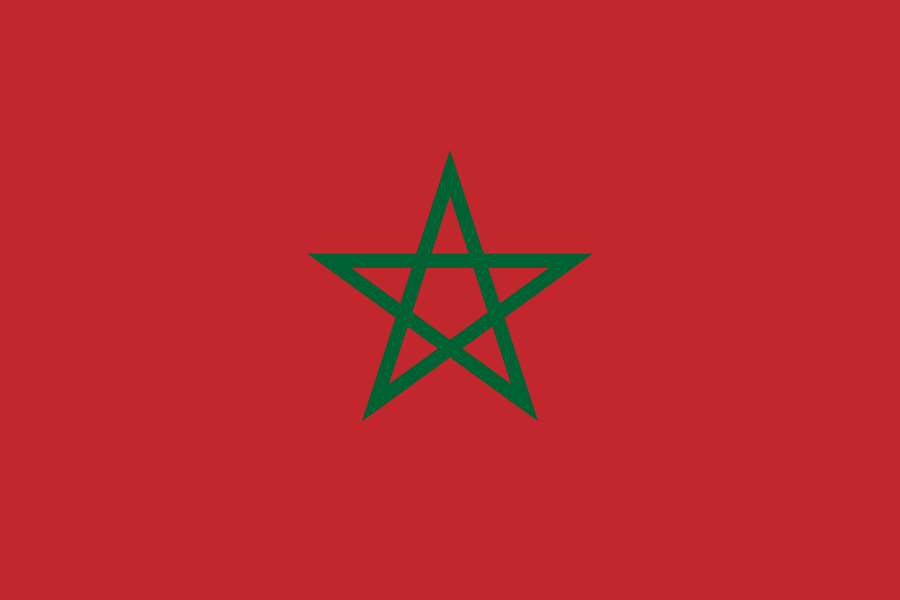
Morocco
Capital
Rabat
Continent
Africa
Time Zone
+01 · Africa/Casablanca
Coordinates
33.57°N, 7.59°W
Currency
MAD (د.م.)
Calling Code
+212
Driving Side
Right
Hemisphere
Northern
Language
Arabic
Measurement System
Metric
Did You Know?
A Laser Pointing at Mecca, in a Country That Could Not Decide What Time It Was
The Hassan II Mosque sits on a promontory at the northwestern tip of Casablanca, with a third of its foundation built directly over the Atlantic Ocean — a design choice reflecting a Quranic verse about God's throne standing upon the water.
The numbers are the point.
The minaret is 210 metres, equivalent to a sixty-storey building, and holds roughly 1,400 stairs — though the muezzin uses a lift. On top of it is a laser that shines thirty kilometres across the sky toward Mecca, switched on every evening.
The mosque holds 105,000 worshippers: 25,000 inside the prayer hall and 80,000 on the grounds outside. The prayer hall's cedar roof weighs 1,100 tonnes and slides open in about five minutes. The doors are titanium and brass, chosen because ordinary metal would corrode in the salt air. Parts of the floor are glass, directly above the waves.
Construction ran from 1986 to 1993, using cedar from the Middle Atlas, marble from Agadir and granite from Tafraoute. Estimates of the cost run from $400 million to $800 million, raised largely by public subscription — which was not voluntary.
The clock: so Casablanca has a building that points at Mecca with laser precision, in a country that has spent nearly twenty years unable to agree what hour to keep.
Morocco introduced seasonal daylight saving in 2008. Because it also moved the clocks back for Ramadan and forward again afterwards, the country ended up with four clock changes a year — twice as many as anywhere else.
Then, on 26 October 2018 — two days before the clocks were due to go back — the government abolished seasonal changes and made summer time, GMT+1, the permanent standard. With one exception: clocks would still fall back to GMT for Ramadan, then jump forward again.
It is the only arrangement of its kind in the world. Everywhere else, clocks spring forward for summer. Morocco fell back for a religious month.
The objection that eventually won was not technical. Critics kept asking a simple question: if the time system is unsuitable for one sacred month, why is it enforced for the other eleven?
Dark winter mornings, children walking to school before sunrise, disrupted sleep. A petition demanding permanent abolition gathered over 90,000 signatures.
In June 2026, after eight years, the government announced Morocco would return to GMT year-round from 20 September 2026, repealing the 2018 decree.
The laser still points at Mecca every night. It was never the thing in dispute.
Sources
- Wikipedia, *Hassan II Mosque* (210 m minare; 105.000 kapasite; 1986-1993 inşaat; 400-700 milyon dolar maliyet; Michel Pinseau; malzemeler)
- hassan2mosque.com (temelin üçte birinin okyanus üzerinde olması; 1.100 tonluk açılır çatı; titanyum-pirinç kapılar; ~1.400 basamak; 30 km lazer)
- Roderick Phillips (maliyetin 800 milyon dolara varması; gönüllü olmayan halk katkısı)
- IslamiCity (Hud 11:7 ayeti)
- timeanddate.com, *Morocco Scraps Time Changes* (yılda dört değişiklik; 26 Ekim 2018 kararı, iki gün kala)
- timeanddate.com, *Morocco Announces DST Will Be Abolished After Summer* (20 Eylül 2026'da GMT'ye dönüş)
- Morocco World News (90.000+ imzalı kampanya; "bir ay için uygun değilse on bir ay için neden" eleştirisi; Ramazan'da 09:00-15:00 mesai)
- KNEWS (Başbakan Aziz Akhannouch'un açıklaması)
Annual Daylight
Working Hours
8h overlap