Brasília
UTC−3Brazil · BRT
Sat, 8 Aug 2026
Timezone Guide
Brasília, Brazil runs on UTC−3. This time zone stays fixed year-round at UTC−3 — daylight saving time is not observed. There is a 1-hour difference between Brasília and New York. Standard 9-to-6 working hours overlap for about 8 hours a day with New York. A good time to connect: 10:00–18:00 in Brasília lines up with 09:00–17:00 in New York. There is a 4-hour difference between Brasília and London. Standard 9-to-6 working hours overlap for about 5 hours a day with London. A good time to connect: 09:00–14:00 in Brasília lines up with 13:00–18:00 in London. There is a 12-hour difference between Brasília and Tokyo. Standard working hours don't overlap at all with Tokyo, so meetings need an early or late slot on one side. This timezone is also shared with cities such as Buenos Aires, São Paulo, Rio de Janeiro. Keeping these offsets in mind makes it easier to schedule calls or travel to and from Brasília.
Practical Info
Brasília (Brazil) is home to roughly 3.1M people. Today brings about 11.1 hours of daylight: sunrise at 06:42, sunset at 17:48. This time zone stays fixed year-round at UTC−3 — daylight saving time is not observed. It sits in the Southern Hemisphere, about 16° south of the equator. Traffic drives on the right.
Flag
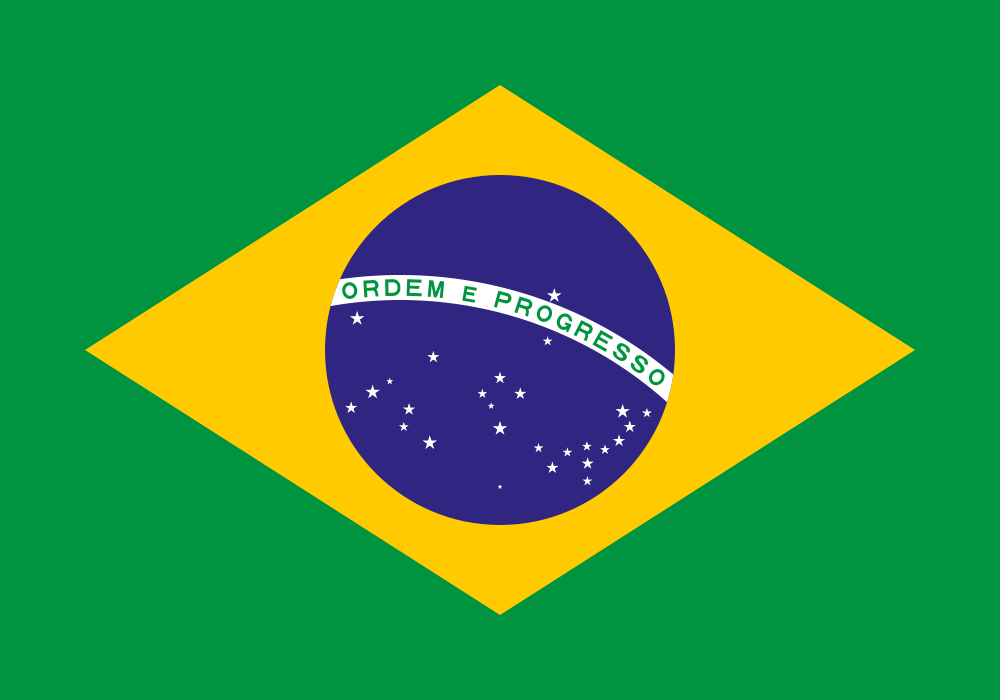
Brazil
Capital
Brasília 👑
Continent
South America
Time Zone
BRT · America/Sao_Paulo
Coordinates
15.79°S, 47.88°W
Currency
BRL (R$)
Calling Code
+55
Driving Side
Right
Hemisphere
Southern
Language
Portuguese
Measurement System
Metric
Did You Know?
A Capital Built in 41 Months
1. Brasília was built from nothing in 41 months.
Construction began in 1956 on an empty plateau in Goiás, 1,100 metres up in the cerrado, hundreds of kilometres from any major city. The capital was inaugurated on 21 April 1960.
Three years and five months.
2. Around 60,000 workers built it, working around the clock.
They were called candangos, and many had migrated from Brazil's impoverished northeast. A state company, Novacap, was created specifically to run the project. Trucks, tractors, drills and thousands of tonnes of concrete and steel were hauled to a site with no infrastructure of any kind.
President Juscelino Kubitschek had campaigned on the slogan fifty years of progress in five. He got a capital city in less than four.
3. In 1987 it became the youngest city ever placed on the UNESCO World Heritage List.
Twenty-seven years after it opened. The listing protects Lúcio Costa's Pilot Plan, which he had submitted to the 1957 competition almost as a sketch — and which five of the six jurors chose anyway. Oscar Niemeyer designed the public buildings; he was 52 at the time and went on working until his death at 104.
One correction worth making: the plan is universally described as an aeroplane seen from above. Costa said it was a cross — two intersecting axes, a Monumental Axis and a Residential Axis. The aeroplane is what everyone else saw in it.
4. And the whole country now sets its clocks by it.
Brazil's official national time is Horário de Brasília — Brasília Time — and it is the reference against which the country's other zones are defined. Brazil spans four time zones; the one everything is measured from is named after a city that did not exist in 1955.
The clock: Brasília sits at about 48° west, on UTC−3, calculated for the 45th meridian. That leaves the city roughly twelve minutes behind its own solar noon. Brazil abolished daylight saving in 2019, so the figure no longer moves at all.
So: a country whose national time standard is named after a place that was scrubland within living memory, built by 60,000 people in 41 months, and protected as heritage before its first residents had retired.
Sources
- Something Curated ve MIT Dome (41 ayda, 1956'dan 21 Nisan 1960'a inşa; Costa'nın planının altı jüri üyesinden beşi tarafından seçilmesi; Cardozo ve Burle Marx'ın rolleri)
- Geography Worlds (~60.000 candango işçi, çoğu kuzeydoğudan; "beş yılda elli yıllık ilerleme" sloganı; 1.100 m rakım; **1987'de UNESCO listesine giren en genç şehir**; Costa'nın planı uçak değil haç olarak tanımlaması; Niemeyer'in 52 yaşında tasarlayıp 104 yaşında ölene kadar çalışması)
- Not the Samo (Novacap'ın kurulması; altyapısız sahaya malzeme taşınması; Anıtsal ve Konut eksenleri)
- UNESCO Dünya Mirası Merkezi (ex nihilo kurulan başkent; Costa ve Niemeyer'in bütünsel tasarım anlayışı)
- Kiddle (Paranoá Gölü'nün yapay olarak inşa edilmesi)
- Boylam hesabı: Brasília 47,9°B, UTC−3 meridyeni 45°B → ~12 dakika **geride**
Annual Daylight
Working Hours
6h overlap