Antalya
UTC+3Türkiye · TRT
Sun, 9 Aug 2026
Timezone Guide
Antalya, Türkiye runs on UTC+3. This time zone stays fixed year-round at UTC+3 — daylight saving time is not observed. There is a 7-hour difference between Antalya and New York. Standard 9-to-6 working hours overlap for about 2 hours a day with New York. A good time to connect: 16:00–18:00 in Antalya lines up with 09:00–11:00 in New York. There is a 2-hour difference between Antalya and London. Standard 9-to-6 working hours overlap for about 7 hours a day with London. A good time to connect: 11:00–18:00 in Antalya lines up with 09:00–16:00 in London. There is a 6-hour difference between Antalya and Tokyo. Standard 9-to-6 working hours overlap for about 3 hours a day with Tokyo. A good time to connect: 09:00–12:00 in Antalya lines up with 15:00–18:00 in Tokyo. This timezone is also shared with cities such as Moscow, Athens, Istanbul. Keeping these offsets in mind makes it easier to schedule calls or travel to and from Antalya.
Practical Info
Antalya (Türkiye) is home to roughly 1.3M people. Today brings about 14.5 hours of daylight: sunrise at 05:42, sunset at 20:12. This time zone stays fixed year-round at UTC+3 — daylight saving time is not observed. It sits in the Northern Hemisphere, about 37° north of the equator. Traffic drives on the right.
Flag
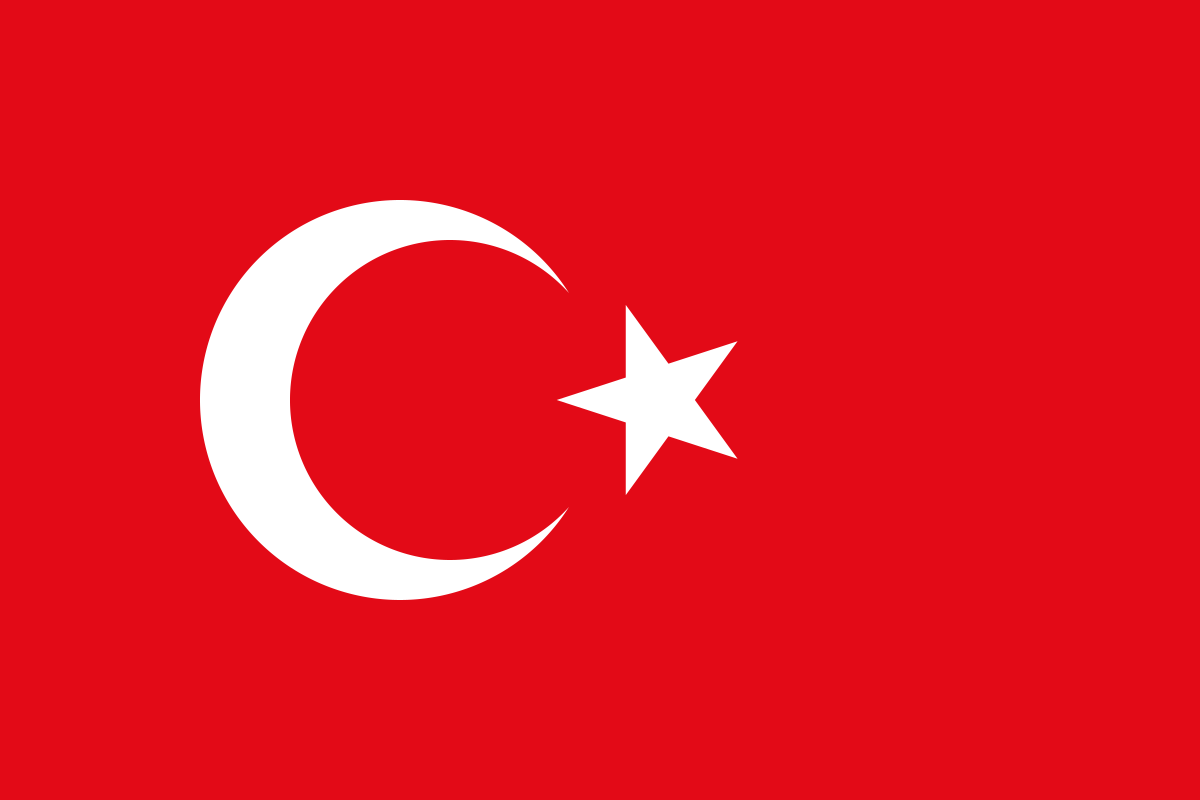
Türkiye
Capital
Ankara
Continent
Europe & Asia
Time Zone
TRT · Europe/Istanbul
Coordinates
36.90°N, 30.71°E
Currency
TRY (₺)
Calling Code
+90
Driving Side
Right
Hemisphere
Northern
Language
Turkish
Measurement System
Metric
Did You Know?
A City That Abolished the Growing Season
Antalya holds 41% of Türkiye's entire covered growing area — roughly 317,000 to 321,000 dekars of greenhouse and tunnel, out of a national total of 776,110. For glass greenhouses specifically the share rises to 79%.
The breakdown is 44,336 dekars of glass, 245,109 of plastic, 15,399 of high tunnel and 12,113 of low tunnel. In districts like Kumluca, Demre and Aksu, the greenhouses run edge to edge; from high ground the landscape reads as a white sheet.
The output is on the same scale. Recent figures put Antalya's production at 2,629,000 tonnes of tomatoes, 774,000 tonnes of peppers, 412,000 tonnes of cucumbers and 261,000 tonnes of aubergines. In 2025 the province exported 548,000 tonnes of fresh fruit and vegetables — 437,000 of vegetables, 111,000 of fruit. Around 80% of the vegetables grown in the province come from under cover.
What that buys is the removal of winter. Covered growing began with state research support in the 1940s and became commercially serious in the 1980s. By the 2000s, with supermarket chains, cold storage and logistics in place, Antalya was supplying winter vegetables to the whole of Türkiye and to export markets beyond it. The provincial agriculture director's summary is that people no longer distinguish between summer and winter produce.
One correction to the picture: 85% of Antalya's greenhouses are traditional, not modern. Computer-controlled climate and soilless growing exist, but a modern greenhouse only pays back at 30–35 dekars or more, which is beyond most individual farmers.
The clock: so this is a province that has spent eighty years taking the seasons out of its agriculture — sitting in a country that took them out of the clock.
In 2016 Türkiye abolished daylight saving and fixed the country permanently at UTC+3. There is no spring forward and no autumn back. The clock reads the same in January as in July.
Antalya sits at about 31° east, which leaves it roughly 57 minutes ahead of its own sun — the smallest gap of Türkiye's big coastal cities, because it is the furthest east of them.
And at 37° north it also has the least seasonal daylight swing of any major Turkish city. The sky here changes less than anywhere else in the country, the clock does not change at all, and under the plastic it is always summer.
Sources
- MyGazete / Antalya İl Tarım ve Orman Müdürlüğü 2025 faaliyet raporu (316.957 dekar örtü altı alan; Türkiye'nin 776.110 dekarının %41'i; cam serada %79 pay; cam/plastik/tünel dağılımı; 2.629.000 ton domates, 774.000 ton biber, 412.000 ton hıyar, 261.000 ton patlıcan)
- Anadolu Ajansı / Haberler.com (321 bin dekar; 2025'te 548 bin ton ihracat, 437 bin sebze + 111 bin meyve; 1940'lardan 2000'lere gelişim; İl Müdürü Şakir Fırat Erkal'ın açıklamaları; Kumluca, Demre, Aksu'nun görünümü)
- AA / Antalya Gıda Tarım Müdürü Ahmet Dallı (sebzenin ~%80'inin serada üretilmesi; seraların %85'inin geleneksel olması; 30-35 dekar eşiği)
- BAKA (2022'de ~7 milyon ton yaş sebze-meyve üretimi; 19,3 milyar TL bitkisel üretim değeriyle Türkiye birinciliği)
- Boylam hesabı: Antalya 30,71°D, UTC+3 meridyeni 45°D → ~57 dakika
Annual Daylight
Working Hours
6h overlap