Ankara
UTC+3Türkiye · TRT
Sun, 9 Aug 2026
Timezone Guide
Ankara, Türkiye runs on UTC+3. This time zone stays fixed year-round at UTC+3 — daylight saving time is not observed. There is a 7-hour difference between Ankara and New York. Standard 9-to-6 working hours overlap for about 2 hours a day with New York. A good time to connect: 16:00–18:00 in Ankara lines up with 09:00–11:00 in New York. There is a 2-hour difference between Ankara and London. Standard 9-to-6 working hours overlap for about 7 hours a day with London. A good time to connect: 11:00–18:00 in Ankara lines up with 09:00–16:00 in London. There is a 6-hour difference between Ankara and Tokyo. Standard 9-to-6 working hours overlap for about 3 hours a day with Tokyo. A good time to connect: 09:00–12:00 in Ankara lines up with 15:00–18:00 in Tokyo. This timezone is also shared with cities such as Moscow, Athens, Istanbul. Keeping these offsets in mind makes it easier to schedule calls or travel to and from Ankara.
Practical Info
Ankara (Türkiye) is home to roughly 5.7M people. Today brings about 15.0 hours of daylight: sunrise at 04:54, sunset at 19:54. This time zone stays fixed year-round at UTC+3 — daylight saving time is not observed. It sits in the Northern Hemisphere, about 40° north of the equator. Traffic drives on the right.
Flag
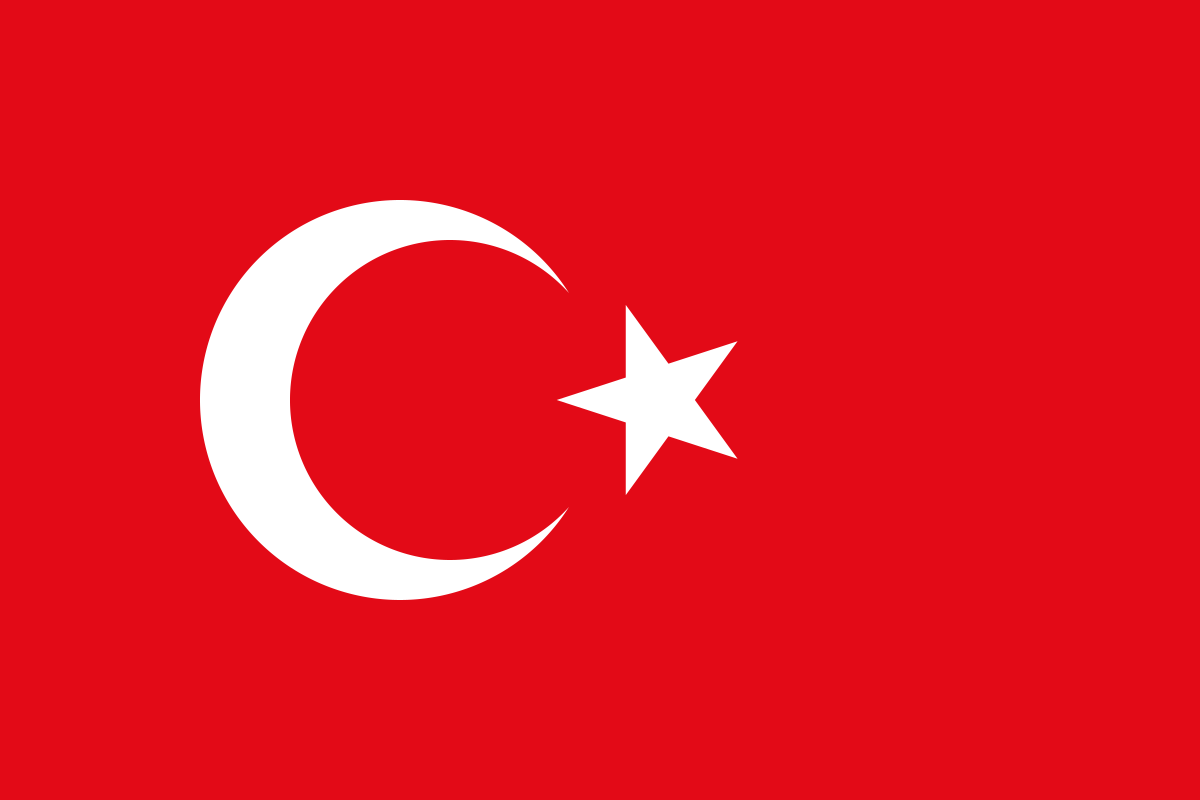
Türkiye
Capital
Ankara 👑
Continent
Europe & Asia
Time Zone
TRT · Europe/Istanbul
Coordinates
39.93°N, 32.86°E
Currency
TRY (₺)
Calling Code
+90
Driving Side
Right
Hemisphere
Northern
Language
Turkish
Measurement System
Metric
Did You Know?
The City Gave Away Its Goats and Kept Its Clock
The Angora goat takes its name from Ankara, which was called Angora until 1930. So does mohair, the fibre it produces. White goats with long ringlets have grazed the plateaux around the city for at least two thousand years, and European travellers were writing about them from the 1550s.
For centuries the Ottoman state restricted their export, because the monopoly was worth protecting.
It did not hold.
In 1838 Sultan Mahmud II sent twelve wethers and one female to South Africa. The males were castrated deliberately, so that no rival herd could be established. It was a reasonable precaution and it failed. In 1849 Sultan Abdülmecid I gave seven does and two bucks to an American adviser — the first import to the United States. Further consignments followed, some six or seven hundred head in total, with final large shipments from South Africa of 148 goats in 1904 and 117 bucks in 1925.
By the 1960s the United States had over five million Angora goats, with more than 90% of American mohair produced in Texas. South Africa now holds roughly a quarter of the world's Angora goats and has overtaken the US in production.
Turkish academic accounts describe the outcome plainly: Anatolia, the cradle of the breed, lost its position in an industry that carries its capital's name.
The clock: and in the same century, Ankara gave the country something it has never given up.
On 26 December 1925 the Grand National Assembly in Ankara passed Law 697, abolishing the Ottoman alaturka system — in which the day began at sunset and every clock in the country had to be corrected every few days — and adopting the international 24-hour clock from 1 January 1926.
Istanbul lived with the consequences; its mosque timekeeping rooms, the muvakkithanes, were only formally closed in 1952. But the decision was made here.
Ankara sits at about 33° east, on UTC+3, a zone built for the 45th meridian — leaving the city roughly 48 minutes ahead of its own sun. Since 2016 Türkiye has stayed on that offset permanently, with no seasonal change at all.
The city renamed itself in 1930. The world still calls the goat Angora.
Sources
- Goat Journal, *Angora Goats Breed Profile* (1838'de II. Mahmud'un Güney Afrika'ya gönderdiği on iki iğdiş teke ve bir dişi, iğdiş etmenin gerekçesi; 1849'da Abdülmecid'in Dr. James P. Davis'e verdiği yedi dişi iki teke; toplam 600-700 baş; 1904'te 148 keçi, 1925'te 117 teke)
- Britannica, *Angora goat* (Ankara yakınlarında köken; 16. yüzyıl ortasında Avrupa'ya girişi)
- Ronan Country Fibers (1960'larda ABD'de 5 milyondan fazla keçi; Teksas'ın %90'dan fazla payı; 1992'de 1,8 milyon, 2009'da 200.000'in altı)
- The Rajasthan Express (dünyadaki Ankara keçilerinin ~%23'ünün Güney Afrika'da olması; 1930 öncesi "Angora" adı; Pierre Belon'un 1555 kaydı)
- Ankara Üniversitesi DTCF Dergisi, *The Angora Goats in History (1765-1908)* (Türk tekelinin kaybı ve Anadolu'nun üstünlüğünü yitirmesi)
- 697 sayılı Kanun, 26 Aralık 1925, yürürlük 1 Ocak 1926
- Boylam hesabı: Ankara 32,85°D, UTC+3 meridyeni 45°D
Annual Daylight
Working Hours
6h overlap