Addis Ababa
UTC+3Ethiopia · EAT
Sun, 9 Aug 2026
Timezone Guide
Addis Ababa, Ethiopia runs on UTC+3. This time zone stays fixed year-round at UTC+3 — daylight saving time is not observed. There is a 7-hour difference between Addis Ababa and New York. Standard 9-to-6 working hours overlap for about 2 hours a day with New York. A good time to connect: 16:00–18:00 in Addis Ababa lines up with 09:00–11:00 in New York. There is a 2-hour difference between Addis Ababa and London. Standard 9-to-6 working hours overlap for about 7 hours a day with London. A good time to connect: 11:00–18:00 in Addis Ababa lines up with 09:00–16:00 in London. There is a 6-hour difference between Addis Ababa and Tokyo. Standard 9-to-6 working hours overlap for about 3 hours a day with Tokyo. A good time to connect: 09:00–12:00 in Addis Ababa lines up with 15:00–18:00 in Tokyo. This timezone is also shared with cities such as Moscow, Athens, Istanbul. Keeping these offsets in mind makes it easier to schedule calls or travel to and from Addis Ababa.
Practical Info
Addis Ababa (Ethiopia) is home to roughly 5.2M people. Today brings about 12.3 hours of daylight: sunrise at 06:24, sunset at 18:42. This time zone stays fixed year-round at UTC+3 — daylight saving time is not observed. It sits in the Northern Hemisphere, about 9° north of the equator. Traffic drives on the right.
Flag
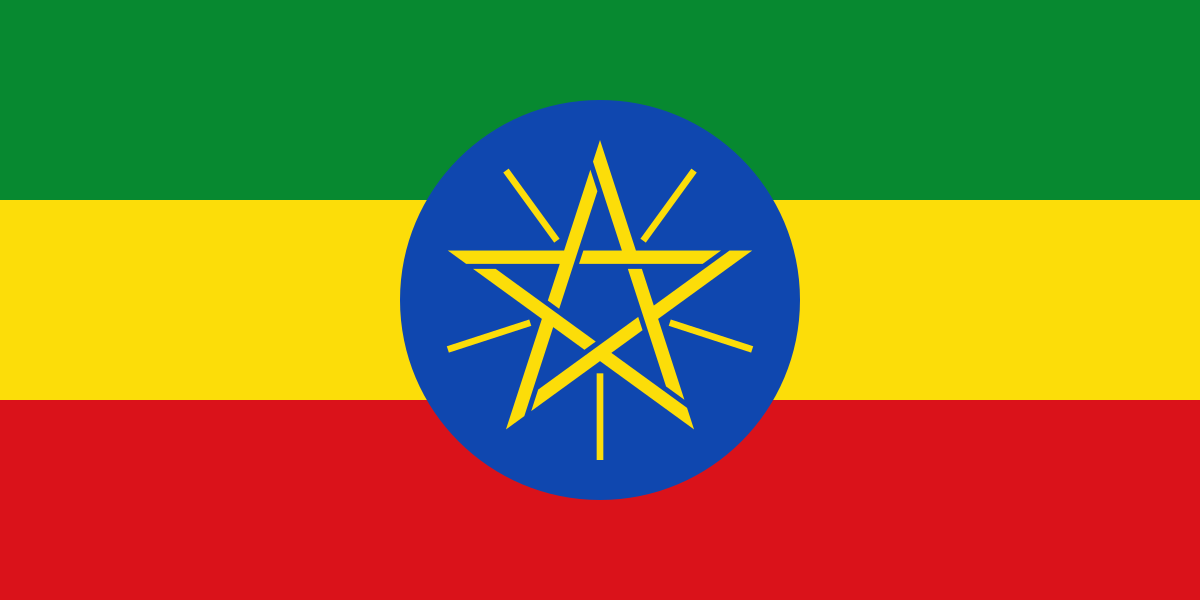
Ethiopia
Capital
Addis Ababa 👑
Continent
Africa
Time Zone
EAT · Africa/Addis_Ababa
Coordinates
9.03°N, 38.74°E
Currency
ETB (Br)
Calling Code
+251
Driving Side
Right
Hemisphere
Northern
Language
Amharic
Measurement System
Metric
Did You Know?
In Ethiopia It Is 2018, There Are Thirteen Months, and the Day Starts at Dawn
Coffee comes from Ethiopia. Not figuratively — Coffea arabica is genetically indigenous to the southwestern highlands, where it still grows wild in the forest understory. The word itself is generally traced to Kaffa, the region where the plant originated.
Ethiopia is now Africa's largest coffee producer and the world's fifth largest. Coffee accounts for roughly 30 to 35% of the country's entire export earnings.
And here is the number that separates it from every other coffee country: Ethiopia drinks about half of what it grows. Around 46% of the harvest never leaves. Most producing nations export nearly all of theirs and drink something else.
The reason is the ceremony. Coffee in Ethiopia is prepared in a ritual — beans roasted over an open flame in front of you, ground by hand with a mortar and pestle, brewed in a clay pot called a jebena. A guest is traditionally served three cups, in sequence. It is not a drink you order. It is an event that takes hours.
Which is a useful thing to know about a country that also counts thirteen months in a year and starts its day at dawn.
Ethiopia runs three timekeeping systems that all disagree with the rest of the world, and it runs them at once.
The year. The Ethiopian calendar is roughly seven to eight years behind the Gregorian one. Right now it is 2018 E.C. — a year that began on 11 September 2025 and ends on 10 September 2026. The gap comes from a different calculation of the date of the Annunciation by early Christian scholars; it is eight years from 1 January until Ethiopian New Year, then seven for the rest of the Gregorian year.
The months. There are thirteen. Twelve of exactly thirty days each, followed by a short thirteenth called Pagumē — five days in a common year, six in a leap year. The name comes from the Greek epagomene, "the additional days."
If that structure sounds familiar, it should. It is the Coptic Egyptian calendar, which is itself the ancient Egyptian civil calendar: twelve months of thirty days plus five days stitched onto the end. The framework that Cairo built five thousand years ago is still running, unbroken, in Addis Ababa.
Ethiopia's leap year rule is also simpler than ours: a sixth day is added to Pagumē every fourth year, with no exceptions. No century rule. No divisible-by-four-hundred clause.
New Year — Enkutatash — falls on 11 September, and Ethiopia entered its new millennium on 11 September 2007.
The clock: and then there is the day itself.
Ethiopia uses a twelve-hour clock that begins at dawn. Six o'clock in the morning by international reckoning is twelve o'clock in Ethiopia. Seven in the morning is one o'clock. Day and night run as two separate twelve-hour cycles, starting at sunrise and sunset.
This is the same logic as Swahili time in Nairobi, and the same logic Ottoman Istanbul abandoned in 1926. And it works here for exactly the reason it worked there and failed in Istanbul: Addis Ababa sits at about 9° north. Sunrise barely moves all year.
So a single conversation in Addis Ababa can involve a year seven behind yours, a month that does not exist in your calendar, and an hour six off your clock — and every one of those numbers is correct.
Ethiopia markets itself as the land of thirteen months of sunshine. It is not a slogan. It is a specification.
Sources
- Coal Town Coffee ve Bondadoso (Kaffa kökeni; Afrika'nın en büyük, dünyanın beşinci üreticisi; ihracat gelirinin %30-35'i)
- Belux Coffee (üretimin %46'sının iç tüketimde kalması; üç fincan geleneği)
- AFAR, *Coffeeland* (ürettiğinin yaklaşık yarısını içmesi)
- Coffee Analytica (jebena töreni; Arabica'nın üretimin %95-97'si)
- ScienceWatch (Arabica'nın yabani olarak orman altında yetişmesi)
- ethiopiancalendar.et (2018 E.C.; 11 Eylül 2025 – 10 Eylül 2026; Pagumē'nin yapısı; şafakta başlayan saat)
- time.et/convert (7–8 yıl farkın 1 Ocak/yılbaşı ayrımı; artık yıl kuralı: 4'e bölündüğünde kalanı 3 olan yıllar)
- Etiyopya Büyükelçiliği, *Ethiopian Time* (Kıpti takvim kökeni; Müjde tarihi hesabı)
- Calculatorian (Pagumē'nin Yunanca kökeni; "1 o'clock Ethiopian = 7 AM")
- ethiopiancalendar.net (2007'de yeni bin yıl)
- Wanderwell ve Aemero Media (Aksum kökeni; Kıpti bağlantısı)
Annual Daylight
Working Hours
6h overlap